

Free Piano Sheet Music for Beginners
25 pieces across 5 progressive levels. Real sheet music with complete fingerings, history, and step-by-step practice guides. From Twinkle Twinkle to Clair de Lune.
Playing for the holidays? The new free Thanksgiving collection (15 songs, 3 levels) is live.
December pianist? The seasonal free Christmas carols collection (15 pieces, 3 levels) is live.
You want to play piano. You search for free piano sheet music for beginners, and you find hundreds of PDFs – blurry scans, random difficulty levels, no fingerings, no practice guidance. You print one out and stare at the notes with no idea where to put your fingers.
That is the problem we built this collection to solve. These 25 easy piano sheet music PDFs are organized from absolute zero to confident intermediate. Every piece includes professional notation, complete finger numbers on every note, historical context, and a step-by-step method to learn the piece in three stages: right hand, left hand, hands together.
Level 1 is completely free – no email required. Levels 2 through 5 are free with your email address. No credit card. No subscription. Just piano sheet music with fingerings that actually teaches you how to play.
25 Pieces Across 5 Progressive Levels
Each level builds on the one before it. You do not jump from a nursery rhyme to Fur Elise. The progression across these 25 beginner piano pieces is deliberate: you master one skill set, then move to the next. Here is the full collection at a glance.
| Level | Focus | Pieces | Access |
|---|---|---|---|
| Level 1 | Right hand melodies (3-5 notes) | Twinkle Twinkle, Mary Had a Little Lamb, Ode to Joy, Jingle Bells, Hot Cross Buns | Free |
| Level 2 | Separate hands independence | Frere Jacques, London Bridge, When the Saints, Alouette, Lightly Row | Free with Email |
| Level 3 | Hands together with accompaniment | Amazing Grace, Happy Birthday, Scarborough Fair, Auld Lang Syne, Brahms’ Lullaby | Free with Email |
| Level 4 | First classical repertoire | Fur Elise, Minuet in G Major, Soldiers’ March, Melody, German Dance in C Major | Free with Email |
| Level 5 | Expression and nuance | Gymnopedie No. 1, The Entertainer, Clair de Lune, Canon in D, Prelude in C Major | Free with Email |
Not sure where to start? If you can read treble clef and play a C Major scale with your right hand, skip Level 1 and begin at Level 2. If you already play hands together on simple pieces, Level 3 or 4 is your entry point.
Which Level Should You Start With?
Use this quick flowchart to find your starting point. Answer honestly – starting one level below your comfort zone is better than struggling through pieces that are too hard.
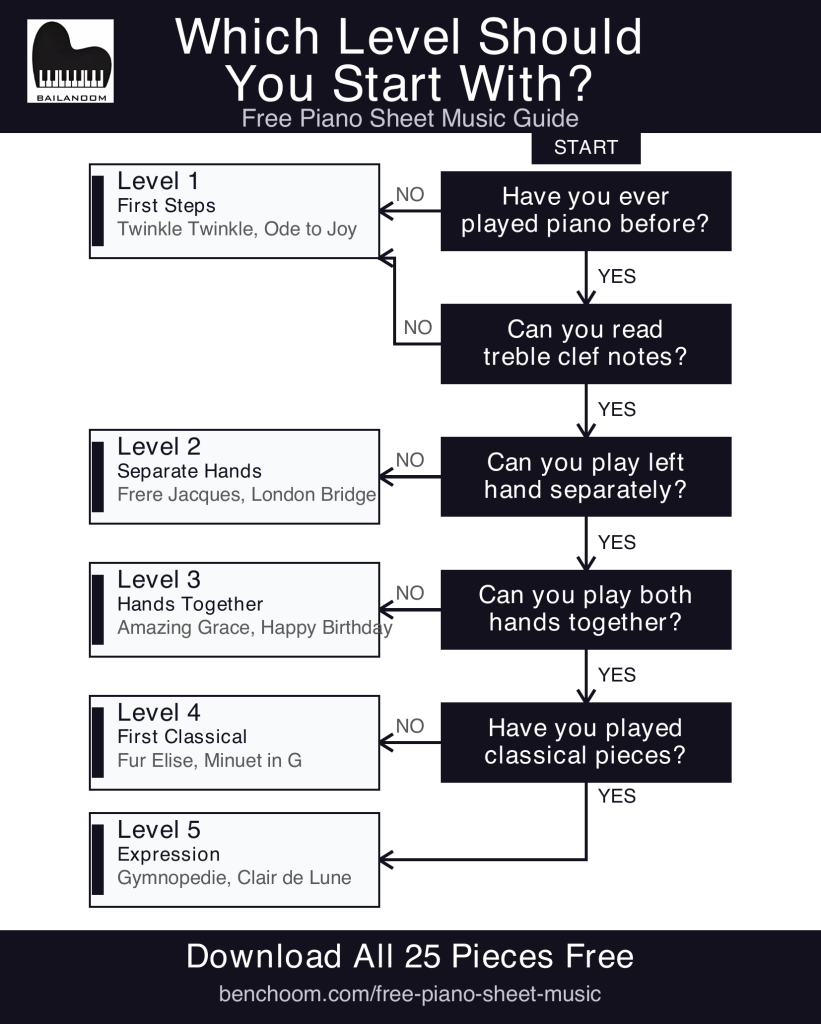
Share this infographic: Copy the code below to embed it on your site.
<a href="https://benchoom.com/free-piano-sheets/"><img src="https://benchoom.com/wp-content/uploads/2026/04/piano-sheet-music-level-flowchart-1.png" alt="Which level of free piano sheet music should you start with - flowchart" /></a><p>Infographic by <a href="https://benchoom.com">Benchoom</a></p>Level 1 – First Steps: Right Hand Melodies
This is where every pianist starts. Level 1 uses only the right hand, only the treble clef, and only 3 to 5 notes in C Major. Your left hand rests in your lap. The entire focus is on reading notes on the staff, matching them to keys, and using the correct fingers.
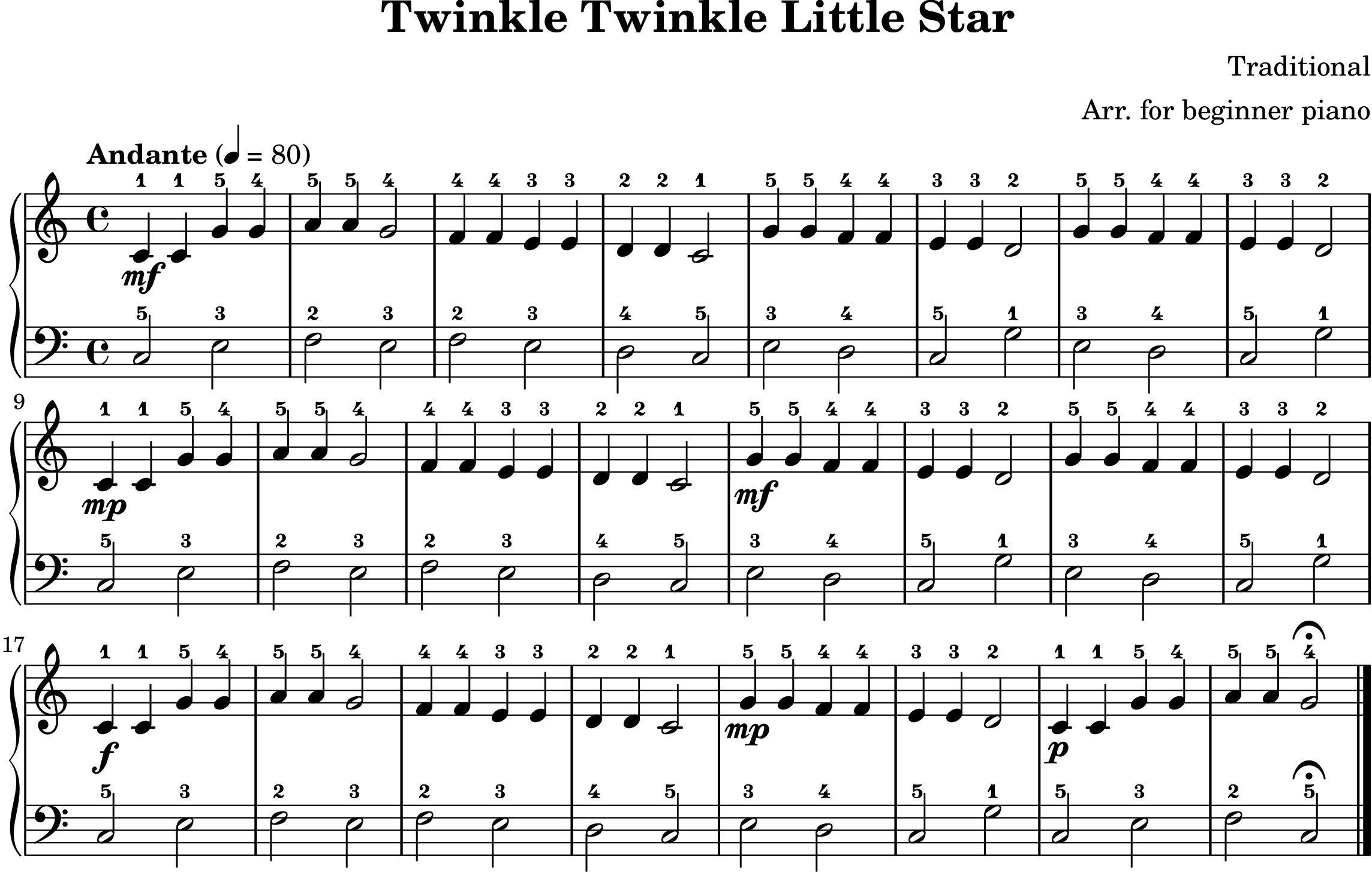
Twinkle Twinkle Little Star (Traditional) – C Major, 24 measures, 4/4 time. The most famous beginner piano melody in the world. Twinkle Twinkle piano sheet music free downloads are everywhere, but this version includes complete fingering on every note. Uses only 6 notes (C to A) and introduces quarter notes and half notes. If you can play this cleanly with the correct fingering, you are ready for everything else in Level 1.
Mary Had a Little Lamb (Traditional) – C Major, 16 measures. Three notes: E, D, C. That is it. This piece teaches you how a melody can move by step – up one note, down one note – and still sound musical. Perfect for building confidence with finger 1, 2, and 3.
Ode to Joy (Beethoven) – C Major, 16 measures. Yes, Beethoven on day one. This famous theme from the Ninth Symphony sits comfortably in a five-finger position and uses mostly stepwise motion. You get to play a masterpiece before you even learn the bass clef. Easy piano sheet music does not get more satisfying than this.
Jingle Bells (J.L. Pierpont) – C Major, 32 measures. The longest piece in Level 1, and the first one with repeated notes on the same key. Your finger 3 gets a workout on the opening “E-E-E, E-E-E” pattern. Great for building evenness and rhythmic consistency.
Hot Cross Buns (Traditional English) – C Major, 8 measures. Short and sweet. Only 3 notes (E, D, C) in a descending pattern. This one takes about 20 seconds to play – use it as a warm-up before tackling the longer pieces.
Level 2 – Separate Hands: Building Independence
Level 2 introduces the left hand and the bass clef. You will play each hand separately – right hand alone, then left hand alone. This builds the independence you need before combining them. Each piece has distinct right-hand and left-hand parts with full fingering for both.
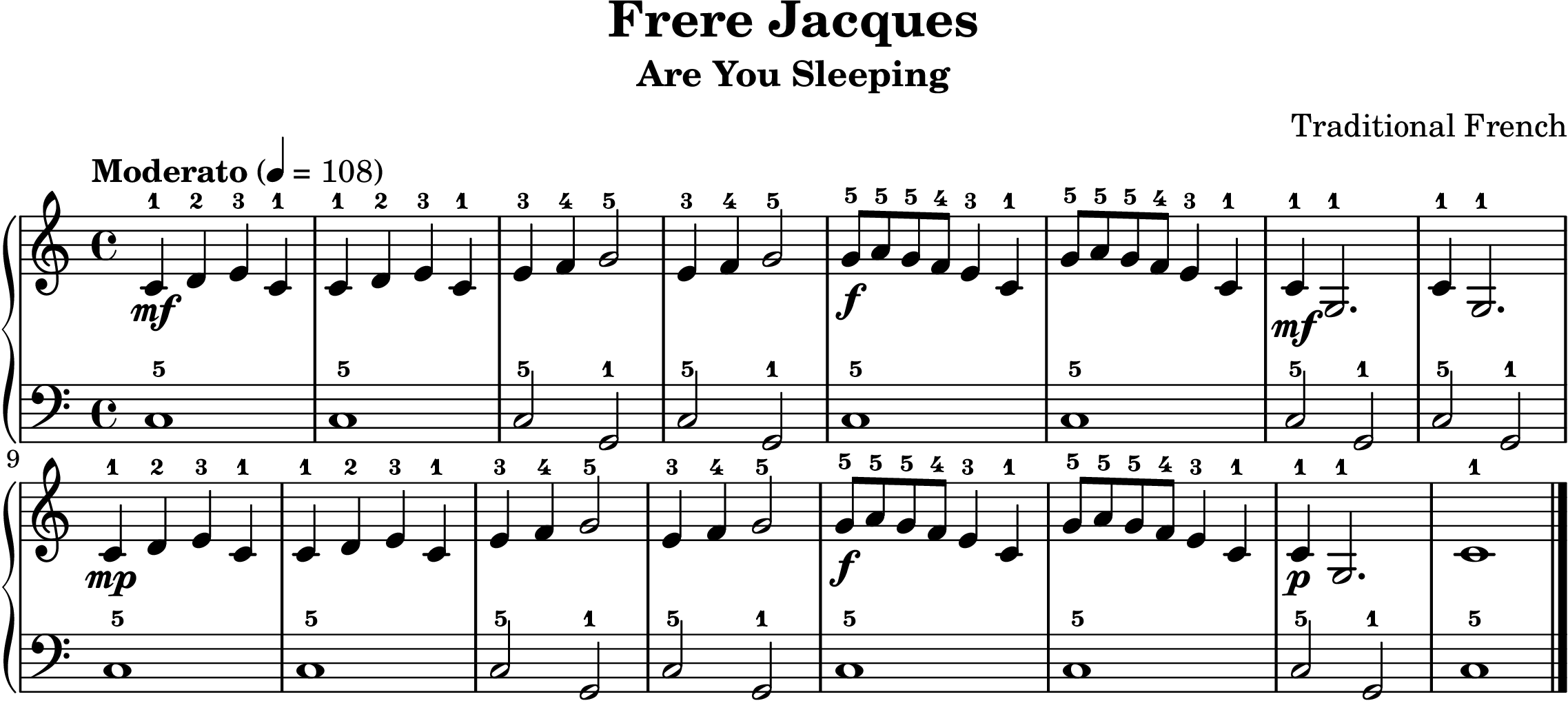
Frere Jacques (Traditional French) – C Major, 16 measures. A round melody that works perfectly as a two-hand exercise. The right hand carries the tune while the left hand learns to hold whole notes. Your first taste of reading two staves at once.
London Bridge Is Falling Down (Traditional English) – C Major, 16 measures. Simple descending melody with a left-hand part that introduces basic bass patterns. The rhythmic simplicity lets you focus entirely on hand coordination.
When the Saints Go Marching In (Traditional) – C Major, 16 measures. A bright, upbeat melody that spans a wider range than Level 1 pieces. The left hand plays on beats 1 and 3 – your first step toward accompaniment patterns.
Alouette (Traditional French-Canadian) – G Major, 20 measures. Your first piece outside C Major. One sharp (F#) in the key signature. This teaches you to adjust your hand position and remember accidentals throughout the piece.
Lightly Row (Traditional German) – C Major, 16 measures. A gentle melody that works beautifully as a two-hand piece. Left hand plays broken thirds – a pattern you will use constantly in Level 3 and beyond.
Level 3 – Hands Together: Simple Accompaniments
This is the level where it starts to sound like real piano playing. Both hands work at the same time. The left hand plays simple chords or broken chord patterns while the right hand carries the melody. Every piece includes a hands-together practice guide that breaks the coordination down measure by measure.
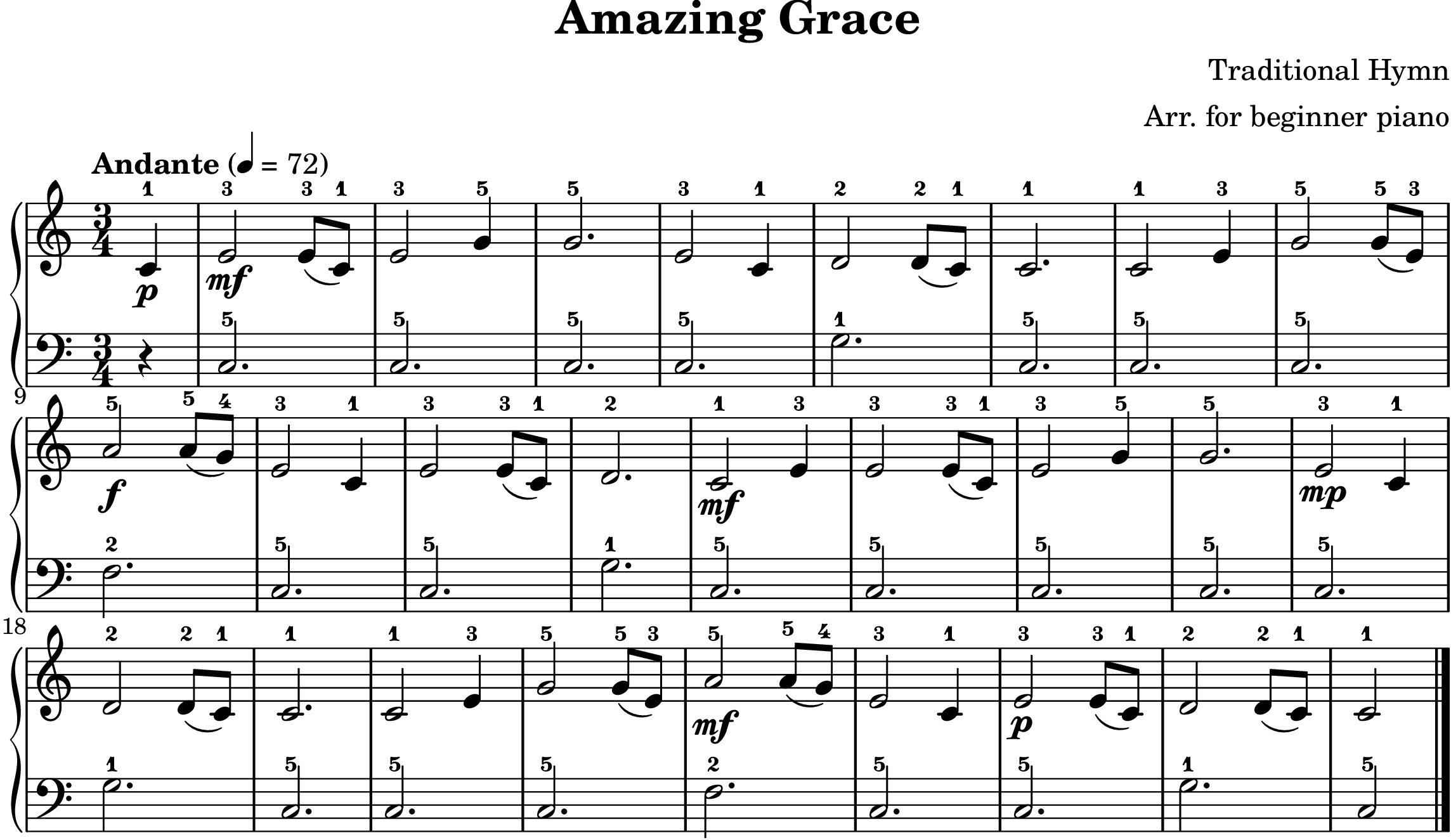
Amazing Grace (John Newton) – G Major, 3/4 time, 24 measures. The open fifths in the left hand give this hymn its characteristic spacious sound. Playing in 3/4 time teaches you to feel the waltz-like pulse – strong beat, two lighter beats.
Happy Birthday (Hill Sisters) – C Major, 3/4 time, 16 measures. Everyone knows this tune. Playing it with both hands means you can perform it at actual birthdays – your first “real world” piano skill. Left hand plays root-fifth patterns.
Scarborough Fair (Traditional English) – D minor, 3/4 time, 24 measures. Your first minor key piece. The haunting melody over a simple drone bass introduces the emotional range of minor tonality. Finger 5 on the left hand holds a sustained D while the melody floats above.
Auld Lang Syne (Traditional Scottish) – G Major, 4/4 time, 16 measures. A piece almost everyone recognizes, with a left hand that plays on beats 1 and 3. The pickup note (starting before beat 1) teaches you about anacrusis – a concept you will encounter constantly in classical music.
Brahms’ Lullaby (Johannes Brahms) – F Major, 3/4 time, 16 measures. Gentle, slow, and perfect for building control at a quiet dynamic level. One flat in the key signature (Bb) and a lilting left-hand waltz pattern. This is where you start to understand how practice time translates into musical expression.
Level 4 – First Classical Pieces
You have been playing folk tunes and traditional melodies. Now you step into the classical repertoire. These are simplified arrangements of iconic themes by Beethoven, Petzold, and Schumann – recognizable, rewarding, and within reach of a late beginner. The notation introduces dynamics (piano, forte), articulation marks, and slightly more complex left-hand patterns.
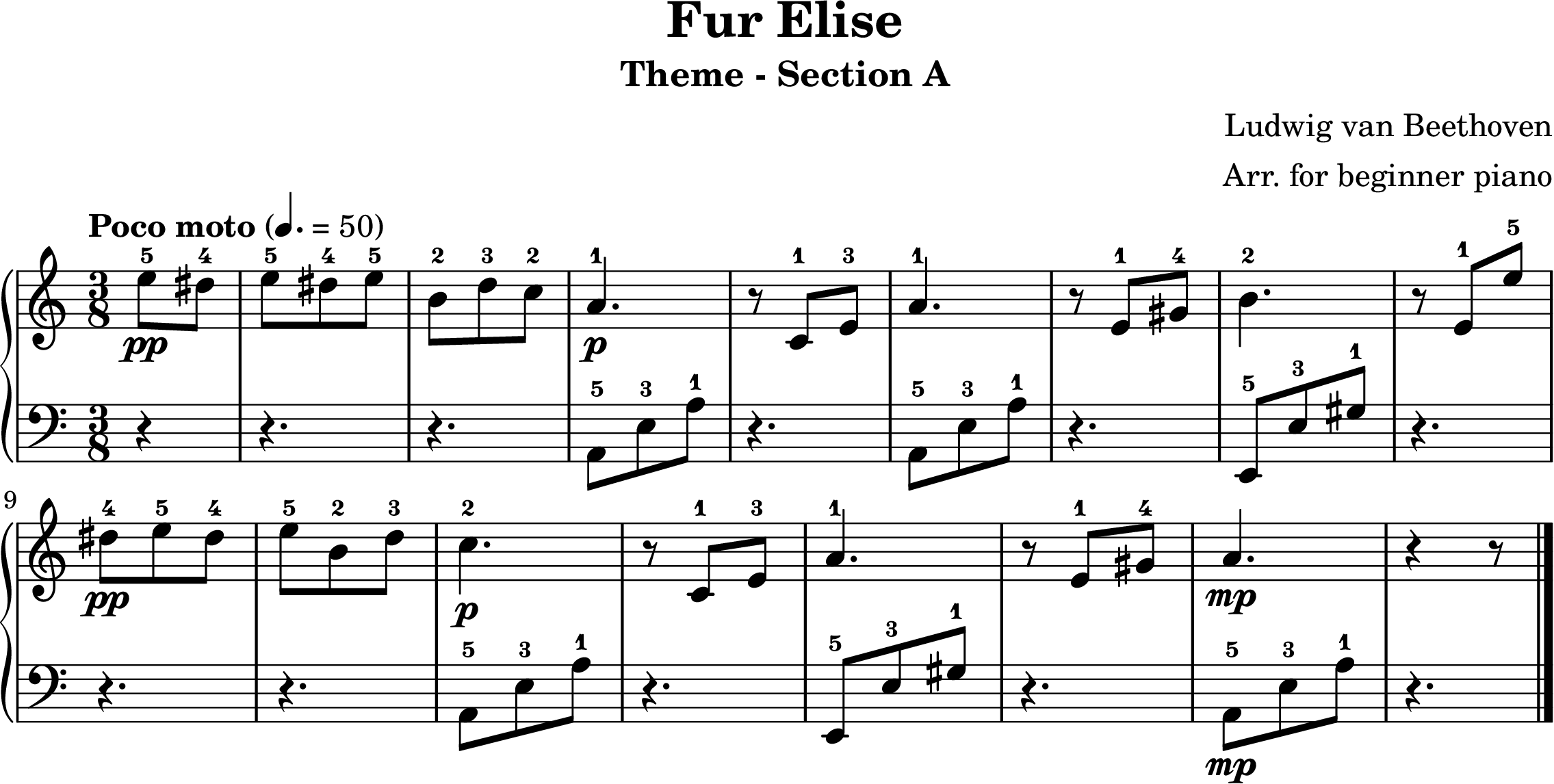
Fur Elise – Theme (Beethoven) – A minor, 3/8 time, 24 measures. The most searched beginner piano piece on the internet. This arrangement covers the famous opening theme – the part everyone recognizes. The alternating E-D#-E pattern in the right hand sits under fingers 3-2-3, and the left hand plays broken octaves. Fur Elise easy piano sheet music that actually sounds like Fur Elise.
Minuet in G Major (attributed to Bach, composed by Petzold) – G Major, 3/4 time, 32 measures. Elegant, structured, and a staple of every beginner piano method. The steady left-hand quarter notes support a flowing right-hand melody. This piece teaches phrasing – how to shape a musical sentence from start to finish.
Soldiers’ March (Robert Schumann) – G Major, 2/4 time, 16 measures. From Schumann’s Album for the Young, this was literally composed for beginner pianists. Crisp, rhythmic, and full of character. Both hands play together in a march-like pattern with staccato dots on nearly every note.
Melody (Robert Schumann) – C Major, 4/4 time, 16 measures. Also from Album for the Young. A singing right-hand melody over sustained left-hand chords. This piece is about legato playing – connecting each note smoothly to the next without gaps. Slow it down, listen, and make it sing.
German Dance in C Major (Beethoven) – C Major, 3/4 time, 16 measures. A cheerful waltz with a left hand that plays Alberti bass patterns (broken chords in a specific order). This pattern shows up everywhere in classical piano. Learn it here and you will recognize it in hundreds of pieces later.
Level 5 – Expression and Nuance
Level 5 is the destination. These pieces require pedaling, dynamic contrast, rubato, and genuine musical interpretation. They are still simplified arrangements – not the full concert versions – but they capture the essential character of each composition. When someone hears you play these, they will not believe you started with Twinkle Twinkle six months ago.
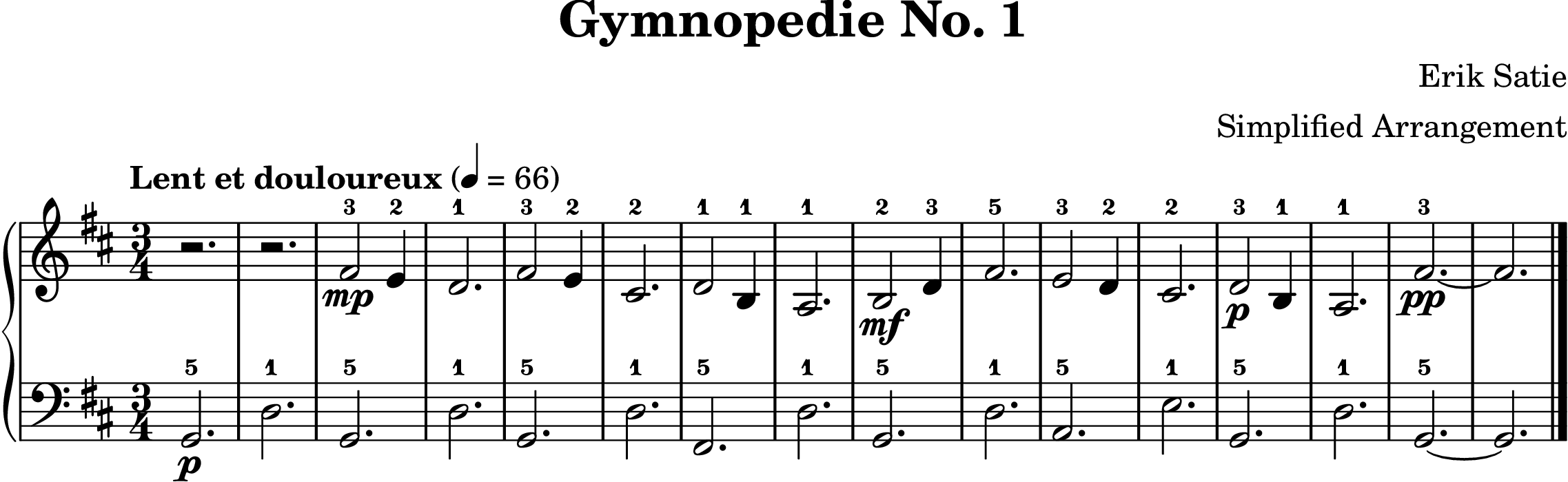
Gymnopedie No. 1 (Erik Satie) – D Major, 3/4 time, 32 measures. Spacious, meditative, and deceptively simple. The left hand plays wide chords while the right hand floats a slow melody above them. This piece is all about touch – how softly you can press a key and still produce a clear tone. Use the sustain pedal to blend notes across the bar lines.
The Entertainer (Scott Joplin) – C Major, 2/4 time, 32 measures. Classic ragtime. The syncopated right-hand rhythm against the steady “oom-pah” left hand is a coordination challenge that makes everything else feel easy afterward. Play it slowly at first – Joplin himself wrote “Not fast” on the original score.
Clair de Lune – Theme (Claude Debussy) – Db Major, 9/8 time, 24 measures. The opening theme of one of the most beautiful piano pieces ever written. Five flats in the key signature looks intimidating, but the hand position is surprisingly natural on the black keys. Clair de Lune easy piano captures the dreamy atmosphere of the original. Pedal generously.
Canon in D (Pachelbel) – D Major, 4/4 time, 16 measures. The most played classical piece at weddings worldwide. The left hand repeats the famous eight-note ground bass in single half notes – no chords – while the melody builds from calm half notes into flowing quarter notes.
Prelude in C Major (Bach, BWV 846) – C Major, 4/4 time, 12 measures. The opening piece of the Well-Tempered Clavier. One rippling broken chord per measure over two calm single bass notes – even, hypnotic, and a joy to play once the hand shape is automatic.
What Makes These Different from Other Free Sheet Music
Free piano sheet music for beginners is everywhere. IMSLP has thousands of public domain scores. YouTube tutorials show you which keys to press. So why bother with this collection?
Real Sheet Music, Not Simplified Chord Charts
Every piece is professionally engraved with LilyPond – the same open-source software used by music publishers. You get a proper grand staff with treble and bass clefs, correct time signatures, bar lines, and note durations. No letter names printed inside the noteheads. No color-coded keys. Just standard music notation that every piano teacher in the world will recognize.
This matters because reading real notation is a skill you build. If you learn from simplified charts now, you will have to re-learn everything later when you encounter actual sheet music. Start right, and every piece of music in existence becomes accessible to you.
Complete Finger Numbers on Every Note
Most beginner piano pieces PDFs give you fingering on the first note and leave you guessing for the rest. These sheets mark every single note with a finger number (1 = thumb through 5 = pinky) for both hands. You never have to wonder which finger goes where.
Correct fingering is not optional – it is the difference between a passage that flows and one that crashes. The fingerings in these sheets are written by a pianist, not auto-generated. They account for hand size, common transitions, and the passages that follow.
Step-by-Step Practice Method
Each piece comes with a practice guide that tells you exactly how to learn it. Not “practice until it sounds good” – actual steps. Right hand alone at half speed. Left hand alone at half speed. Hands together on the first 4 measures. Then the next 4. Then the whole piece. Specific tempo targets for each stage.
This is the method piano teachers use in private lessons. Having it written down means you can follow it on your own, at your own pace, without a teacher correcting you in real time.
How to Practice Piano Using Sheet Music
Having great sheet music is half the equation. The other half is how you use your practice session. Here is a straightforward method that works for every level.
Set Up for Comfortable Practice
Before you play a single note, check your setup. Your forearms should be roughly parallel to the floor when your fingers rest on the keys. If they angle downward, your bench is too high. If your shoulders are raised, your bench is too low. Getting the proper piano bench height right takes 30 seconds and changes everything about how your hands feel on the keyboard.
Sit on the front half of the bench, not the back. Feet flat on the floor (or on a footrest for children). Back straight but not rigid. If you find yourself slumping after 15 minutes, your bench might lack support – something to address before bad habits take root. Many beginners overlook common posture mistakes that creep in during the first weeks and become harder to correct later.
Quick posture check: Sit down and let your arms hang at your sides. Bend your elbows to 90 degrees. Your fingertips should land naturally on the white keys. If they land above or below the keyboard surface, adjust your bench height until they do.
Right Hand, Left Hand, Together
This three-step sequence is the fastest way to learn any piece of piano music. Do not skip steps. Do not try to play hands together on the first attempt.
Step 1 – Right hand alone. Play through the right-hand part at half speed (or slower). Follow the fingering exactly. If you stumble on a passage, isolate those 2-4 measures and repeat them 5 times before moving on. Do not play faster than you can play accurately.
Step 2 – Left hand alone. Same process, same patience. The left hand is usually simpler, but it is also the hand most beginners neglect. Give it equal time. If a piece has a left-hand pattern that repeats (and most beginner pieces do), master the pattern once and it carries through the whole piece.
Step 3 – Hands together. Start with just the first 2 measures. Play them slowly until both hands feel natural. Then add 2 more measures. Then 2 more. Build the full piece in small sections. This feels slow, but it prevents the scrambled coordination that happens when you try to play the whole thing at once.
How Long to Spend on Each Piece
Level 1 pieces: 3 to 5 days each. Level 2: about a week. Level 3: 1 to 2 weeks. Levels 4 and 5: 2 to 4 weeks per piece, depending on difficulty. These timelines apply to most beginner piano pieces – your pace is your pace.
Practice 20 to 30 minutes per day as a beginner. That is enough for real progress without burning out. If you want a deeper breakdown of how long to practice piano at each level, we have a full guide on that.
One thing that makes a bigger difference than practice duration: comfort. If your back hurts after 15 minutes, you will stop early regardless of your motivation. The right bench removes that barrier entirely. A piano bench designed for beginners with adjustable height and proper cushioning lets you focus on the music instead of counting down the minutes.
Frequently Asked Questions
Are these piano sheets really free?
Level 1 (5 pieces) is a free download with no email required. Levels 2 through 5 are free when you sign up with your email address. There is no credit card, no trial period, and no hidden cost. You get the easy piano sheet music PDF immediately after signing up – no waiting, no approval process.
What level of piano sheet music should I start with?
If you have never played piano before, start with Level 1. If you can already read treble clef and play simple melodies with your right hand, try Level 2. If you play hands together comfortably, Level 3 or 4 is a better starting point. Every level includes piano sheet music with fingerings on every note, so even if the music is slightly above your comfort zone, the finger numbers guide you through it.
Do I need to read music to use these sheets?
You will learn to read music by using them. Level 1 starts with simple treble clef notation and finger numbers on every note. By the time you finish Level 1, you will be reading notes on the staff without thinking about it. That is the whole point of free piano sheet music for beginners – it should teach you to read, not just give you something to copy.
Can I print the sheet music PDFs?
Yes. Every PDF is formatted for standard US Letter (8.5 x 11 inches) and A4 paper. Print quality is high – these are vector-based scores generated with LilyPond, not scanned images. They look sharp at any resolution. Print as many copies as you need for personal use.
What is included besides the sheet music?
Each piece includes a short history of the composition, a hand position diagram showing exactly where to place your fingers on the keyboard, and a step-by-step practice guide. This is piano sheet music with fingerings, practice steps, and musical context – everything a teacher would give you in a private lesson. The guides break down the learning process into right hand, left hand, and hands together stages with specific tempo targets.
Are these piano pieces suitable for kids?
Absolutely. Levels 1 and 2 work well for children ages 6 and up. The finger numbers on every note remove the guesswork, and the familiar melodies keep kids engaged. For younger children, a parent or teacher should sit with them during the first few sessions to help with hand position and reading the staff.
Ready to Practice? Make Sure You Are Sitting Right.
Great sheet music and bad posture cancel each other out. A proper bench keeps your arms at the right angle, your back supported, and your focus on the music. Browse our piano benches and find the one that fits your setup.
Looking for a present instead? See our gifts for pianists and piano players guide.
Learn each piece note by note
Every piece below has its own page: an interactive player where the score and the keys light up as it plays, the sheet music section by section, full fingering, and a follow-along video.