
When the Saints Go Marching In is the joyful New Orleans march every beginner should own, and you can learn it right here: press play on the interactive player to hear it at half speed while the notes and keys light up, then drag the score to move around. Sheet music, fingering, and a free printable PDF follow below.
Learn it with the interactive player
- Slow it down: x0.5 or x0.75 while you learn the notes, back to x1 once they flow.
- Pause anywhere: the current keys stay lit so you can find them on your own piano.
- Drag the score left or right, or use the 15s buttons, to replay a phrase.
The sheet music, section by section

Set the player above to x0.5 and read Section A slowly: the bright ascending motif C-E-F-G opens the march and returns three times with small variations. Practice the jump from C up to F, fingers 1 to 4, until it lands cleanly every time.

Section B stretches the melody with longer held notes and a wider range - count carefully so the march never loses its steady beat, then let it resolve back home to C.
The full score
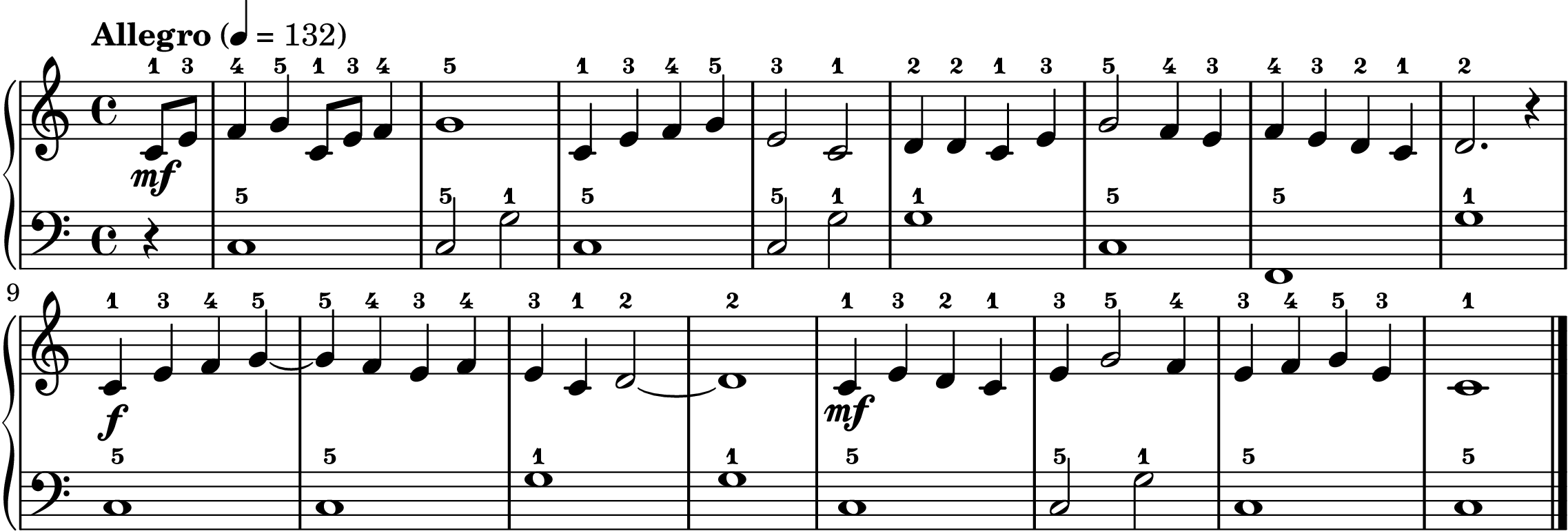
When both halves feel solid, play the full score at 80 BPM with a strong left-hand beat, then build toward the joyful 120 BPM Allegro target.
Note by note: keys and fingering
- Right hand: C4, D4, E4, F4, G4 - Standard C position. Wider intervals (C to E, C to F).
- Left hand: C3, F3, G3 - Pinky on C3, index on F3, thumb on G3. One bass note per measure.
| Note | On the Staff | On the Keyboard | Finger |
|---|---|---|---|
| C4 (Middle C) | One ledger line below treble staff | White key left of two black keys, center | RH Thumb (1) |
| D4 | Just below bottom line of treble staff | Between the two black keys | RH Index (2) |
| E4 | On the bottom line of treble staff | Right of two black keys | RH Middle (3) |
| F4 | First space of treble staff | Left of three black keys | RH Ring (4) |
| G4 | Second line of treble staff | Between first two of three black keys | RH Pinky (5) |
| C3 | Two ledger lines below bass staff | One octave below middle C | LH Pinky (5) |
| F3 | Fourth space of bass staff | Left of three black keys, below middle C | LH Index (2) |
| G3 | Top line of bass staff | Between first two of three black keys | LH Thumb (1) |
Prefer a video? Watch the keys light up
Same color code as the player: green marks the right hand, blue the left hand, with the score and keyboard in one vertical video.
The story behind When the Saints
When the Saints Go Marching In began as an American Christian hymn in the 1890s, with an early copyrighted version appearing around 1896. In the early twentieth century the song took root in New Orleans, where brass bands played it in street parades and funeral processions - somber on the way to the cemetery, jubilant on the way back. Louis Armstrong's 1938 recording turned the hymn into a worldwide jazz standard, and it has since become the unofficial anthem of New Orleans. For piano beginners it is an ideal march: the melody moves mostly stepwise, with a few bright, characteristic jumps.
Get the printable PDF
The printable PDF of When the Saints Go Marching In - full score, hand positions, and a step-by-step practice guide - ships inside our free Level 2 pack together with four other beginner favorites.
A march needs a steady pulse from head to toe, and kids play it best when their feet actually reach something solid - a Classic Piano Bench for kids paired with a piano pedal extender takes care of that.
FAQ
How hard is When the Saints Go Marching In on piano?
It is an easy piece - Level 2 in our free sheet collection. The right hand stays in the standard C position from C4 to G4, and the left hand plays only three bass notes, C3, F3, and G3, as whole notes. The only new challenge after Level 1 is the wider intervals, like the jumps from C to E and from C to F.
How long does it take to learn When the Saints Go Marching In?
The opening motif C-E-F-G returns three times in the first eight measures, so Section A comes together quickly. Most beginners play the piece hands together within a week or two at a slow tempo. Reaching the full 120 BPM Allegro with a steady march feel usually takes a little longer.
What level is When the Saints Go Marching In?
This arrangement sits in the Level 2 pack of our free sheet collection. It keeps one five-finger hand position but introduces wider melodic intervals and a three-note bass line following the I-IV-V chord progression, which is exactly the step up from Level 1 pieces.
What are the notes for When the Saints Go Marching In on piano?
The right hand opens with the ascending motif C-E-F-G, repeated three times with slight variations, then develops with longer held notes in measures 9 to 16. The left hand plays whole-note bass notes in the sequence C-C-F-F-C-C-G-C. The full note-by-note table with fingering is above.