
Dies Irae is the medieval chant of the day of wrath, the melody horror scores still borrow, and you can learn it with the interactive player below: hear it at half speed, watch the notes and keys light up, and drag the score to replay any phrase. Sheet music, fingering, and a free printable PDF follow.
Learn it with the interactive player
- Slow it down: x0.5 or x0.75 while you learn the notes, back to x1 once they flow.
- Pause anywhere: the current keys stay lit so you can find them on your own piano.
- Drag the score left or right, or use the 15s buttons, to replay a phrase.
The sheet music, section by section
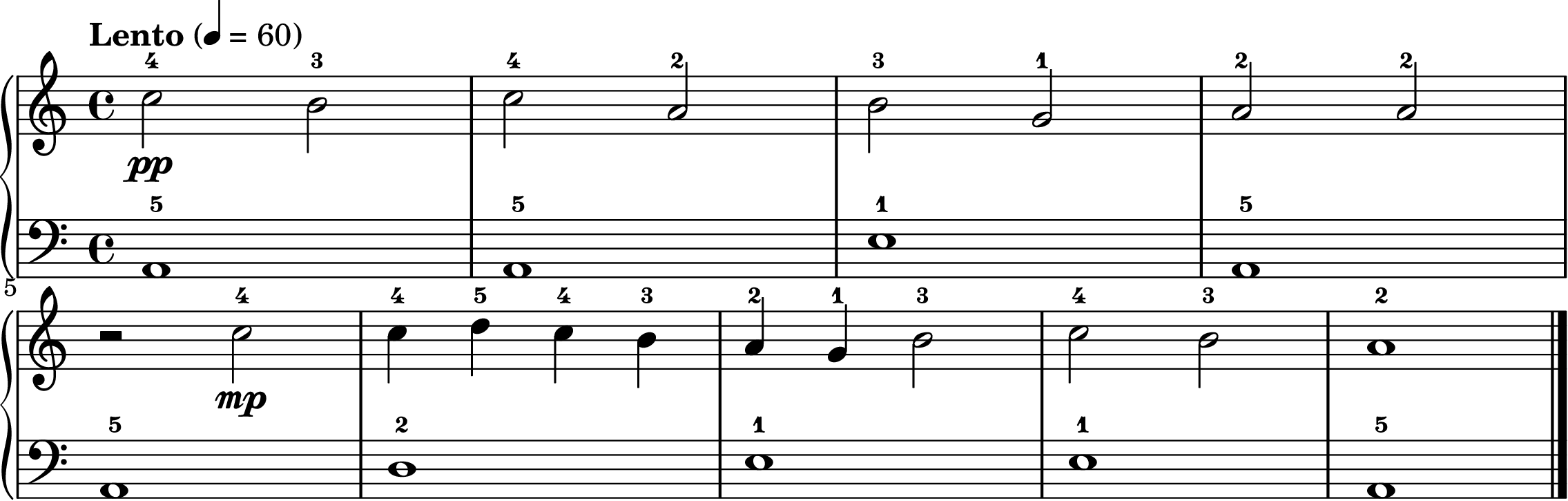
Start with Section A at x0.5 on the player. It holds the first two lines of the real chant with the thumb on G4: line 1 is C5-B4, C5-A4, B4-G4, A4-A4 in slow half notes. After a half-rest breath, line 2 sings C5, then three two-note pairs in quarter notes, C5-D5, C5-B4, A4-G4, then B4, C5, B4 and a long A4.

Section B is line 3 of the chant. Use the half rest to shift your hand down so the thumb takes E4, then play E4, G4-A4, A4, A4-G4, B4, C5, B4 and the final whole note A4 under a fermata. Keep the left-hand drones soft underneath the melody.
The full score
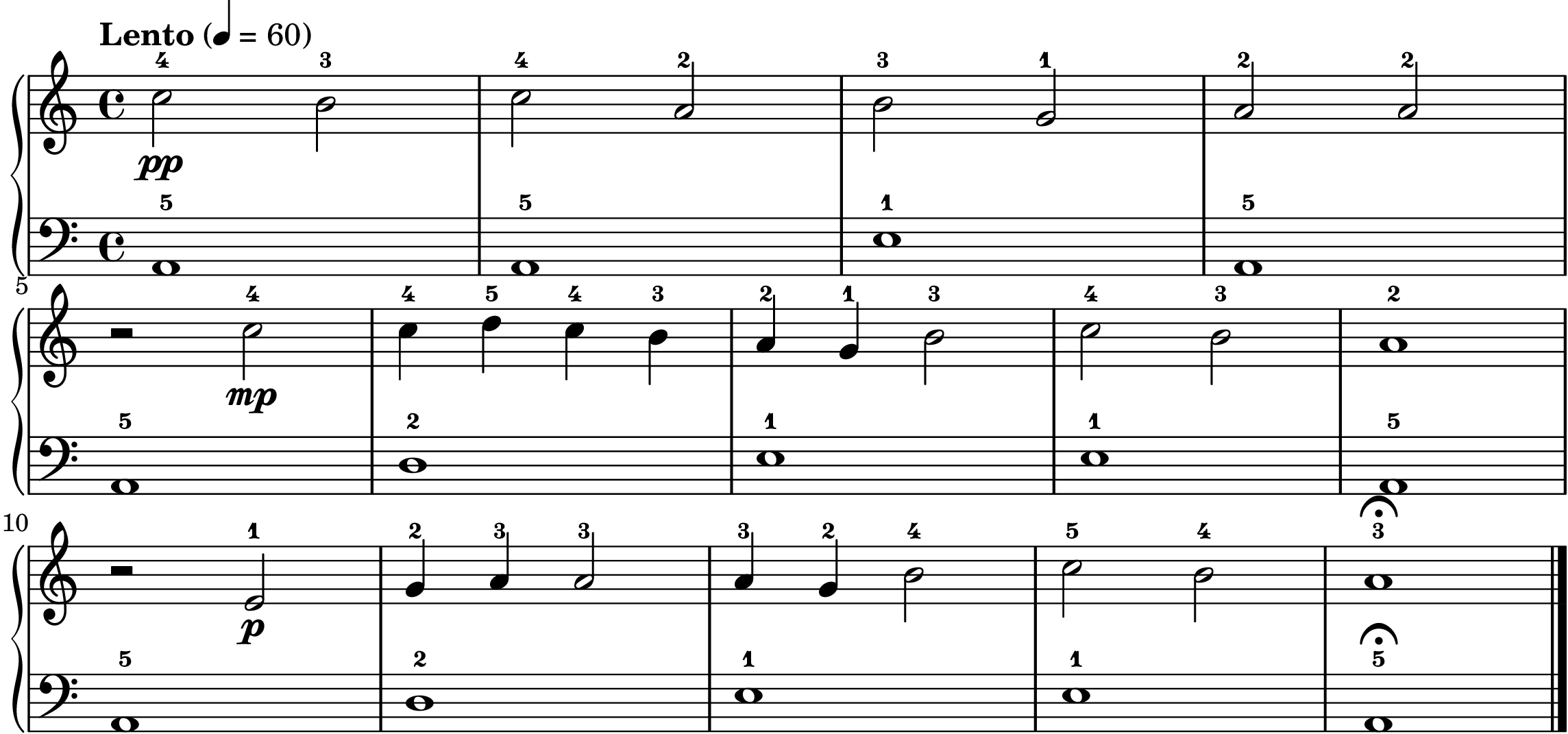
At Lento the full score is fourteen slow measures, the first verse of the chant from start to finish; play it like a procession, perfectly even, and resist every urge to speed up.
Note by note: keys and fingering
- Right hand: Two positions and one hand shift. Lines 1 and 2: thumb (1) on G4, then A4 (2), B4 (3), C5 (4), D5 (5); the chant opens C5-B4, C5-A4, B4-G4, A4-A4 in slow half notes. Line 3: during the half rest in measure 10, move the hand down so the thumb (1) sits on E4, then G4 (2), A4 (3), B4 (4), C5 (5).
- Left hand: A2, D3, and E3 only - one whole note per measure, a drone under the chant. Pinky (5) on A2, index (2) on D3, thumb (1) on E3. The left hand never moves.
| Note | On the Staff | On the Keyboard | Finger |
|---|---|---|---|
| C5 | Third space of treble staff | White key left of the two black keys above middle C | RH Ring (4); Pinky (5) in line 3 |
| B4 | Third line of treble staff | White key right of the three black keys | RH Middle (3); Ring (4) in line 3 |
| A4 | Second space of treble staff | White key between the last two of three black keys | RH Index (2); Middle (3) in line 3 |
| G4 | Second line of treble staff | White key between the first two of three black keys | RH Thumb (1); Index (2) in line 3 |
| D5 | Fourth line of treble staff | White key between the two black keys above C5 | RH Pinky (5), line 2 only |
| E4 | First line of treble staff | White key right of the two black keys just above middle C | RH Thumb (1), line 3 only |
| A2 | First space of bass staff | White key between the last two of three black keys, two octaves down | LH Pinky (5) |
| D3 | Middle line of bass staff | White key between the two black keys below middle C | LH Index (2) |
| E3 | Third space of bass staff | White key right of the two black keys below middle C | LH Thumb (1) |
Prefer a video? Watch the keys light up
Same color code as the player: green marks the right hand, blue the left hand, with the score and keyboard in one vertical video.
The story behind Dies Irae
Dies Irae, Latin for day of wrath, is a Gregorian chant from the 13th century, traditionally attributed to the friar Thomas of Celano. For centuries it was sung in the Requiem, the Catholic Mass for the dead, which is how its first four notes became a universal symbol of death in music. Berlioz quoted it in his Symphonie fantastique in 1830, Liszt and Rachmaninoff built whole works around it, and film composers still slip it into horror scores today. This arrangement moves the chant into A minor and slows it to a calm, even pulse over a bass drone. For the full story, from the medieval Requiem to The Shining and Frozen II, read what Dies Irae means and where you've heard it.
Get the printable PDF
The printable PDF of this easy Dies Irae - full score, hand positions, and a step-by-step practice guide - ships inside our free Halloween pack together with fourteen other spooky pieces.
A chant this slow exposes every fidget, and an Adjustable Piano Bench with Back Support helps you sit tall and still for the whole procession.
Piano teacher? Track your students' practice. Join the early list
FAQ
How hard is Dies Irae on piano?
This arrangement is about as easy as real repertoire gets. The right hand plays half notes and a few slow quarter-note pairs, with just one hand shift before the last line, and the left hand holds one drone note per measure. It opens Level 1 of our Halloween collection, so it works even as a first piece.
How long does it take to learn Dies Irae?
Most complete beginners can play it hands together within a few days. There are only six different right-hand notes and three bass notes, and the Lento tempo of 60 BPM leaves plenty of time to think between them, including the one hand shift.
What level is Dies Irae?
We place it at Level 1 of our Halloween collection. The melody uses one hand shift (thumb on G4, then on E4 for the last line), nothing faster than quarter notes, and the left hand plays a single whole note per measure - the classic profile of a first-year piece.
What are the notes for Dies Irae?
In this A minor arrangement the first verse of the chant has three lines. Line 1: C5 B4 C5 A4 B4 G4 A4 A4. Line 2: C5 C5-D5 C5-B4 A4-G4 B4 C5 B4 A4. Line 3: E4 G4-A4 A4 A4-G4 B4 C5 B4 A4. The hyphenated pairs are two notes sung on one syllable. The left hand drones on A2, D3, and E3, one whole note per measure. The full note-by-note table is above.