
O Come, All Ye Faithful is the processional of our Christmas collection, and the interactive player below is the surest way to learn it: hear it at half speed, watch the notes and keys light up, and drag the score to repeat any refrain. Sheet music, fingering for both hands, and a free printable PDF come next.
Learn it with the interactive player
- Slow it down: x0.5 or x0.75 while you learn the notes, back to x1 once they flow.
- Pause anywhere: the current keys stay lit so you can find them on your own piano.
- Drag the score left or right, or use the 15s buttons, to replay a phrase.
The sheet music, section by section

Section A is the verse: after the upbeat C5, the melody strides C5-G4-C5, D5-G4, then E5-D5-E5-F5 up to the top before E5-D5-C5 and the walk C5-B4-A4, B4-C5-D5-E5 settles on a long G4. Listen for the left hand climbing G2-A2-B2-C3 under measure 6; take it at x0.5 with the printed fingering.

Section B is the triple refrain, O come, let us adore Him: first p with C5-B4-C5-D5, then mf a third higher on E5-D5-E5-F5, then f with F5-E5-D5-C5, the leap from C5 up to F5 on Him, and E5-D5-C5 closing on Christ the Lord. Practice all three at one volume at x0.75, then add the terraces.
The full score
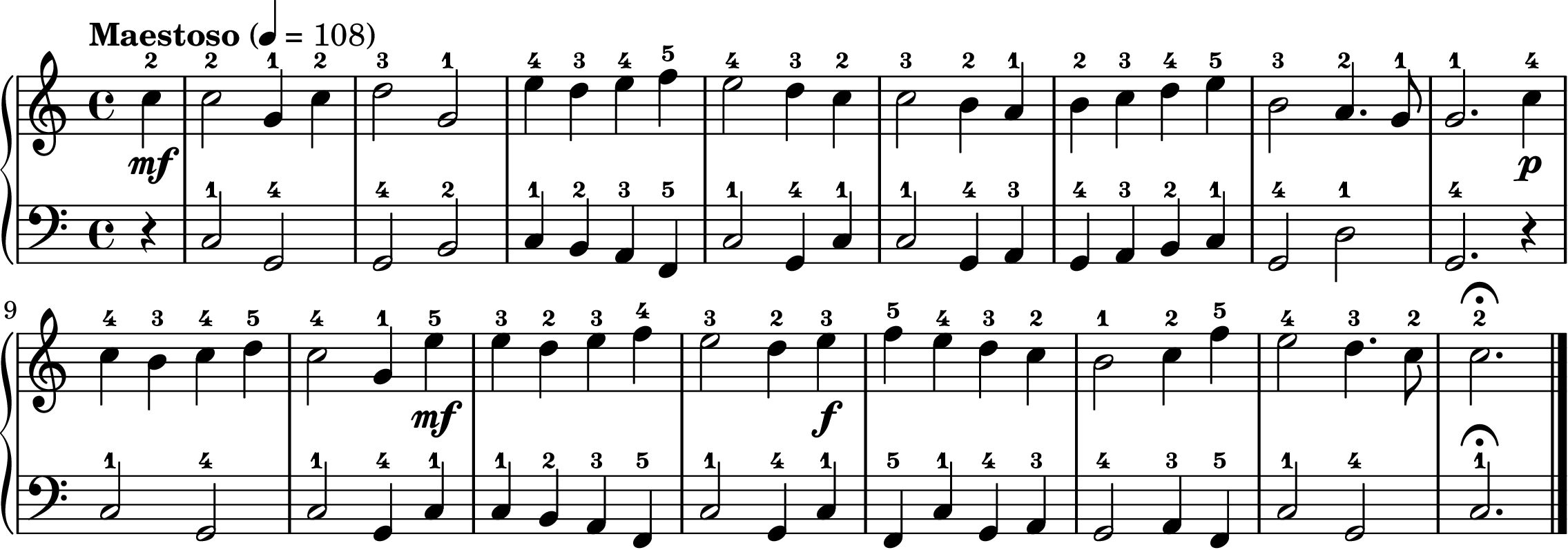
In the full score the upbeat quarter starts alone in the right hand, so count a silent measure first. The bass changes mostly on beats 1 and 3; work up from 80 toward the 108 BPM Maestoso with a broad, steady pulse, like a procession entering a cathedral.
Note by note: keys and fingering
- Right hand: Two overlapping frames: thumb (1) on G4 for the verse, with index (2) on C5, middle (3) on D5, ring (4) on E5 and pinky (5) on F5, then a C5-centered frame for the refrains with the ring (4) on C5. Silent finger changes on repeated notes, C5 (2 then 3) and E5 (5 then 3), tell you exactly when to shift.
- Left hand: One five-finger frame from the pinky (5) on F2 to the thumb (1) on C3, with ring (4) on G2, middle (3) on A2 and index (2) on B2, and a single stretch of the thumb up to D3 in measure 7. Walking single-note lines, never two notes at once.
| Note | On the Staff | On the Keyboard | Finger |
|---|---|---|---|
| G4 | Second line of treble staff | White key between the first two of three black keys above middle C | RH Thumb (1) |
| A4 | Second space of treble staff | White key between the last two of three black keys above middle C | RH Thumb (1) |
| B4 | Middle line of treble staff | White key right of the three black keys above middle C | RH Index (2) |
| C5 | Third space of treble staff | One octave above middle C | RH Index (2) |
| D5 | Fourth line of treble staff | White key between the two black keys above C5 | RH Middle (3) |
| E5 | Fourth space of treble staff | White key right of the two black keys above C5 | RH Ring (4) |
| F5 | Top line of treble staff | White key left of the three black keys above C5 | RH Pinky (5) |
| F2 | Space just below the bottom line of the bass staff | White key left of the three black keys, two octaves below F4 | LH Pinky (5) |
| G2 | Bottom line of bass staff | White key between the first two of three black keys, an octave and a fourth below middle C | LH Ring (4) |
| A2 | First space of bass staff | White key between the last two of three black keys, an octave and a third below middle C | LH Middle (3) |
| B2 | Second line of bass staff | White key right of the three black keys, an octave and a step below middle C | LH Index (2) |
| C3 | Second space of bass staff | One octave below middle C | LH Thumb (1) |
| D3 | Third line of bass staff | White key between the two black keys below middle C | LH Thumb (1) |
Prefer a video? Watch the keys light up
Same color code as the player: green marks the right hand, blue the left hand, with the score and keyboard in one vertical video.
The story behind O Come, All Ye Faithful
John Francis Wade was an English music copyist living in exile in Douai, France, when he wrote down the Latin hymn Adeste Fideles around 1751. Whether he composed the tune or preserved it, his manuscripts are where it first appears. Frederick Oakeley's English translation of 1841 gave us the words sung today. The genius of the carol is its refrain: O come, let us adore Him repeats three times, and every choir instinctively sings each repeat a little stronger. This arrangement writes that crescendo into the score, p, then mf, then f, so you practice real dynamic storytelling while staying in C major over a single-note walking bass.
Get the printable PDF
The printable PDF of O Come, All Ye Faithful - full score, hand positions, and a step-by-step practice guide - ships inside our free Christmas pack together with fourteen other carols.
A processional carol like this is often the first piece a learner plays for guests, and if that learner is on your list this year, our gifts for pianists guide starts with the Adjustable Piano Bench with Back Support.
Piano teacher? Track your students' practice. Join the early list
FAQ
How hard is O Come, All Ye Faithful on piano?
It is a Level 3 piece in our Christmas collection, mainly because of the dynamics and the hand shifts. The right hand moves between a G4 frame and a C5 frame using two silent finger changes on repeated notes, the left hand stays in one five-finger frame from F2 to C3, and the three refrains must be shaped p, mf, f.
How long does it take to learn O Come, All Ye Faithful?
Three to four weeks for most learners. The verse takes the first week with the printed fingering, the three refrains share the same shape at different heights, and the remaining time goes into playing the dynamic terraces cleanly hands together at 108 BPM.
What level is O Come, All Ye Faithful?
Level 3 of our Christmas collection. C major, 4/4 with a quarter-note upbeat, Maestoso at 108 BPM, 16 measures. The right hand covers G4 to F5 and the left hand walks single notes from F2 to D3.
What are the notes for O Come, All Ye Faithful?
After the upbeat C5, the verse goes C5, G4, C5, D5, G4, then E5, D5, E5, F5, E5, D5, C5, then C5, B4, A4, B4, C5, D5, E5, B4, A4, G4. The first refrain runs C5, B4, C5, D5, C5, G4, the second sits a third higher, and the last is F5, E5, D5, C5, B4, C5, F5, E5, D5, C5, C5. The left hand opens C3, G2; see the full table above.