
Beethoven’s German Dance in C Major is a cheerful Viennese waltz, and the interactive player below makes it easy to pick up: play it at half speed, watch the notes and keys light up in real time, and drag the score to loop any passage. Sheet music, fingering, and a free printable PDF follow.
Learn it with the interactive player
- Slow it down: x0.5 or x0.75 while you learn the notes, back to x1 once they flow.
- Pause anywhere: the current keys stay lit so you can find them on your own piano.
- Drag the score left or right, or use the 15s buttons, to replay a phrase.
The sheet music, section by section

With the player at x0.5, learn the Section A melody first: E-G-G, F-E-D, C-E-G over the waltz bass. Feel the strong-weak-weak pulse of the 3/4 before you worry about speed.

Section B begins softer on D-F-F and builds back to forte, the classic dynamic contrast of a Classical dance. Keep the left-hand waltz pattern perfectly steady while the volume changes.
The full score
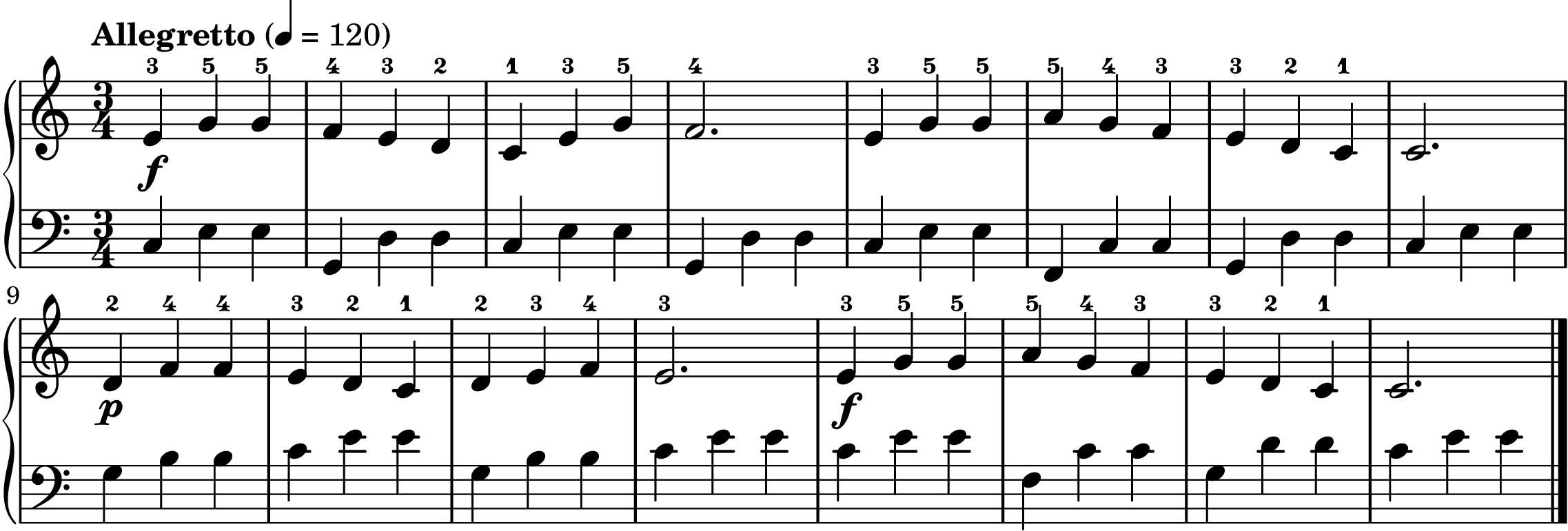
Run the full 16 measures with a clear ONE-two-three lift, letting the melody float over the bass as you work toward the 120 BPM target.
Note by note: keys and fingering
- Right hand: C4, D4, E4, F4, G4, A4 - C position with extension to A4. Quarter and half note melody.
- Left hand: C3, E3, G3, D3, F3 - Waltz bass pattern: root on beat 1, chord tones on beats 2-3.
| Note | On the Staff | On the Keyboard | Finger |
|---|---|---|---|
| C4 (Middle C) | One ledger line below treble staff | White key left of two black keys, center | RH Thumb (1) |
| D4 | Just below bottom line of treble staff | Between the two black keys | RH Index (2) |
| E4 | On the bottom line of treble staff | Right of two black keys | RH Middle (3) |
| F4 | First space of treble staff | Left of three black keys | RH Ring (4) |
| G4 | Second line of treble staff | Between first two of three black keys | RH Pinky (5) |
| A4 | Second space of treble staff | Between last two of three black keys | RH stretched |
| C3 | Two ledger lines below bass staff | One octave below middle C | LH Pinky (5) |
| D3 | Third line of bass staff | Between two black keys, below middle C | LH Ring (4) |
| E3 | Fourth line of bass staff | Right of two black keys | LH Middle (3) |
| F3 | Fourth space of bass staff | Left of three black keys | LH Index (2) |
| G3 | Top line of bass staff | Between first two of three black keys | LH Thumb (1) |
Prefer a video? Watch the keys light up
Same color code as the player: green marks the right hand, blue the left hand, with the score and keyboard in one vertical video.
The story behind the German Dance
Beethoven spent part of his early career in Vienna writing dance music for the city's ballrooms, including sets of German dances composed around 1795. These were functional pieces in the best sense: music for real dancers at masked balls and public halls, supplied by a young virtuoso newly arrived from Bonn. The German dance, or Deutscher Tanz, was a turning couple dance in triple time and a direct ancestor of the waltz. Beethoven kept the form simple - two balanced eight-measure strains with clear harmonies - which is exactly why these dances are among the most approachable pieces he ever wrote and a natural doorway into the Classical style.
Get the printable PDF
The printable PDF of the German Dance - full score, hand positions, and a step-by-step practice guide - ships inside our free Level 4 pack with four other intermediate favorites.
A waltz is kinder to play when your forearms sit level with the keys, and an Adjustable Piano Bench with Back Support lets you dial that in precisely.
FAQ
How hard is the German Dance in C on piano?
It is a comfortable Level 4 piece: all white keys in C major, a five-finger melody with one stretch up to A4, and a waltz bass of a root note followed by repeated chord tones. Coordinating the floating melody with that steady bass is the main skill it trains.
How long does it take to learn the German Dance in C?
Two to three weeks of regular practice is typical. The waltz bass pattern - C on beat 1, then E-E on beats 2 and 3 - usually needs a few days alone before the hands go together around 80 BPM and build toward the 120 BPM target.
What level is the German Dance in C?
Beethoven's German dances are usually graded around 1 to 2 on exam scales, and this arrangement sits in the Level 4 pack of our free collection. It is a classic introduction to the Classical dance style and to 3/4 accompaniment patterns.
What are the notes for the German Dance in C?
The right hand plays E-G-G, F-E-D, C-E-G, F-F in Section A and starts Section B softer on D-F-F, using C4 up to A4. The left hand plays a waltz pattern on C3, D3, E3, F3, and G3: root on beat 1, chord tones on beats 2 and 3. The full note table is above.