
Moonlight Sonata is Beethoven’s haunting Adagio, simplified into an easy A minor theme you can learn with the interactive player: the notes and keys light up as it plays, at full or half speed, and you can drag the score to move around. Sheet music, fingering, and a free PDF follow.
Learn it with the interactive player
- Slow it down: x0.5 or x0.75 while you learn the notes, back to x1 once they flow.
- Pause anywhere: the current keys stay lit so you can find them on your own piano.
- Drag the score left or right, or use the 15s buttons, to replay a phrase.
The sheet music, section by section

Begin with Section A, hands separate: the dotted call repeats on E5, and the first long E5 lasts a measure and a half before the line rises to F5 and comes to rest on C5. Under it the left hand plays whole notes, sinking from A2 to G sharp 2. The piece is marked Adagio sostenuto, so even x0.75 on the player is a fine practice tempo.
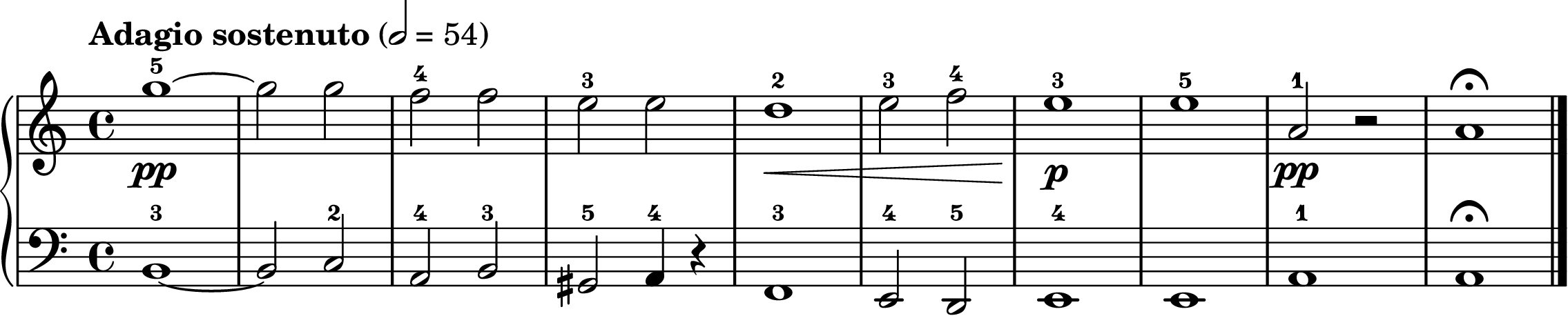
Section B is Beethoven's closing phrase: a long G5 tied over the bar line and struck once more, then half notes in pairs on F5 and E5, a swell through D5-E5-F5, and the final A4. Learn the change from finger 3 to 5 on the repeated E5 in bar 15 first, then add the left hand, which drops to E2 and D2 below the staff.
The full score
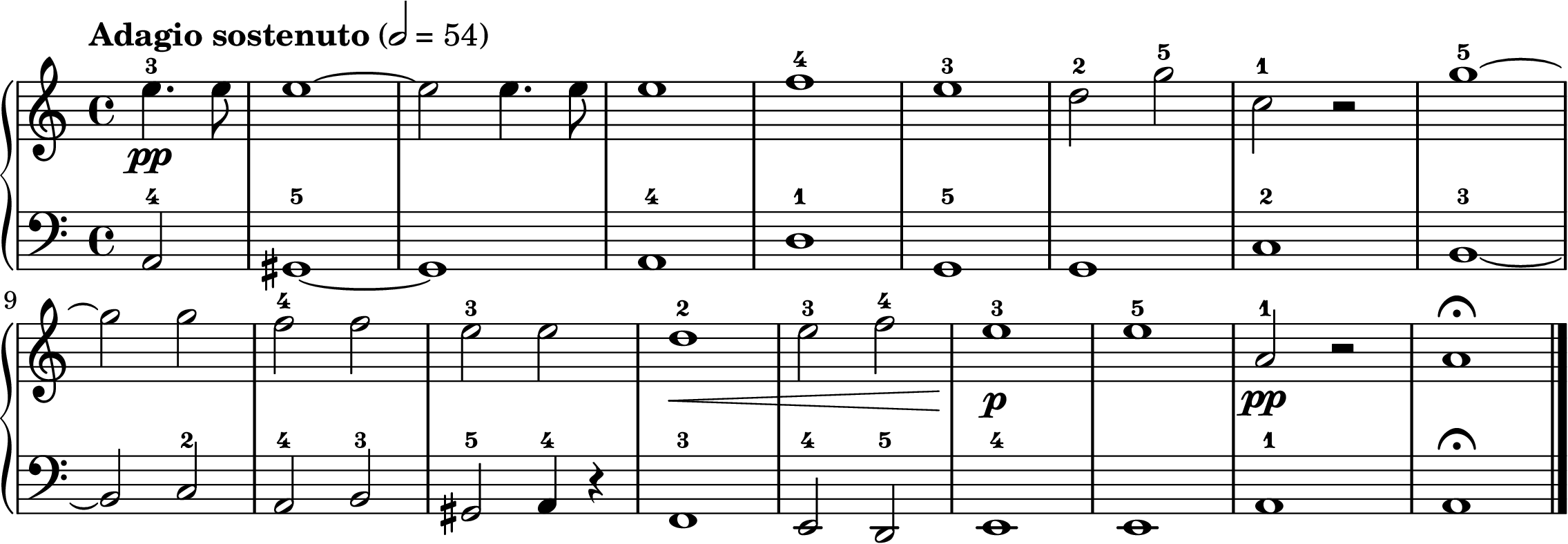
Play the full score pianissimo over a slow half-note pulse. The only swell is the crescendo in bars 12 and 13, rising from pp to p in bar 14; the last two A's drop back to pp.
Note by note: keys and fingering
- Right hand: One C position almost to the end: thumb (1) on C5, then D5 (2), E5 (3), F5 (4), G5 (5). The dotted call repeats on E5 under the middle finger (3). In bar 15 the pinky (5) takes the repeated E5, which brings the thumb over the closing A4.
- Left hand: Beethoven's bass line as single notes, mostly whole notes. Through bar 11 the hand sits in a G position: pinky (5) on G2 and G sharp 2, A2 (4), B2 (3), C3 (2), D3 (1). The quarter rest in bar 11 gives time to move down for F2 (3), E2 (4) and D2 (5); the thumb (1) plays the last A2.
| Note | On the Staff | On the Keyboard | Finger |
|---|---|---|---|
| E5 | Fourth space of treble staff | White key right of the two black keys above C5 | RH Middle (3) |
| F5 | Top line of treble staff | White key left of the three black keys above C5 | RH Ring (4) |
| D5 | Fourth line of treble staff | White key between the two black keys above C5 | RH Index (2) |
| G5 | Space above the treble staff | White key between the first two of the three black keys above C5 | RH Pinky (5) |
| C5 | Third space of treble staff | White key left of the two black keys above middle C | RH Thumb (1) |
| A4 | Second space of treble staff | White key between the last two of three black keys | RH Thumb (1) |
| A2 | First space of bass staff | White key between the last two of three black keys, two octaves down | LH Ring (4) |
| G#2 | Bottom line of bass staff, with a sharp sign | Black key right of G2, two octaves down | LH Pinky (5) |
| D3 | Middle line of bass staff | White key between the two black keys below middle C | LH Thumb (1) |
| G2 | Bottom line of bass staff | White key between the first two of three black keys, two octaves down | LH Pinky (5) |
| C3 | Second space of bass staff | White key left of the two black keys below middle C | LH Index (2) |
| B2 | Second line of bass staff | White key right of the three black keys, two octaves down | LH Middle (3) |
| F2 | Space just below the bass staff | White key left of the three black keys, two octaves down | LH Middle (3) |
| E2 | First ledger line below the bass staff | White key right of the two black keys, two octaves down | LH Ring (4) |
| D2 | Space below the first ledger line | White key between the two black keys, two octaves down | LH Pinky (5) |
Prefer a video? Watch the keys light up
Same color code as the player: green marks the right hand, blue the left hand, with the score and keyboard in one vertical video.
The story behind the Moonlight Sonata
Beethoven composed his Piano Sonata No. 14 in 1801 and subtitled it Sonata quasi una fantasia. The nickname Moonlight came later, from the critic Ludwig Rellstab rather than from Beethoven himself, and it stuck. Beethoven dedicated the sonata to his young student, Countess Giulietta Guicciardi. The original first movement flows in C-sharp minor triplets. The arrangement on this page leaves the triplets out and keeps Beethoven's melody, the theme and then his closing phrase, transposed to A minor with doubled note values; the left hand plays his bass line one note at a time.
Get the printable PDF
The printable PDF of this easy Moonlight Sonata theme - full score, hand positions, and a step-by-step practice guide - ships inside our free Halloween pack together with fourteen other spooky classics.
The Adagio tempo invites long, unhurried practice, and an Adjustable Piano Bench with Back Support lets you settle in comfortably and lean back between passages.
Piano teacher? Track your students' practice. Join the early list
FAQ
How hard is Moonlight Sonata on piano?
The original first movement is an advanced piece: constant triplets, four sharps, and long-held bass octaves. This arrangement keeps only Beethoven's melody and bass line, in A minor with one note at a time in each hand, and is playable after a few months of lessons. We place it at Level 2 of our Halloween collection.
How long does it take to learn Moonlight Sonata?
The full first movement typically takes an intermediate player one to three months. This easy theme arrangement takes most beginners one to two weeks. It is only 17 bars plus a pick-up, and at Adagio sostenuto, mostly in whole notes, there is time to find each key before it sounds.
What level is Moonlight Sonata?
The original movement is usually graded around level 6 or higher on exam scales. The arrangement on this page is written for Level 2 players: the right hand stays in one C position up to G5, with no sharps or flats, and moves once, in bar 15, to reach the final A4. The left hand plays single notes, mostly whole and half notes, with one move down during the bar-11 rest for E2 and D2 below the staff.
What are the notes for the Moonlight Sonata theme?
In this A minor arrangement the right hand repeats a dotted rhythm on E5, holds E5, rises to F5 and back to E5, then plays D5, G5, C5. The closing phrase starts on a long G5 tied into the next bar, strikes it once more, then steps down in pairs (F5 F5, E5 E5), swells through D5, E5, F5, and ends E5, E5, A4. The left hand plays Beethoven's bass: A2, G sharp 2, A2, D3, G2, C3, then B2, C3, A2, B2, G sharp 2, A2, F2, E2, D2, E2 and a final A2. The full note-by-note table is above.