
Simple Gifts is the Shaker song Aaron Copland made famous, and this easy C major arrangement is built around the interactive player below: hear it at half speed, watch the notes and keys light up as it plays, and drag the score to replay any phrase. The sheet music, fingering for both hands, and a free printable PDF come next.
Learn it with the interactive player
- Slow it down: x0.5 or x0.75 while you learn the notes, back to x1 once they flow.
- Pause anywhere: the current keys stay lit so you can find them on your own piano.
- Drag the score left or right, or use the 15s buttons, to replay a phrase.
The sheet music, section by section

Set the player to x0.5 for Section A (upbeat plus measures 1-8): two pickup G4s lift you into the tune, the melody climbs the C chord C5-D5-E5 to G5 on gift to be, falls back E5-D5-C5 for free, then repeats a patient half-note D5 four times on gift to come down before D5-E5-D5-B4 settles on G4. The left hand rolls one broken chord per measure beneath.

Section B (measures 9-16) climbs the same hill from C5-B4-C5-D5 and crowns it with a dotted-half G5 on right, then the valley of love and delight winds down by step through D5 and C5 to close on a whole-note C5 over a bare C3 in the bass.
The full score
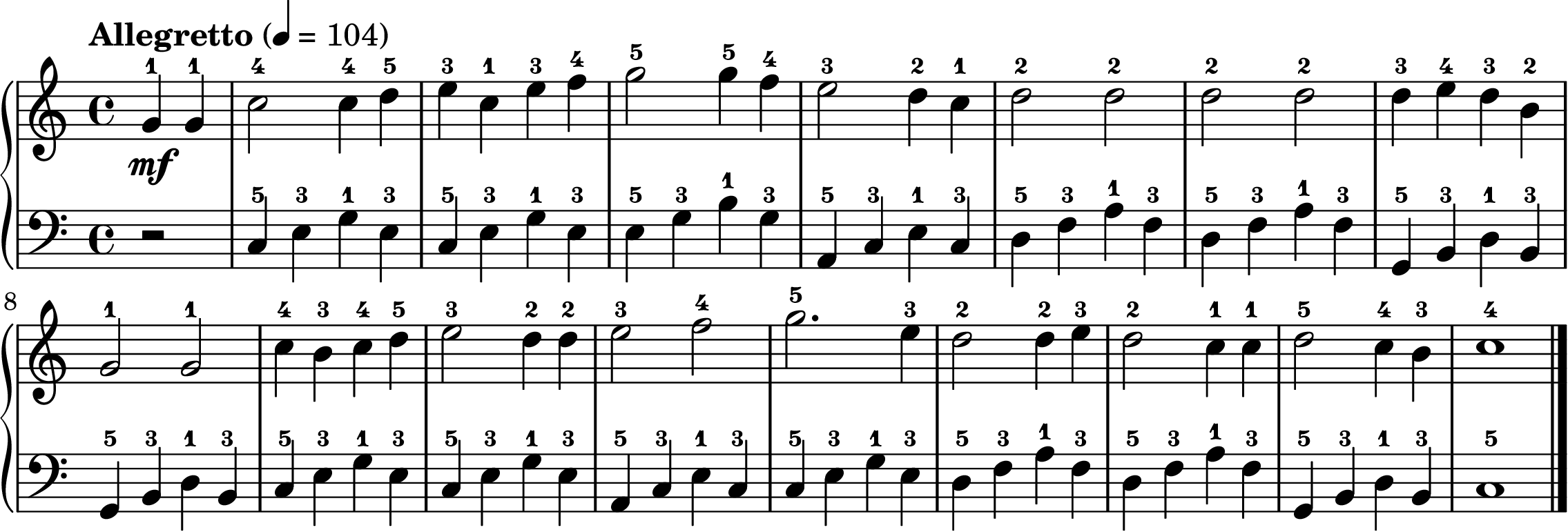
In the full score, play the left hand alone at 60 BPM until the 5-3-1-3 wave feels like slow breathing, then add the melody at 66 BPM and let it flow, unhurried and without accents, toward 104 BPM.
Note by note: keys and fingering
- Right hand: A high, singing register: the home position is the thumb (1) on C5 with fingers up to the pinky (5) on G5, dipping to B4 and G4 with the thumb. The tune flows mostly by step, so once each phrase is placed the hand barely moves.
- Left hand: Rolling broken chords in a steady 5-3-1-3 wave, pinky (5) on the root, middle finger (3) on the third, thumb (1) on the fifth: C (C3-E3-G3), E minor (E3-G3-B3), A minor (A2-C3-E3), D minor (D3-F3-A3) and G (G2-B2-D3). One chord per measure, like a calm heartbeat.
| Note | On the Staff | On the Keyboard | Finger |
|---|---|---|---|
| G4 | Second line of treble staff | Between first two of three black keys | RH Thumb (1) |
| B4 | Middle line of treble staff | Right of three black keys | RH Index (2) |
| C5 | Third space of treble staff | One octave above middle C | RH Ring (4) |
| D5 | Fourth line of treble staff | Right of C5, between two black keys | RH Pinky (5) |
| E5 | Fourth space of treble staff | Right of D5 | RH Middle (3) |
| F5 | Top line of treble staff | One octave above F4 | RH Ring (4) |
| G5 | Space above the top line | One octave above G4 | RH Pinky (5) |
| G2 | Bottom line of bass staff | Two octaves below middle C, between first two of three black keys | LH Pinky (5) |
| A2 | Bottom space of bass staff | Two octaves below middle C, after three black keys | LH Pinky (5) |
| B2 | Second line of bass staff | Right of three black keys, below C3 | LH Middle (3) |
| C3 | Second space of bass staff | One octave below middle C | LH Pinky (5) |
| D3 | Third line of bass staff | Between the two black keys below middle C | LH Pinky (5) |
| E3 | Third space of bass staff | Right of two black keys, below middle C | LH Middle (3) |
| F3 | Fourth line of bass staff | Left of three black keys, below middle C | LH Middle (3) |
| G3 | Fourth space of bass staff | Between first two of three black keys, below middle C | LH Thumb (1) |
| A3 | Top line of bass staff | Between last two of three black keys, below middle C | LH Thumb (1) |
| B3 | Ledger area just above bass staff | White key left of middle C | LH Thumb (1) |
Prefer a video? Watch the keys light up
Same color code as the player: green marks the right hand, blue the left hand, with the score and keyboard in one vertical video.
The story behind Simple Gifts
Elder Joseph Brackett of the Shaker community in Alfred, Maine, wrote this quick dance in 1848. The Shakers sang it while they danced their worship, turning and bowing as the words instructed: it is the gift to be simple, the gift to be free. The little song stayed inside Shaker villages for nearly a century, until Aaron Copland found it and set it at the heart of his ballet Appalachian Spring in 1944, making it one of the most beloved American melodies of all. Played plainly, as the Shakers meant it, it needs no decoration. This arrangement gives the melody to a high, singing register over rolling single-note broken chords, one harmony per measure.
Get the printable PDF
The printable PDF of Simple Gifts - full score, hand positions, and a step-by-step practice guide - ships inside our free Thanksgiving pack together with fourteen other Thanksgiving pieces.
Shaker plainness means every beat equal and every muscle at ease, and an Adjustable Piano Bench with Back Support set to your height helps the whole arm stay quiet while the left hand rolls.
Piano teacher? Track your students' practice. Join the early list
FAQ
How hard is Simple Gifts on piano?
It is a Level 2 piece in our Thanksgiving collection. The right hand sits high, from G4 to G5, mostly moving by step in half and quarter notes, and the left hand rolls a broken chord in every measure in a steady 5-3-1-3 pattern using only single notes.
How long does it take to learn Simple Gifts?
Two to three weeks. The melody itself comes in a few days, but the rolling left hand, five chord shapes in a constant quarter-note wave, needs to be learned alone at 60 BPM before hands go together.
What level is Simple Gifts?
Level 2 of our Thanksgiving collection. It introduces a pickup, a left hand that plays four notes in every measure, finger substitutions on repeated notes in both hands, and a hand-position change in measure 15.
What are the notes for Simple Gifts?
The melody starts with two upbeat G4s, then C5, C5, D5, E5, C5, E5, F5, G5, G5, F5, E5, D5, C5, followed by four half-note D5s, then D5, E5, D5, B4 and two long G4s. The left hand rolls C3-E3-G3-E3, E3-G3-B3-G3, A2-C3-E3-C3, D3-F3-A3-F3 and G2-B2-D3-B2. See the full table above.