
Old MacDonald Had a Farm is a bright, bouncy first piece, and the interactive player below is the easiest way to start: press play to hear it at half speed, watch the notes and keys light up, and drag the score to move around. The sheet music, fingering for both hands, and a free printable PDF follow.
Learn it with the interactive player
- Slow it down: x0.5 or x0.75 while you learn the notes, back to x1 once they flow.
- Pause anywhere: the current keys stay lit so you can find them on your own piano.
- Drag the score left or right, or use the 15s buttons, to replay a phrase.
The sheet music, section by section
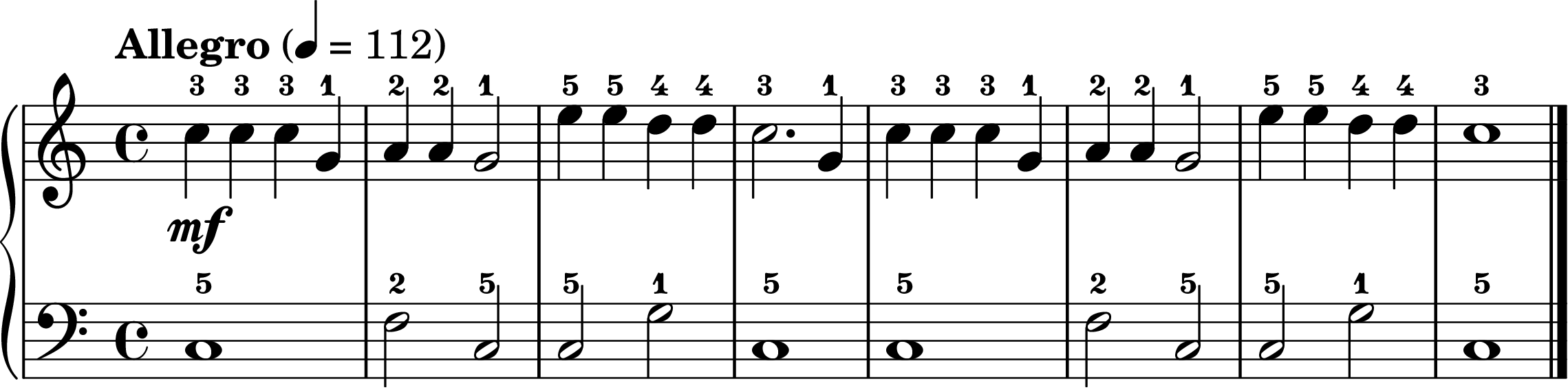
Start with Section A, the verse everyone knows: three repeated C5s under the middle finger dropping to the thumb on G, A-A-G for had a farm, then E-I-E-I-O falling neatly down the hand under fingers 5-5-4-4-3. Set the player above to x0.5; the four measures repeat for the cow, so your child learns four and instantly owns eight.
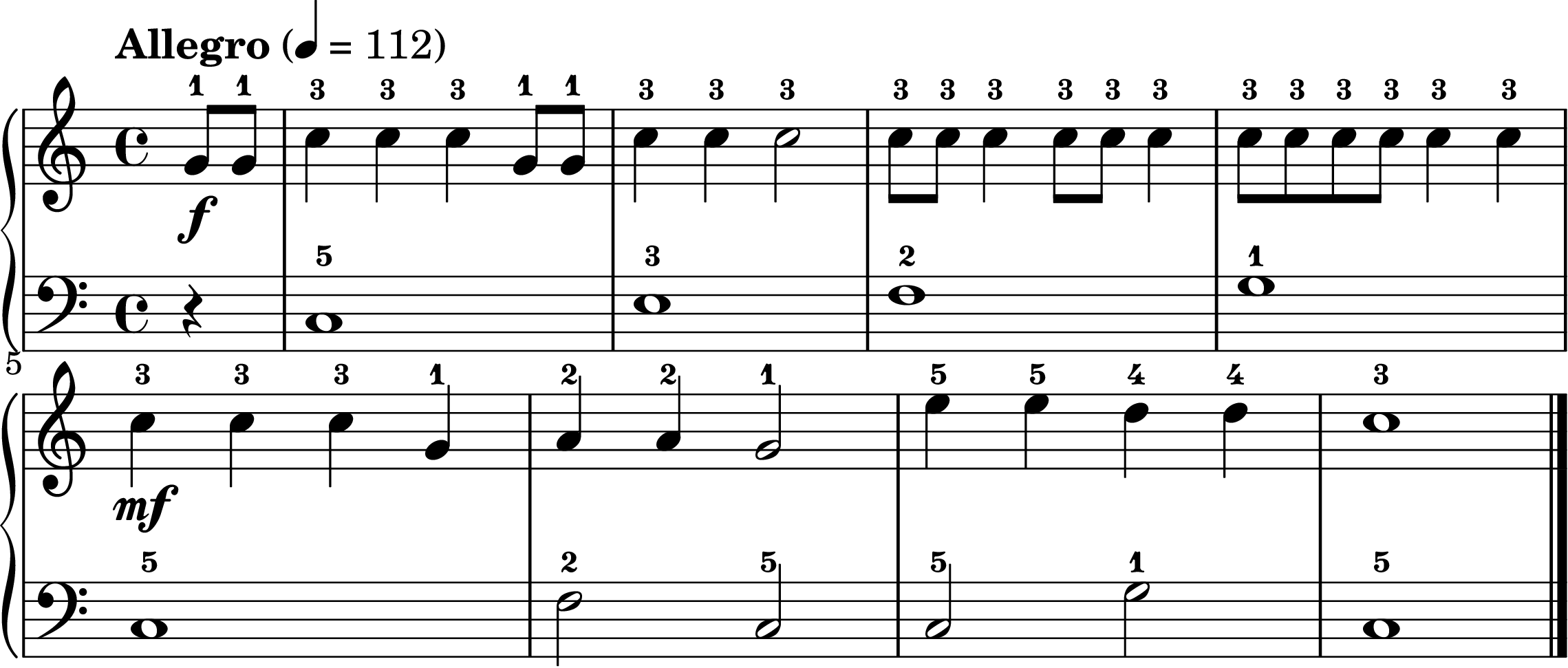
Section B opens on the little with-a pickup, two G eighth notes on the thumb, then the moo-moo chorus bounces between the middle finger on C5 and the thumb on G while the left hand climbs its fence one whole note at a time, C3-E3-F3-G3. The verse comes back with a final E-I-E-I-O to close.
The full score
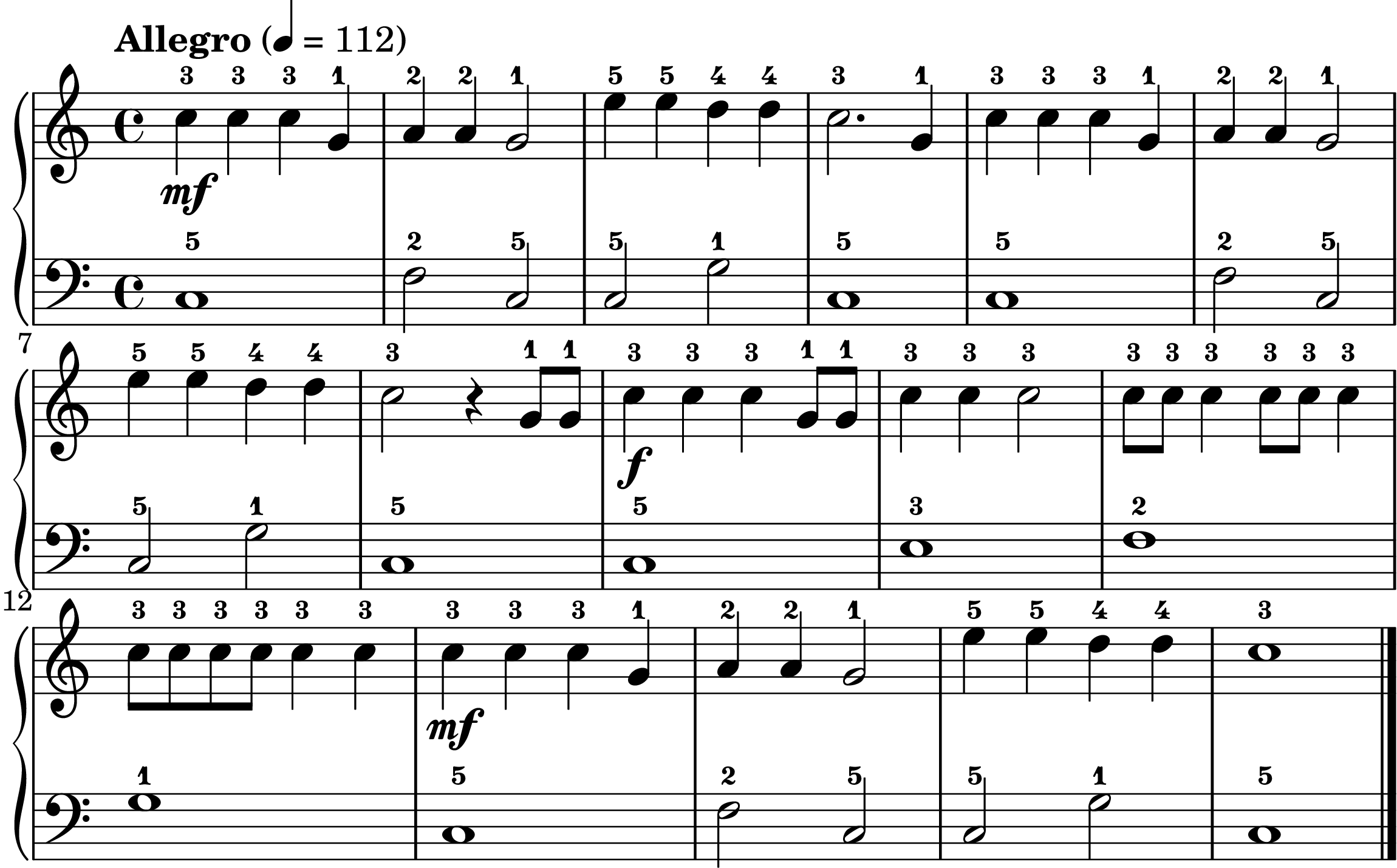
Then play all 16 measures in one go, left hand landing squarely on beat 1 of every measure, first around 90 BPM on the player and then up to the bouncy 112 BPM Allegro.
Note by note: keys and fingering
- Right hand: The Old MacDonald position: thumb (1) on G4, index (2) on A4, then skip the note B so the middle finger (3) sits on C5, the ring finger (4) on D5 and the pinky (5) on E5. The hand opens just a little between fingers 2 and 3 and then never moves for the whole song.
- Left hand: Pinky (5) on C3 with the thumb (1) reaching up to G3 and the index (2) on F3, one or two long notes per measure. In the moo-moo chorus the bass walks up C3, E3, F3, G3 like the farmer climbing his fence, one whole note per measure under fingers 5-3-2-1.
| Note | On the Staff | On the Keyboard | Finger |
|---|---|---|---|
| G4 | Second line of treble staff | Between first two of three black keys | RH Thumb (1) |
| A4 | Second space of treble staff | Between last two of three black keys | RH Index (2) |
| C5 | Third space of treble staff | One octave above middle C | RH Middle (3) |
| D5 | Fourth line of treble staff | Right of C5, between two black keys | RH Ring (4) |
| E5 | Fourth space of treble staff | Right of D5 | RH Pinky (5) |
| C3 | Second space of bass staff | One octave below middle C | LH Pinky (5) |
| E3 | Third space of bass staff | Right of two black keys, below middle C | LH Middle (3) |
| F3 | Fourth line of bass staff | Left of three black keys, below middle C | LH Index (2) |
| G3 | Fourth space of bass staff | Between first two of three black keys | LH Thumb (1) |
Prefer a video? Watch the keys light up
Same color code as the player: green marks the right hand, blue the left hand, with the score and keyboard in one vertical video.
The story behind Old MacDonald
The words of Old MacDonald Had a Farm were first printed in 1917, in a songbook of songs collected from British soldiers, but the tune itself is much older and belongs to the traditional American repertoire. Children everywhere have been filling the farm with their own animals ever since, and that is the secret power of this piece at the piano: play the verse once with a cow, then again with a duck, a pig, or even a dinosaur. The E-I-E-I-O never changes, so your child gets free repetitions of the same five notes without ever getting bored, which is exactly what a first piece should do.
Get the printable PDF
The printable PDF of Old MacDonald Had a Farm - full score, hand positions, and a step-by-step practice guide - ships inside our free Kids pack with big, easy-to-read notes, together with nine other first pieces.
A bouncy verse like this is easier to keep in time when a child sits at the right height, which is exactly what a kids piano bench is built for.
Piano teacher? Track your students' practice. Join the early list
FAQ
How hard is Old MacDonald on piano?
It is an easy piece from our Kids collection: the right hand sits in one five-note position from G4 to E5 and never moves, and the left hand plays only long whole and half notes on C3, E3, F3 and G3. At 16 measures it is a little longer than most first pieces, but half of it is the same verse repeated.
How long does it take to learn Old MacDonald?
Most children play the verse within a few sessions, because the same four measures come back three times. The moo-moo chorus, with its here-a-moo, there-a-moo eighth notes, usually takes a few more days before both hands go together at a comfortable tempo.
What level is Old MacDonald?
It belongs to our Kids collection of first pieces (the same level as our Level 1 pack). One hand position, C major with no black keys, simple whole, half, quarter and eighth notes, and a bright Allegro at 112 BPM once the notes are secure.
What are the notes for Old MacDonald on piano?
The verse starts C5-C5-C5-G, then A-A-G, and E-I-E-I-O is E5-E5-D5-D5-C5. The chorus bounces between C5 and G4, and the left hand plays long C3, F3 and G3 notes, climbing C3-E3-F3-G3 under the moos. Full fingering is in the table above.