
Lacrimosa is the weeping heart of Mozart’s Requiem, left unfinished at his death, and this easy version plays his real melody from the movement’s first eight bars. The interactive player below makes it approachable: hear it at half speed, watch the keys light up, and drag the score to any phrase. Sheet music, fingering and a free PDF follow.
Learn it with the interactive player
- Slow it down: x0.5 or x0.75 while you learn the notes, back to x1 once they flow.
- Pause anywhere: the current keys stay lit so you can find them on your own piano.
- Drag the score left or right, or use the 15s buttons, to replay a phrase.
The sheet music, section by section
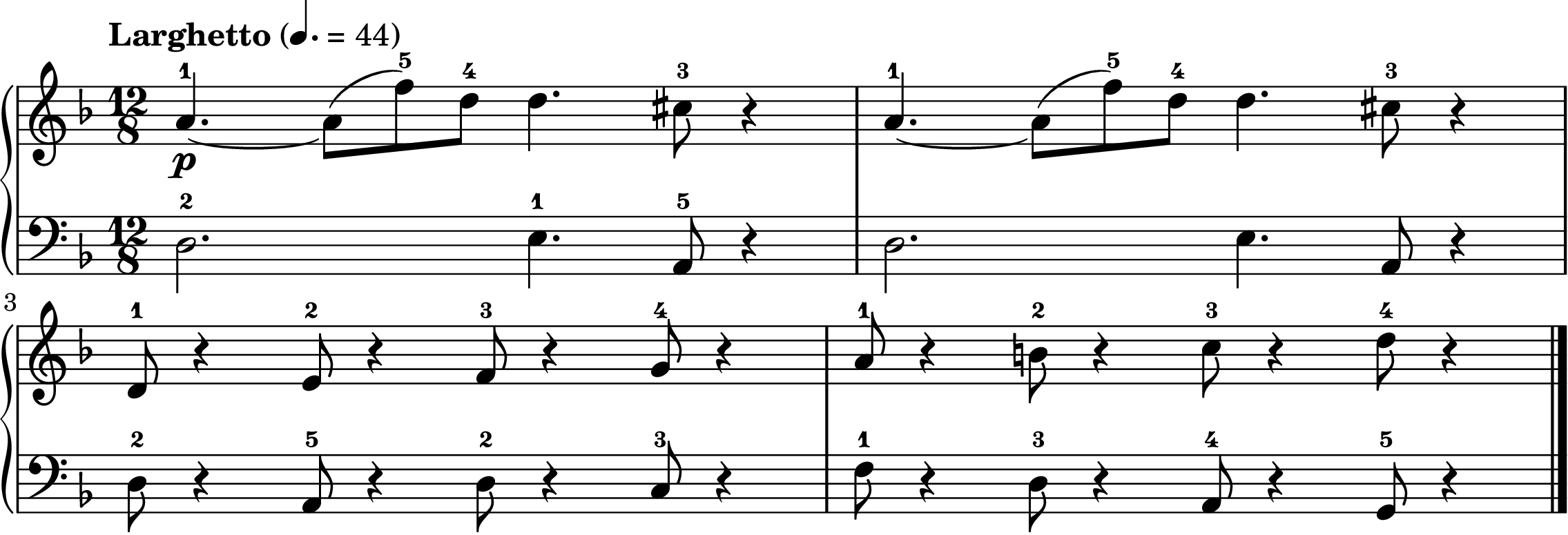
Play Section A at x0.5 on the player: A4 is held across the first beat and one more eighth, then the voice leaps to F5 and sighs down D5, D5, C-sharp 5, twice. In measures 3-4 both hands play one short note per beat, D-E-F-G and then A-B-C-D in the right hand; the eighth-note rests are breaths, so count them.

Section B is Mozart's great crescendo: the right hand climbs by half steps from E-flat 5 to a forte A5 (2-3, thumb under onto F5, then 2-3-4-5) while the left hand slides down C, B-flat, A and B, B-flat, A. Mozart's manuscript stops right after the drop to A4; our final measure only adds a soft D to end on the home note.
The full score
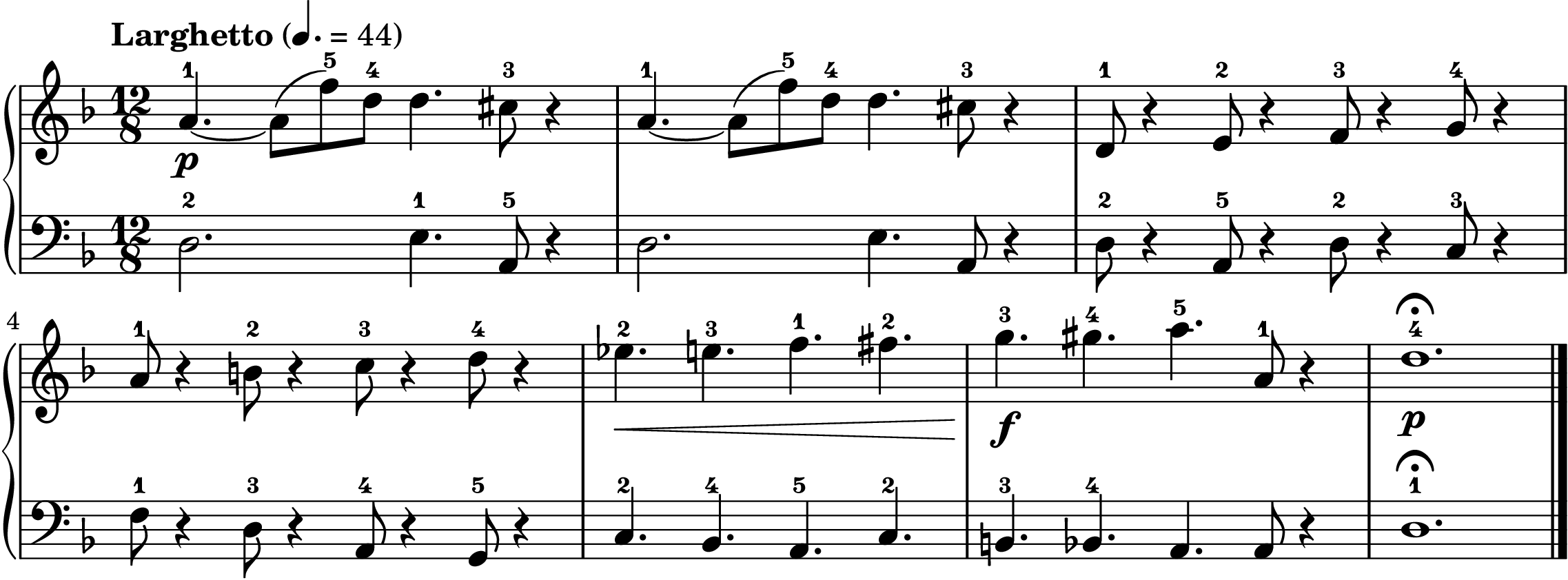
At Larghetto, count each measure as four slow beats (dotted quarter = 44), every beat split in three: that 12/8 rocking is the sound of the Lacrimosa. Play it quietly, let the crescendo in measure 5 grow note by note, and hold the final D under its fermata.
Note by note: keys and fingering
- Right hand: Mozart's soprano line in three hand positions. Thumb on A4 for the sighs: A4 (1), C#5 (3), D5 (4), F5 (5). Thumb on D4 for the rising notes D4, E4, F4, G4 (1-2-3-4), then back to A4 for A4, B4, C5, D5 (1-2-3-4). The climb E-flat 5 (2), E5 (3), thumb under onto F5 (1), then F#5 (2), G5 (3), G#5 (4), A5 (5), dropping to A4 (1) and closing on D5 (4).
- Left hand: Mozart's bass, one single note at a time: index (2) on D3, thumb (1) on E3 and F3, pinky (5) on A2 and G2, middle (3) on C3. In measures 5-6 the hand walks down by half steps: C3 (2), B-flat 2 (4), A2 (5), then B2 (3), B-flat 2 (4), A2 (5).
| Note | On the Staff | On the Keyboard | Finger |
|---|---|---|---|
| A4 | Second space of treble staff | White key between the last two of three black keys | RH Thumb (1) |
| F5 | Top line of treble staff | White key left of the three black keys, an octave above F4 | RH Pinky (5) |
| D5 | Fourth line of treble staff | White key between the two black keys, an octave above D4 | RH Ring (4) |
| C#5 | Third space of treble staff, with a sharp sign | Black key just right of C5 | RH Middle (3) |
| D4 | Just below the bottom line of the treble staff | White key between the two black keys above middle C | RH Thumb (1) |
| B4 | Middle line of treble staff, with a natural sign | White key right of the three black keys above middle C | RH Index (2) |
| Eb5 | Fourth space of treble staff, with a flat sign | Black key just left of E5 | RH Index (2) |
| F#5 | Top line of treble staff, with a sharp sign | Black key just right of F5 | RH Index (2) |
| G#5 | Space above the treble staff, with a sharp sign | Black key just right of G5 | RH Ring (4) |
| A5 | First ledger line above the treble staff | White key an octave above A4 | RH Pinky (5) |
| D3 | Middle line of bass staff | White key between the two black keys below middle C | LH Index (2) |
| E3 | Third space of bass staff | White key right of the two black keys below middle C | LH Thumb (1) |
| A2 | First space of bass staff | White key between the last two of three black keys, two octaves down | LH Pinky (5) |
| G2 | First line of bass staff | White key between the first two of three black keys, two octaves down | LH Pinky (5) |
| Bb2 | Second line of bass staff, with a flat sign | Black key just left of B2 | LH Ring (4) |
| B2 | Second line of bass staff, with a natural sign | White key right of the three black keys, two octaves down | LH Middle (3) |
Prefer a video? Watch the keys light up
Same color code as the player: green marks the right hand, blue the left hand, with the score and keyboard in one vertical video.
The story behind the Lacrimosa
Mozart began his Requiem in D minor, K. 626, in 1791, a commission delivered by an anonymous messenger, and died on December 5 of that year before finishing it. His manuscript of the Lacrimosa breaks off after eight bars. His student Franz Xaver Sussmayr completed the movement and the rest of the Requiem so Mozart's widow Constanze could collect the fee. The Latin words Lacrimosa dies illa mean that day of tears; they close the Dies Irae sequence, the same chant that opens our collection. This arrangement plays Mozart's own soprano melody from bars 3 to 8, in the original D minor and 12/8 time, closed by a single soft D.
Get the printable PDF
The printable PDF of this easy Lacrimosa theme - full score, hand positions, and a step-by-step practice guide - ships inside our free Halloween pack together with fourteen other spooky pieces.
Quiet, expressive phrasing comes easiest when you are seated well, and an Adjustable Piano Bench with Back Support holds you at the right height through every long, soft measure.
Piano teacher? Track your students' practice. Join the early list
FAQ
How hard is Lacrimosa on piano?
The original is written for choir and orchestra, and full piano transcriptions are advanced. This arrangement closes Level 3 of our Halloween collection: Mozart's real soprano melody in D minor and 12/8, three right-hand positions, a half-step climb with one thumb-under, and a single-note left hand that follows Mozart's bass.
How long does it take to learn Lacrimosa?
About two to three weeks at this level. The seven measures come quickly at a slow Larghetto; the real work is counting 12/8 as four slow beats, keeping the eighth-note rests honest in measures 3-4, and making the climb to A5 smooth and gradually louder.
What level is Lacrimosa?
Level 3 of our Halloween collection, the Midnight Classics. It is the expressive summit of the set: compound 12/8 time, many accidentals (C-sharp, B natural, E-flat, F-sharp, G-sharp), position shifts, and a crescendo that only works with real dynamic control.
What are the notes for Lacrimosa?
Mozart's soprano line: A4 held, then F5, D5, D5, C-sharp 5, played twice. Next one short note per beat: D4, E4, F4, G4, A4, B4, C5, D5. Then the climb E-flat 5, E5, F5, F-sharp 5, G5, G-sharp 5, A5, a drop to A4 and the closing D5. The left hand plays Mozart's bass: D3, E3, A2, then D, A, D, C and F, D, A, G, then C, B-flat, A, C and B, B-flat, A, ending on D3. Full table above.