
Gnossienne No. 1 is Satie’s strange, floating miniature, and this simplified A minor version starts with the interactive player below: run it at half speed, watch the notes and keys light up, and drag the score wherever you like. The sheet music, fingering, and a free printable PDF are just after.
Learn it with the interactive player
- Slow it down: x0.5 or x0.75 while you learn the notes, back to x1 once they flow.
- Pause anywhere: the current keys stay lit so you can find them on your own piano.
- Drag the score left or right, or use the 15s buttons, to replay a phrase.
The sheet music, section by section

Set the player to x0.5 for Section A: the melody waits out a half rest, enters on a long E5, and drifts down E5-D5-C5-B4 while the left hand rocks its unchanging A2-E3 ostinato underneath.

Section B brings the answering phrases with their little eighth-note turns, C5-B4-C5 and B4-A4-B4. Keep the turns light and unhurried - Satie wrote no bar lines in the original, so let them float.
The full score
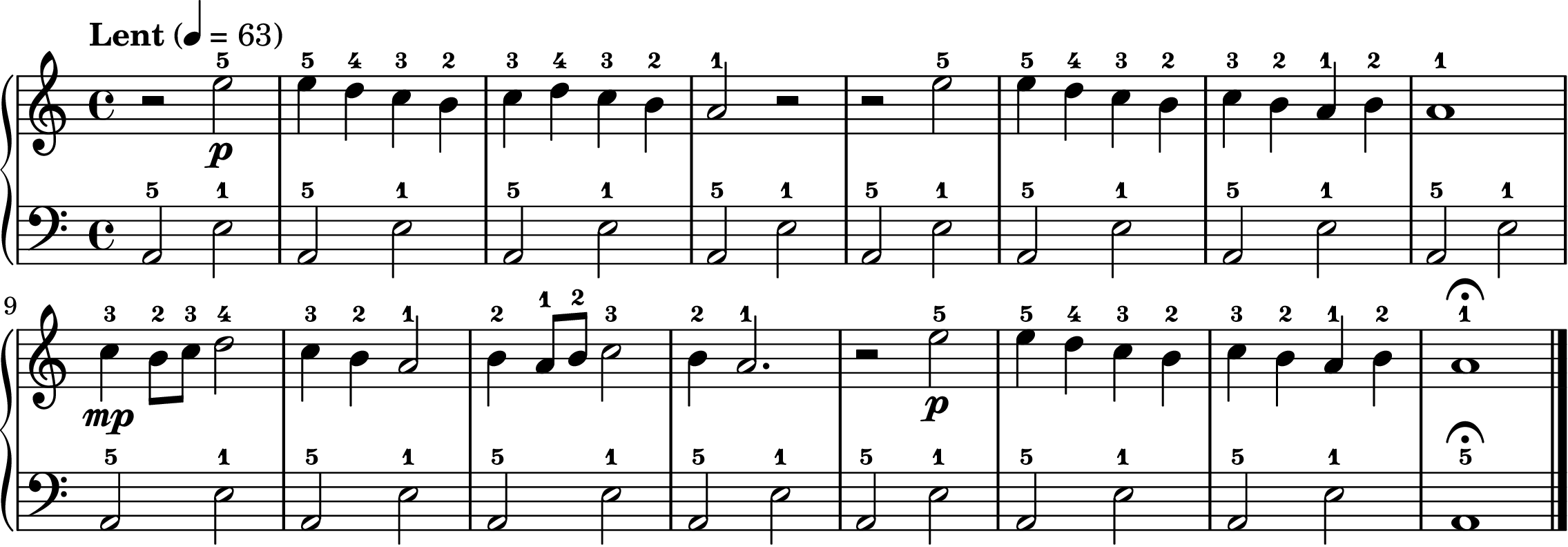
Play the full score as one long trance: the left hand never changes, so pour all your attention into shading the melody quieter and dreamier with each phrase.
Note by note: keys and fingering
- Right hand: One position from A4 to E5 for the entire piece: thumb (1) on A4, then B4 (2), C5 (3), D5 (4), E5 (5). The melody enters on a long E5 after a half rest, and the middle phrases add little eighth-note turns like C5-B4-C5.
- Left hand: A hypnotic two-note ostinato that never changes: pinky (5) on A2, thumb (1) on E3, half notes from the first measure to the last.
| Note | On the Staff | On the Keyboard | Finger |
|---|---|---|---|
| A4 | Second space of treble staff | White key between the last two of three black keys | RH Thumb (1) |
| B4 | Third line of treble staff | White key right of the three black keys | RH Index (2) |
| C5 | Third space of treble staff | White key left of the two black keys above middle C | RH Middle (3) |
| D5 | Fourth line of treble staff | White key between the two black keys above C5 | RH Ring (4) |
| E5 | Fourth space of treble staff | White key right of the two black keys above C5 | RH Pinky (5) |
| A2 | First space of bass staff | White key between the last two of three black keys, two octaves down | LH Pinky (5) |
| E3 | Third space of bass staff | White key right of the two black keys below middle C | LH Thumb (1) |
Prefer a video? Watch the keys light up
Same color code as the player: green marks the right hand, blue the left hand, with the score and keyboard in one vertical video.
The story behind Gnossienne No. 1
Erik Satie composed his first Gnossienne around 1890, a few years after the Gymnopedies, publishing it in 1893. He invented the word gnossienne himself; scholars still argue whether it refers to the palace of Knossos in Crete or to gnostic mysticism. The original score is famous for having no time signature and no bar lines, with instructions like think with great sorrow written above the staff instead of tempo marks. Its modal, Eastern-tinged melody made it a favorite of filmmakers a century later. This simplified version fixes the music in 4/4 over a steady two-note ostinato.
Get the printable PDF
The printable PDF of this simplified Gnossienne No. 1 - full score, hand positions, and a step-by-step practice guide - ships inside our free Halloween pack together with fourteen other spooky pieces.
Trance-like repetition is easier when nothing about your seat distracts you, and an Adjustable Piano Bench with Back Support dials in the height once so you can disappear into the ostinato.
FAQ
How hard is Gnossienne No. 1 on piano?
The original is an intermediate piece, mostly for its rubato and ornaments. This simplified version sits in Level 2 of our Halloween collection: one right-hand position from A4 to E5, an unchanging A2-E3 ostinato in the left hand, and a slow Lent pulse of 63 BPM.
How long does it take to learn Gnossienne No. 1?
One to two weeks for most learners at this stage. The left hand is the same two half notes in every measure, so it becomes automatic within days, leaving all your practice time for the melody and its small eighth-note turns.
What level is Gnossienne No. 1?
We place this arrangement at Level 2 of our Halloween collection, where both hands play throughout. The coordination is friendly because the bass is a pure ostinato - the same A2 to E3 rocking figure repeated for all sixteen measures.
What are the notes for Gnossienne No. 1?
After a half rest the melody enters on E5, then falls E5, D5, C5, B4, turns C5, D5, C5, B4, and rests on A4. The middle phrases add the turns C5-B4-C5 and B4-A4-B4. The left hand repeats A2 and E3 in half notes throughout. The full table is above.