
Level 4: First Classical Pieces
Sign up for free and receive this PDF with 5 pieces directly in your inbox.
Level 4 puts real classical repertoire under your fingers. These are not generic exercises dressed up with famous names – they are simplified but faithful arrangements of pieces by Beethoven, Bach (Petzold), and Schumann. You will learn staccato and legato articulation, musical phrasing, and how to shape dynamics from soft to loud. The left hand takes on more responsibility here, with broken octaves, steady quarter-note bass lines, and the first Alberti bass patterns. This is where you start sounding like a pianist.
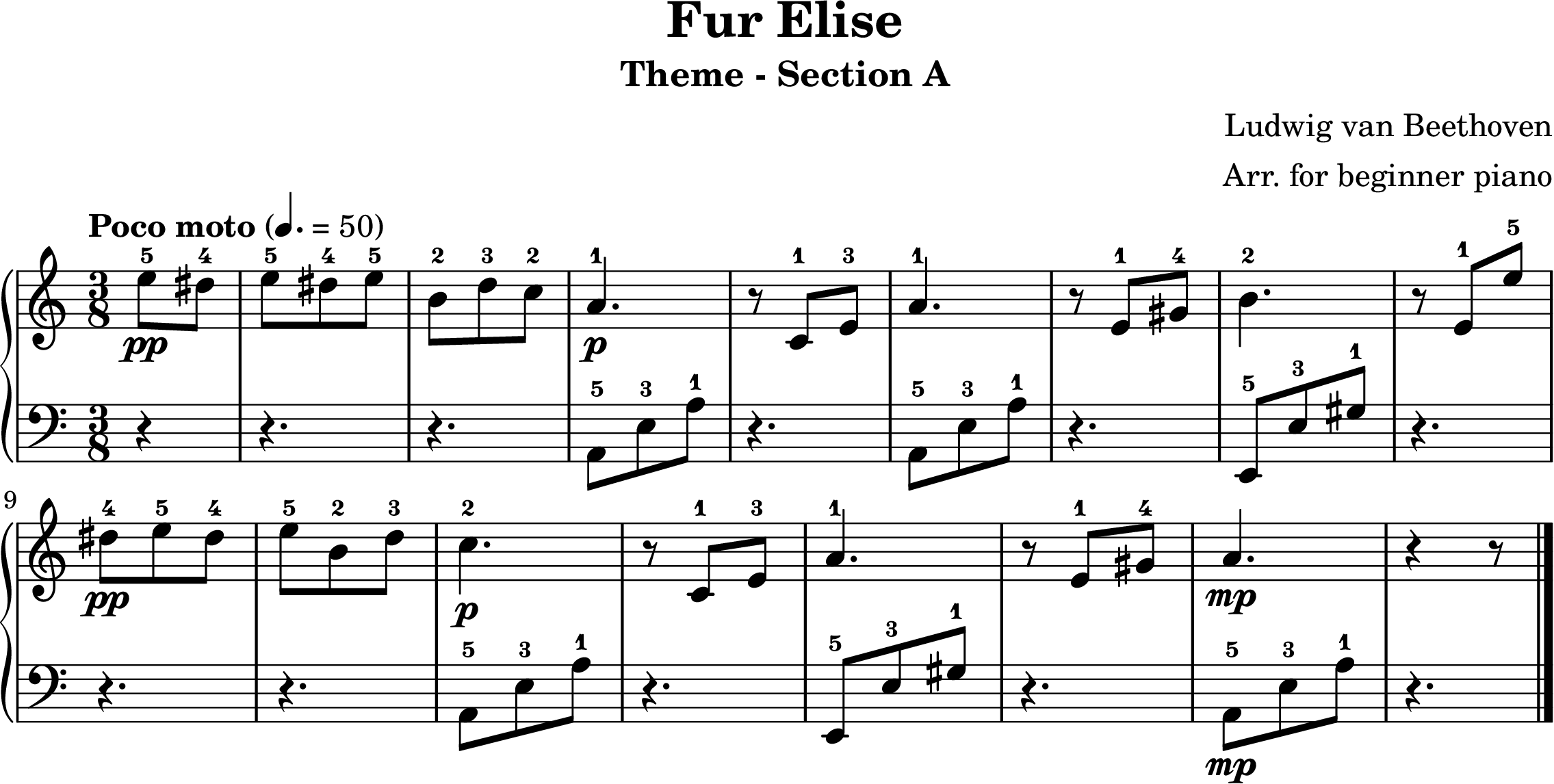
Score Preview
What You’ll Learn at This Level
- Articulation: staccato vs. legato – Soldiers’ March demands crisp, detached staccato notes while Melody asks for smooth, connected legato lines. Learning to switch between these two touch styles gives you control over how each note sounds, not just which note you play.
- Musical phrasing and dynamics – Classical music lives and dies by phrasing. You will learn to shape four-bar and eight-bar phrases with crescendos and decrescendos, making the music breathe like a singer taking breaths between lines.
- Alberti bass and broken octaves – The German Dance introduces the Alberti bass pattern (bottom-top-middle-top) that Mozart, Haydn, and Beethoven used constantly. Fur Elise uses broken octaves in the left hand. These patterns underpin most classical piano music.
What’s Inside – 5 Pieces
Fur Elise Theme
Beethoven | A minor | 3/8 | 24 measures
The most searched beginner piano piece on the internet, and for good reason. The iconic E-D#-E-D#-E pattern uses fingers 3-2-3-2-3 in the right hand, creating a rocking motion that is oddly satisfying to play. The left hand plays broken octaves – a single bass note followed by a higher note – giving the theme its characteristic depth. This is in 3/8 time, meaning three eighth notes per measure, so count “1-2-3” briskly. Start at half tempo and resist the urge to speed up before the notes are clean.
Minuet in G Major
Bach/Petzold | G Major | 3/4 | 32 measures
Long attributed to J.S. Bach, this minuet was actually composed by Christian Petzold and included in the Notebook for Anna Magdalena Bach. It is one of the most elegant beginner pieces ever written. The right hand plays a graceful, flowing melody while the left hand provides steady quarter notes that march underneath. At 32 measures, it is the longest piece in Level 4 and teaches you to sustain focus over a full musical form. Pay attention to phrasing – group notes in four-bar phrases and let the melody breathe at the end of each one.
Soldiers’ March
Schumann | G Major | 2/4 | 16 measures
From Schumann’s Album for the Young (1848), a collection he wrote specifically for his children to play. This piece is all about character. The staccato dots over the notes mean you lift your fingers quickly after each strike, producing a crisp, march-like sound. The 2/4 time signature gives it a military snap. Play with firm, confident fingers and imagine soldiers stepping in time. The contrast between this piece and the legato Melody that follows teaches you how much articulation changes the feel of music.
Melody
Schumann | C Major | 4/4 | 24 measures
Also from Album for the Young, this is the polar opposite of Soldiers’ March. Where that piece was sharp and detached, Melody is smooth and singing. The right hand plays a long, lyrical line that should sound like a voice – connected, expressive, and shaped with gentle dynamics. The left hand holds sustained chords underneath, providing harmonic support without competing. The challenge is keeping the right hand legato while the left hand changes chords. Practice the chord changes separately until they are silent and smooth.
German Dance in C Major
Beethoven | C Major | 3/4 | 16 measures
Beethoven wrote dozens of German Dances for social gatherings in Vienna. This one introduces the Alberti bass pattern in the left hand – a broken chord that rolls bottom-top-middle-top repeatedly. The Alberti bass is one of the most important patterns in classical piano: Mozart used it constantly, and you will encounter it in nearly every sonata you play later. The right hand carries a cheerful waltz melody above. Focus on making the left hand pattern even and quiet so the melody can sing on top.
How to Practice Level 4
- Isolate the left hand patterns. The broken octaves in Fur Elise and the Alberti bass in German Dance are new motor skills for your left hand. Practice them as standalone exercises – ten repetitions of the pattern at a slow tempo – before playing the full piece. Your left hand needs to work on autopilot so your brain can focus on the melody.
- Exaggerate the staccato and legato. When learning Soldiers’ March, make the staccato extra short and bouncy. When learning Melody, make the legato extra smooth and connected. Exaggeration in practice leads to clarity in performance. You can always dial it back later.
- Listen to recordings of these pieces. Search for Fur Elise, Minuet in G, or Soldiers’ March on any streaming platform. Hearing how professionals phrase and shape these melodies gives your brain a target to aim for. You are not copying them – you are training your ear to recognize what good phrasing sounds like.
- Use the sustain pedal sparingly. Level 4 is the first time the pedal becomes relevant, especially in Fur Elise. But do not use it to cover up sloppy playing. Learn each piece cleanly without pedal first, then add a touch of pedal only where the arrangement indicates it.
Every Piece Includes
Real Sheet Music
Professionally engraved with treble and bass clef.
Fingering Guide
Every note mapped to the correct finger.
Practice Steps
Right hand, left hand, then hands together.
Classical pieces demand longer, more focused practice sessions. A good piano bench makes a real difference when you are spending 30 minutes or more at the keys. If you are still using a dining chair or a wobbly stool, our guide on the best piano bench for beginners covers what to look for. And when you are ready for all five levels of free sheet music, visit our complete collection.
Browse Other Levels
First Steps | Fluent Separate Hands | Simple Hands Together | Advanced Beginner