
The Toccata in D minor opens with the most famous organ cry in music, and the interactive player below puts it under your fingers: hear it at half speed, watch the notes and keys light up, and drag the score between statements. The easy sheet music, fingering, and a free printable PDF follow.
Learn it with the interactive player
- Slow it down: x0.5 or x0.75 while you learn the notes, back to x1 once they flow.
- Pause anywhere: the current keys stay lit so you can find them on your own piano.
- Drag the score left or right, or use the 15s buttons, to replay a phrase.
The sheet music, section by section
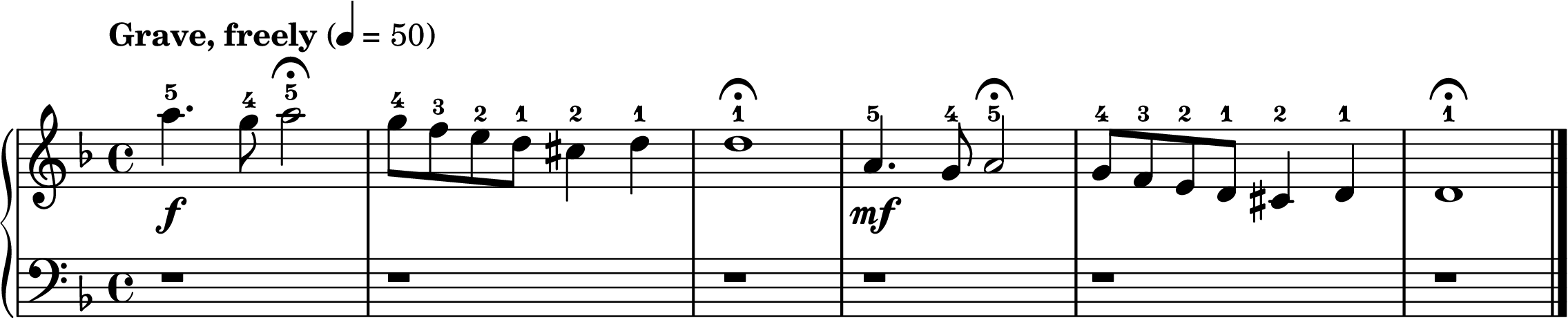
Set the player to x0.5 for Section A: the cry is A-G-A held under a fermata, answered by the tumbling run G-F-E-D, C sharp, D. It comes first from A5, then repeats identically an octave lower from A4 - same fingers, new position.

In Section B the left hand alone takes the third statement, deep from A2 down to D2, before both hands build the quiet D minor cadence. Let every fermata breathe - Bach marked this music free, not metronomic.
The full score
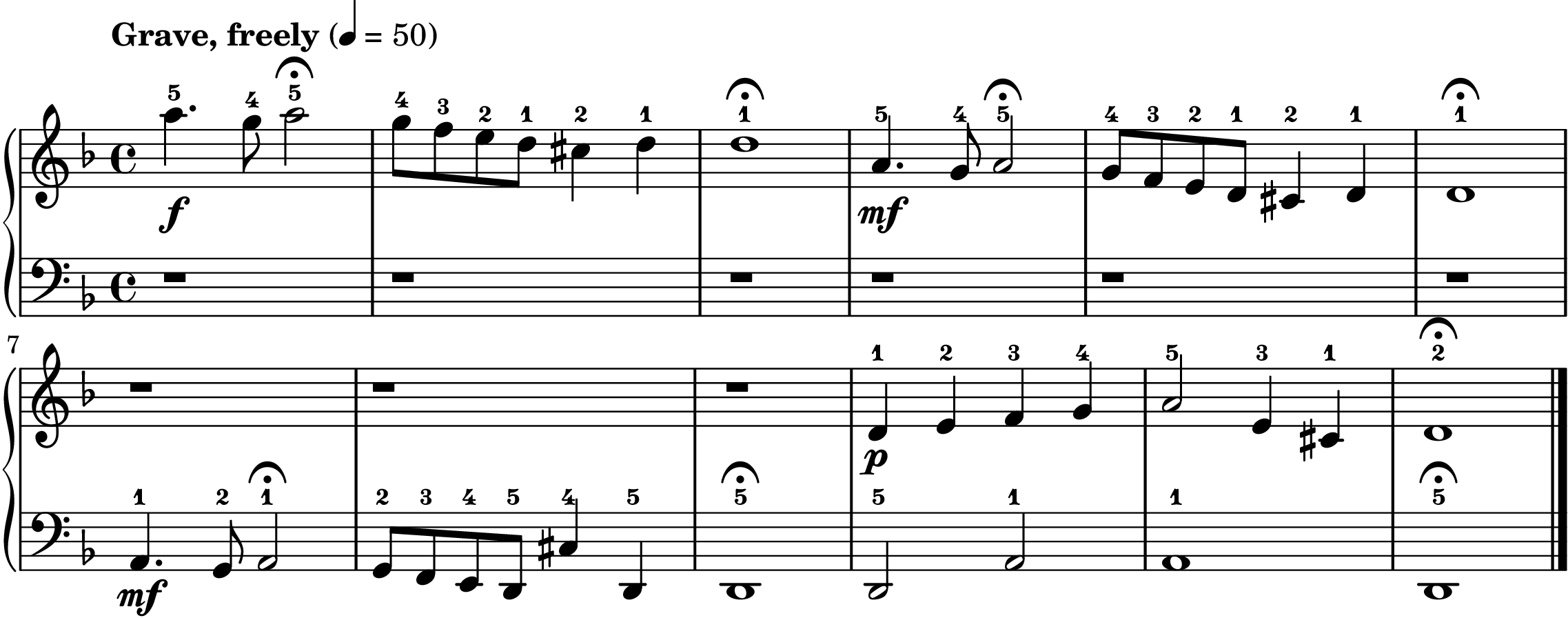
The full score is only twelve measures: play it like an improvising organist, pausing on each held note until the echo fades, then releasing the next run.
Note by note: keys and fingering
- Right hand: Three statements of the A-G-A cry, each an octave lower. The high one starts with the pinky (5) on A5, and the descending run G5-F5-E5-D5 rolls down fingers 4-3-2-1, with C#5 under 2. The middle statement repeats the identical shape from A4, and the closing phrase climbs D4 (1) up to A4 (5).
- Left hand: Silent under the first two cries, then it takes the third statement itself: thumb (1) on A2, rolling down G2 (2), F2 (3), E2 (4) to D2 under the pinky (5), before the final single D and A anchors.
| Note | On the Staff | On the Keyboard | Finger |
|---|---|---|---|
| A5 | First ledger line above the treble staff | White key between the last two of three black keys, an octave above A4 | RH Pinky (5) |
| G5 | Space just above the top line of the treble staff | White key between the first two of three black keys, an octave above G4 | RH Ring (4) |
| F5 | Fifth line of treble staff | White key left of the three black keys above C5 | RH Middle (3) |
| E5 | Fourth space of treble staff | White key right of the two black keys above C5 | RH Index (2) |
| D5 | Fourth line of treble staff | White key between the two black keys above C5 | RH Thumb (1) |
| C#5 | Third space of treble staff, with a sharp sign | Black key right of C5 | RH Index (2) |
| A2 | First space of bass staff | White key between the last two of three black keys, two octaves down | LH Thumb (1) |
| G2 | First line of bass staff | White key between the first two of three black keys, two octaves down | LH Index (2) |
| F2 | Space just below the bottom line of the bass staff | White key left of the three black keys, two octaves below middle C | LH Middle (3) |
| E2 | First ledger line below the bass staff | White key right of the two black keys, two octaves below middle C | LH Ring (4) |
| D2 | Below the first ledger line under the bass staff | White key between the two black keys, two octaves below middle C | LH Pinky (5) |
| C#3 | Second space of bass staff, with a sharp sign | Black key right of C3 | LH Ring (4) |
Prefer a video? Watch the keys light up
Same color code as the player: green marks the right hand, blue the left hand, with the score and keyboard in one vertical video.
The story behind the Toccata in D minor
The Toccata and Fugue in D minor, BWV 565, is attributed to Johann Sebastian Bach, who died in 1750, though the earliest surviving copy is in another hand and some scholars still debate its authorship. Likely composed early in Bach's career, possibly during his years in Arnstadt around 1704, it opens with a bare octave flourish that plunges down the keyboard - music so theatrical it barely sounds baroque. Its spooky reputation is a modern invention: silent-film organists adopted it for horror pictures, and the 1931 film Dracula and Disney's Fantasia in 1940 sealed the association forever. This arrangement keeps the three opening cries and the final cadence.
Get the printable PDF
The printable PDF of this easy Toccata opening - full score, hand positions, and a step-by-step practice guide - ships inside our free Halloween pack together with fourteen other spooky pieces.
Reaching from A5 down to a growling D2 means using the whole keyboard, and an Adjustable Piano Bench with Back Support centers you at the right height to command both extremes.
FAQ
How hard is the Toccata in D minor on piano?
The complete organ work is virtuoso repertoire. This opening-only arrangement sits in Level 3 of our Halloween collection: each hand plays one statement of the same five-finger shape, the tempo is a free Grave around 50 BPM, and the fermatas remove all time pressure.
How long does it take to learn the Toccata in D minor?
The twelve measures of this arrangement come together in one to two weeks. Because all three statements share the same A-G-A cry and descending run, you learn one gesture and then relocate it - first an octave lower, then into the left hand.
What level is the Toccata in D minor?
Level 3 of our Halloween collection. It asks for octave relocations across the keyboard, a low bass reach down to D2, the accidental C sharp inside the key of D minor, and the maturity to hold fermatas - skills that fit the Midnight Classics.
What are the notes for the Toccata in D minor?
Each cry is A, G, A held long, answered by the run G, F, E, D, C sharp, D. It sounds first from A5, then from A4, then in the left hand from A2 down to a deep D2. The closing phrase climbs D4, E4, F4, G4 to A4 and settles on D. The full table is above.