
Lightly Row is the gentle German folk song that teaches smooth, connected playing, and you can learn it right here: press play on the interactive player to hear it at half speed while the notes and keys light up, then drag the score to move around. Sheet music, fingering, and a free printable PDF follow below.
Learn it with the interactive player
- Slow it down: x0.5 or x0.75 while you learn the notes, back to x1 once they flow.
- Pause anywhere: the current keys stay lit so you can find them on your own piano.
- Drag the score left or right, or use the 15s buttons, to replay a phrase.
The sheet music, section by section

Read Section A with the player set to x0.5: each phrase starts high and steps down - G-E-E, F-D-D, then C-D-E-F-G-G-G - so aim for true legato, keeping every note ringing until the next one starts.

Section B mirrors the first half but resolves down to C instead of ending on G. Give special care to that final settling measure - the piece should land peacefully on the home note.
The full score
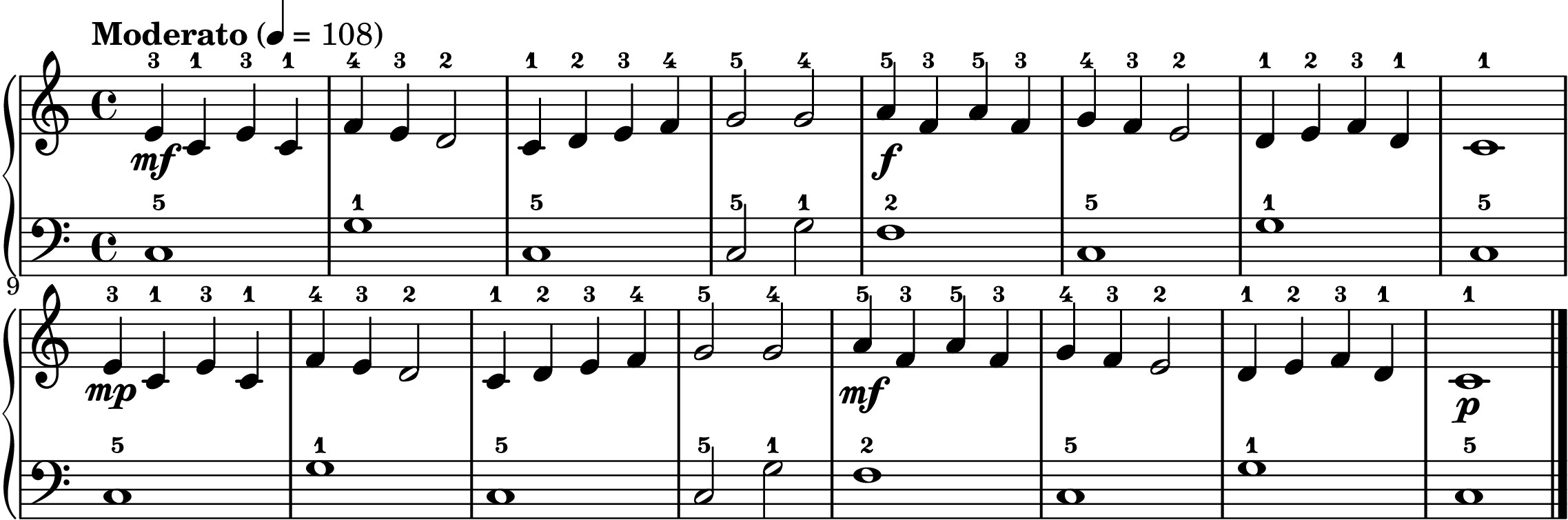
Play the full score at 60 BPM first - both hands move in quarter notes - and remember this piece is about tone quality, not speed, on the way to the 100 BPM target.
Note by note: keys and fingering
- Right hand: C4, D4, E4, F4, G4 - Standard C position. Focus on smooth legato connections between notes.
- Left hand: C3, E3, G3 - Pinky on C3, middle on E3, thumb on G3. Broken chord accompaniment.
| Note | On the Staff | On the Keyboard | Finger |
|---|---|---|---|
| C4 (Middle C) | One ledger line below treble staff | White key left of two black keys, center | RH Thumb (1) |
| D4 | Just below bottom line of treble staff | Between the two black keys | RH Index (2) |
| E4 | On the bottom line of treble staff | Right of two black keys | RH Middle (3) |
| F4 | First space of treble staff | Left of three black keys | RH Ring (4) |
| G4 | Second line of treble staff | Between first two of three black keys | RH Pinky (5) |
| C3 | Two ledger lines below bass staff | One octave below middle C | LH Pinky (5) |
| E3 | Fourth line of bass staff | Right of two black keys, below middle C | LH Middle (3) |
| G3 | Top line of bass staff | Between first two of three black keys | LH Thumb (1) |
Prefer a video? Watch the keys light up
Same color code as the player: green marks the right hand, blue the left hand, with the score and keyboard in one vertical video.
The story behind Lightly Row
Lightly Row is a German folk tune known at home as Hanschen klein, or Little Hans, a song about a boy who sets out into the wide world and comes home to his mother. The melody spread through nineteenth-century German songbooks and crossed into English with new words about rowing a boat over the water. Shinichi Suzuki placed it near the very beginning of his method books, and since the 1960s millions of children have met it as one of their first real pieces. Its predictable phrase structure and gentle, flowing melody make it ideal for developing smooth, connected legato playing at the piano.
Get the printable PDF
The printable PDF of Lightly Row - full score, hand positions, and a step-by-step practice guide - ships inside our free Level 2 pack together with four other beginner favorites.
Legato comes easier to a child who is not perched on an adult seat, so consider a Classic Piano Bench for kids for the right height and a piano pedal extender to keep small feet grounded.
FAQ
How hard is Lightly Row on piano?
It is an easy Level 2 piece. The right hand stays in the standard C position from C4 to G4, and the left hand plays a repeating C-E-G broken chord in quarter notes. The real work is not the notes but the touch: the piece is a study in smooth, connected legato playing.
How long does it take to learn Lightly Row?
Most beginners read through the melody within a few days, since measures 5 to 8 largely repeat measures 1 to 4 with a different ending. Hands together at 60 BPM typically takes a week or so, and the 100 BPM Moderato target follows once the broken-chord left hand feels automatic.
What level is Lightly Row?
It sits in the Level 2 pack of our free sheet collection, and it holds a similar early spot in the Suzuki method books. One hand position, quarter-note rhythms, and a repeating broken-chord accompaniment make it the ideal bridge between single-line melodies and true hands-together playing.
What are the notes for Lightly Row on piano?
Each phrase starts high and steps down: G-E-E, F-D-D, then C-D-E-F-G-G-G. The second half repeats the shape but resolves to C in the final measure. The left hand plays a C-E-G broken chord that repeats identically every two measures. The full table with fingering is above.