
Danse Macabre is Saint-Saens’s waltz of skeletons dancing at midnight, and the interactive player below gets you started: hear the fiddler’s tune at half speed, watch the notes and keys light up, and drag the score to loop any phrase. Sheet music, fingering, and a free printable PDF follow.
Learn it with the interactive player
- Slow it down: x0.5 or x0.75 while you learn the notes, back to x1 once they flow.
- Pause anywhere: the current keys stay lit so you can find them on your own piano.
- Drag the score left or right, or use the 15s buttons, to replay a phrase.
The sheet music, section by section

Take Section A at x0.5 on the player: the fiddler's waltz falls E5-D5, C5-B4, then swirls C5-D5-C5 back to a long A4 - fingers 5-4-3-2-1 in order, one per key, while the left hand keeps the oom-pah-pah going.

Section B hides a treat: it quotes the medieval Dies Irae chant, C5-B4, C5-A4, B4-G4, the same melody that opens this collection, before the waltz returns fortissimo and closes through G sharp 4. Feel the hand shift down for the quote.
The full score
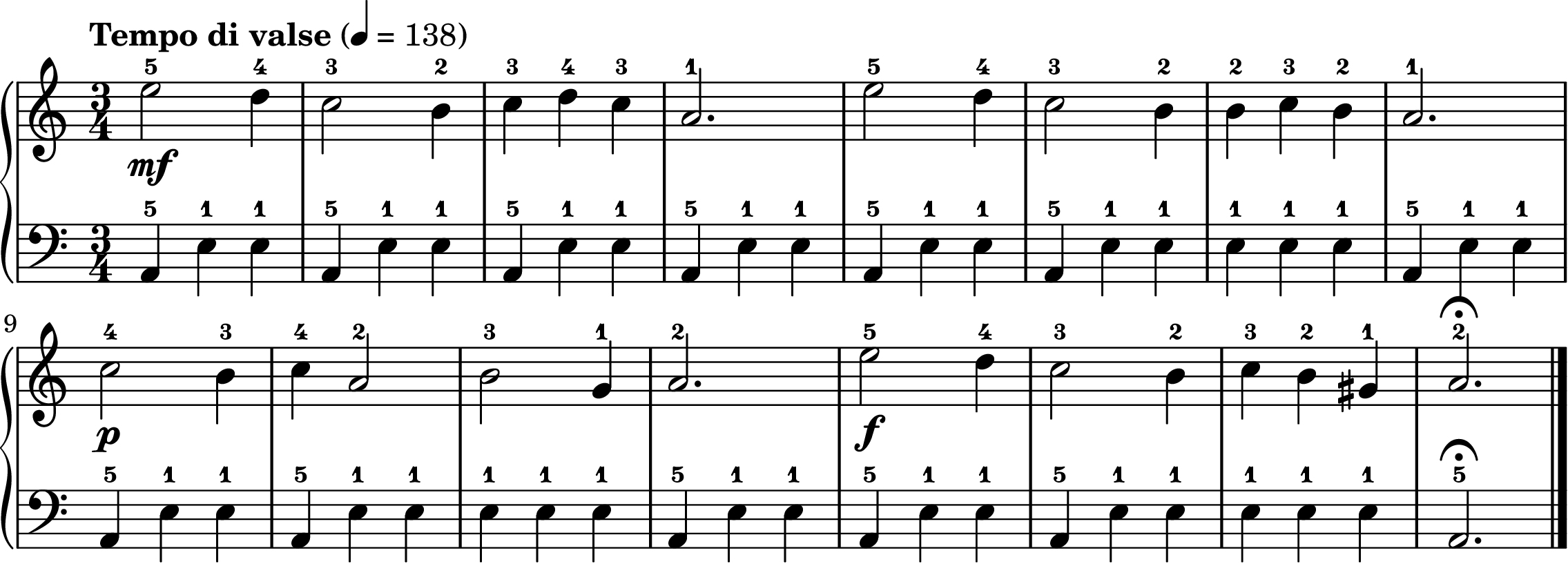
Tempo di valse at 138 BPM sounds fast, but it is one beat per measure in feel: keep the full score light and lilting, a dance for bones rather than boots.
Note by note: keys and fingering
- Right hand: The waltz theme falls E5-D5-C5-B4 under fingers 5-4-3-2 with the thumb (1) on A4. For the Dies Irae quote in Section B the hand shifts down one step, putting G4 under the thumb (1) and C5 under the ring finger (4); the closing cadence touches G#4 with the thumb.
- Left hand: A waltz bass with single notes only: pinky (5) plays A2 on beat one, thumb (1) repeats E3 on beats two and three.
| Note | On the Staff | On the Keyboard | Finger |
|---|---|---|---|
| E5 | Fourth space of treble staff | White key right of the two black keys above C5 | RH Pinky (5) |
| D5 | Fourth line of treble staff | White key between the two black keys above C5 | RH Ring (4) |
| C5 | Third space of treble staff | White key left of the two black keys above middle C | RH Middle (3) |
| B4 | Third line of treble staff | White key right of the three black keys | RH Index (2) |
| A4 | Second space of treble staff | White key between the last two of three black keys | RH Thumb (1) |
| G4 | Second line of treble staff | White key between the first two of three black keys | RH Thumb (1) |
| G#4 | Second line of treble staff, with a sharp sign | Black key right of G4 | RH Thumb (1) |
| A2 | First space of bass staff | White key between the last two of three black keys, two octaves down | LH Pinky (5) |
| E3 | Third space of bass staff | White key right of the two black keys below middle C | LH Thumb (1) |
Prefer a video? Watch the keys light up
Same color code as the player: green marks the right hand, blue the left hand, with the score and keyboard in one vertical video.
The story behind Danse Macabre
Camille Saint-Saens composed Danse Macabre in 1874 as a tone poem for orchestra, based on a poem by Henri Cazalis in which Death plays the fiddle at midnight and skeletons dance until the rooster crows at dawn. A solo violin, deliberately mistuned, plays Death's waltz, a xylophone rattles like bones, and midway through Saint-Saens slyly quotes the medieval Dies Irae chant in waltz time. Parisian audiences found it shocking in 1875; today it is the most beloved piece of Halloween concert music. Our arrangement keeps the waltz theme and the chant quote in A minor, with a strict single-note waltz bass.
Get the printable PDF
The printable PDF of this easy Danse Macabre theme - full score, hand positions, and a step-by-step practice guide - ships inside our free Halloween pack together with fourteen other spooky pieces.
Waltz bass patterns settle in faster when you sit at the right height, and an Adjustable Piano Bench with Back Support lets you match the bench to your keyboard before the skeletons start dancing.
FAQ
How hard is Danse Macabre on piano?
The orchestral original and its virtuoso piano transcriptions are advanced repertoire. This theme arrangement belongs to Level 3 of our Halloween collection: a brisk waltz at 138 BPM with a one-step hand shift for the Dies Irae quote and a single-note waltz bass throughout.
How long does it take to learn Danse Macabre?
Around two to three weeks at this level. The falling waltz theme comes quickly because the fingers descend in order, 5-4-3-2. Most of the practice time goes to the left-hand waltz pattern and to keeping the quote section relaxed during the position shift.
What level is Danse Macabre?
Level 3 of our Halloween collection, the Midnight Classics. The tempo is the fastest in the collection, and the piece asks for two hand positions, one accidental on G sharp 4, and an independent oom-pah-pah bass - solid third-level skills.
What are the notes for Danse Macabre?
The waltz falls E5, D5, C5, B4, then C5, D5, C5, A4. The Dies Irae quote runs C5, B4, C5, A4, B4, G4, A4, and the final phrase closes E5, D5, C5, B4, C5, B4, G sharp 4, A4. The left hand plays A2 on beat one and E3 on beats two and three. Full table above.