
Now Thank We All Our God is the great thanksgiving chorale, and this easy C major arrangement is built around the interactive player below: hear it at half speed, watch the notes and keys light up, and drag the score to repeat any phrase. The sheet music, fingering for both hands, and a free printable PDF come next.
Learn it with the interactive player
- Slow it down: x0.5 or x0.75 while you learn the notes, back to x1 once they flow.
- Pause anywhere: the current keys stay lit so you can find them on your own piano.
- Drag the score left or right, or use the 15s buttons, to replay a phrase.
The sheet music, section by section

Set the player to x0.5 for Section A (measures 1-8): two identical phrases, each starting on a half-note upbeat G4, rise to A4 on all our, sink down the scale F4-E4-D4-C4 with 5-4-3-2, and cadence B3 to C4 under a fermata. The bass answers with repeated C3s, a dip to low F2, and the walking line A2-C3-D3-E3.

Section B (measures 9-16) shifts the thumb to D4 for phrase 3, which climbs E4-G4-G4 through one black key, F sharp, to a fermata on G4. Phrase 4 is the grand ending: countless gifts of love falls from A4, and the bass walks up D3-E3-F3-G3 before both hands settle on a whole-note C under the final fermata.
The full score
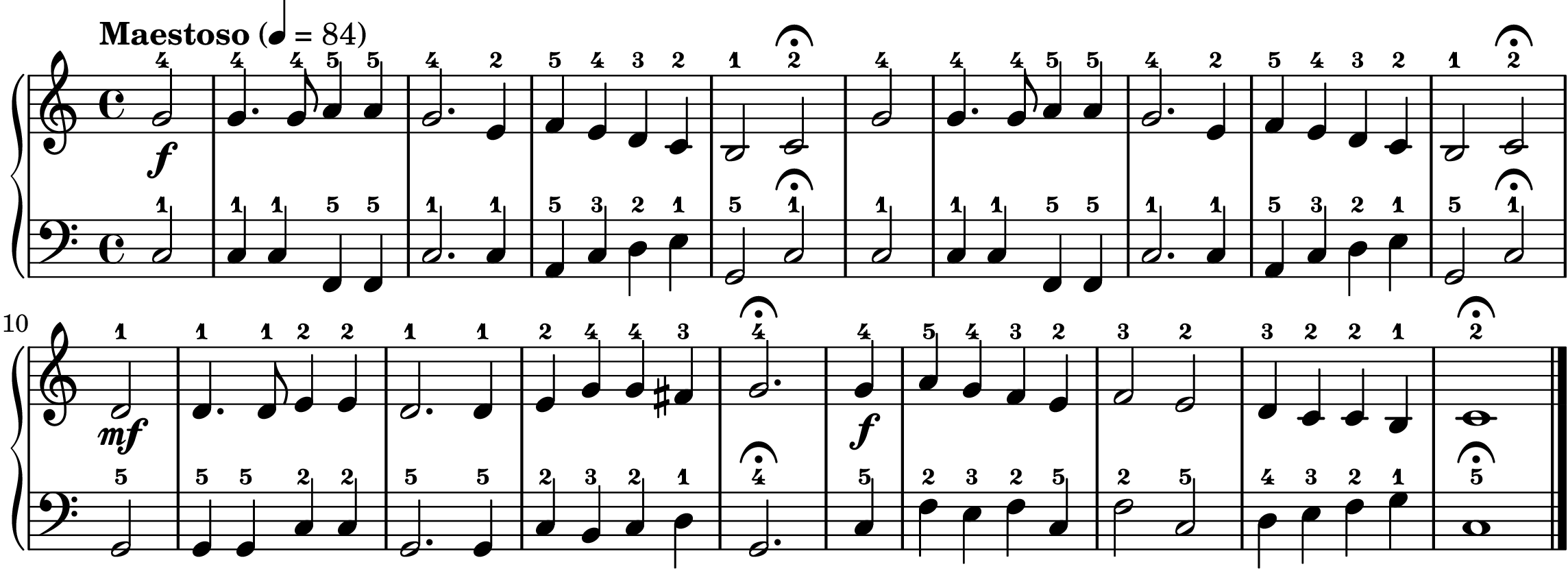
In the full score, play hands together at 60 BPM one beat at a time, freeze on every fermata for about two extra beats, breathe, and continue; the target is a majestic 84 BPM with a broad final measure.
Note by note: keys and fingering
- Right hand: A compact hand between B3 and A4: phrases 1, 2 and 4 keep the ring finger (4) on G4 and the pinky (5) on A4, with the thumb (1) reaching down to B3 at cadences; phrase 3 shifts the thumb to D4 and touches one black key, F sharp 4, with the middle finger (3).
- Left hand: A true chorale bass in single notes: the thumb (1) repeats C3 with the pinky (5) dipping to low F2, a walking line A2-C3-D3-E3 with 5-3-2-1 into each cadence, and a final climb D3-E3-F3-G3 with 4-3-2-1 into the last measure.
| Note | On the Staff | On the Keyboard | Finger |
|---|---|---|---|
| B3 | Below the ledger line under the staff | White key left of middle C | RH Thumb (1) |
| C4 | Ledger line below treble staff | Middle C | RH Index (2) |
| D4 | Just below the bottom line | Right of middle C, between two black keys | RH Middle (3) |
| E4 | Bottom line of treble staff | Right of the two black keys near middle C | RH Index (2) |
| F4 | First space of treble staff | Left of three black keys | RH Pinky (5) |
| F#4 | First space, with a sharp sign | First of the three black keys | RH Middle (3) |
| G4 | Second line of treble staff | Between first two of three black keys | RH Ring (4) |
| A4 | Second space of treble staff | Between last two of three black keys | RH Pinky (5) |
| F2 | Below the bottom line of bass staff | Two octaves below middle C, left of three black keys | LH Pinky (5) |
| G2 | Bottom line of bass staff | Two octaves below middle C, between first two of three black keys | LH Pinky (5) |
| A2 | Bottom space of bass staff | Two octaves below middle C, after three black keys | LH Pinky (5) |
| B2 | Second line of bass staff | Right of three black keys, below C3 | LH Middle (3) |
| C3 | Second space of bass staff | One octave below middle C | LH Thumb (1) |
| D3 | Third line of bass staff | Between the two black keys below middle C | LH Index (2) |
| E3 | Third space of bass staff | Right of two black keys, below middle C | LH Thumb (1) |
| F3 | Fourth line of bass staff | Left of three black keys, below middle C | LH Index (2) |
| G3 | Fourth space of bass staff | Between first two of three black keys, below middle C | LH Thumb (1) |
Prefer a video? Watch the keys light up
Same color code as the player: green marks the right hand, blue the left hand, with the score and keyboard in one vertical video.
The story behind Now Thank We All Our God
Martin Rinkart was a pastor in the walled town of Eilenburg during the Thirty Years' War, burying dozens of plague victims a day, and still he wrote Nun danket alle Gott, a table grace of pure gratitude, around 1636. Johann Crueger gave it this sturdy melody in 1647, and Catherine Winkworth's 1856 translation made it the great thanksgiving chorale of England and America. Germans call it their Te Deum: it has been sung at peace treaties, harvest festivals and Thanksgiving tables for nearly four centuries. The fermatas at the end of every phrase are original chorale style, so hold them like a congregation taking a breath, and keep the bass a little softer than the melody, like an organ pedal under a choir.
Get the printable PDF
The printable PDF of Now Thank We All Our God - full score, hand positions, and a step-by-step practice guide - ships inside our free Thanksgiving pack together with fourteen other Thanksgiving pieces.
Playing a chorale with an organ-like, unhurried touch starts with a seat that is neither too high nor too low, and an Adjustable Piano Bench with Back Support lets you dial that in exactly.
Piano teacher? Track your students' practice. Join the early list
FAQ
How hard is Now Thank We All Our God on piano?
It is a Level 2 piece in our Thanksgiving collection. The right hand stays in a compact span from B3 to A4 with one black key, F sharp, in measure 11, and the left hand plays a real chorale bass in single notes from F2 to G3, including short walking lines into each cadence.
How long does it take to learn Now Thank We All Our God?
Two to three weeks. Phrases 1 and 2 are identical, so half the piece comes quickly; the walking bass lines in measures 3, 11 and 15 and the fermata pacing take a few sessions of slow hands-together practice.
What level is Now Thank We All Our God?
Level 2 of our Thanksgiving collection. It introduces a moving single-note bass, pickup bars before each phrase, one black key under the middle finger, and fermatas that both hands must hold together.
What are the notes for Now Thank We All Our God?
The melody starts on a half-note upbeat G4, then G4, G4, A4, A4, G4, E4, and walks down F4, E4, D4, C4 to the cadence B3, C4. Phrase 3 begins on D4: D4, D4, E4, E4, D4, D4, E4, G4, G4, F sharp 4, G4. The left hand repeats C3, dips to F2, and walks A2-C3-D3-E3 into the cadences. The full note-by-note table is above.