
Aase’s Death is Grieg’s quiet farewell from Peer Gynt, and this easy A minor version plays his real melody. Start with the interactive player below at half speed; the notes and keys light up as it plays, and you can drag the score back to any phrase. Sheet music, fingering, and a free printable PDF follow.
Learn it with the interactive player
- Slow it down: x0.5 or x0.75 while you learn the notes, back to x1 once they flow.
- Pause anywhere: the current keys stay lit so you can find them on your own piano.
- Drag the score left or right, or use the 15s buttons, to replay a phrase.
The sheet music, section by section

Play Section A at x0.5 on the player. These are Grieg's first four bars, in longer notes: the melody rises E4-A4 to a held B4, twice, then turns C5-B4, A4-B4-C5, D5-C5 and comes to rest on a long B4. Use the held B4 in measure 4 to move the hand up, thumb on A4 from measure 5.

Section B is Grieg's next four bars, pianissimo. It opens with the same E4-A4-B4 call, twice, but the left hand now drops to a low F2 under each held B4. Then the line climbs higher than before: D5-C5, B4-C5-D5, down to G sharp 4, the only sharp in the piece, and a long A4 under the fermata.
The full score
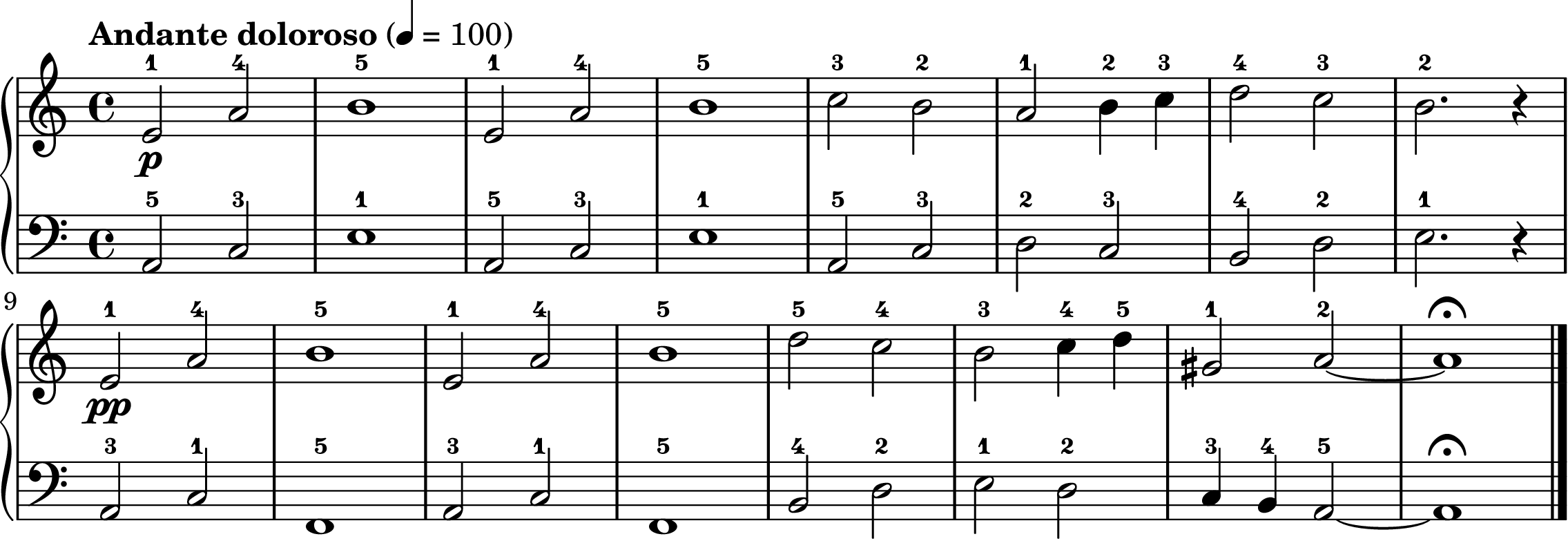
Andante doloroso means a slow walk full of grief. Grieg wrote it in B minor; here every note value is doubled, so 100 BPM still feels slow and broad. Sixteen measures, no eighth notes: hold each long note its full value and keep it soft to the end.
Note by note: keys and fingering
- Right hand: Three five-finger positions and no stretches. Measures 1-4 and 9-12: thumb (1) on E4, A4 under the ring finger (4), B4 under the pinky (5). Measures 5-8: the thumb moves up to A4, so B4 is 2, C5 is 3 and D5 is 4. Measures 13-16: thumb on G sharp 4, then A4 (2), B4 (3), C5 (4), D5 (5). The table shows the finger each note gets most often.
- Left hand: Single notes, never faster than a half note. Measures 1-8 and 13-16: pinky (5) on A2, ring (4) on B2, middle (3) on C3, index (2) on D3, thumb (1) on E3. In measures 9-12 the hand moves down: pinky (5) on a low F2, middle (3) on A2, thumb (1) on C3. The last bars walk C3-B2-A2 with 3-4-5.
| Note | On the Staff | On the Keyboard | Finger |
|---|---|---|---|
| E4 | Bottom line of treble staff | White key right of the two black keys above middle C | RH Thumb (1) |
| A4 | Second space of treble staff | White key between the last two of three black keys | RH Ring (4) |
| B4 | Third line of treble staff | White key right of the three black keys | RH Pinky (5) |
| C5 | Third space of treble staff | White key left of the two black keys above middle C | RH Middle (3) |
| D5 | Fourth line of treble staff | White key between the two black keys above C5 | RH Ring (4) |
| G#4 | Second line of treble staff, with a sharp sign | Middle black key of the three | RH Thumb (1) |
| A2 | First space of bass staff | White key between the last two of three black keys, two octaves down | LH Pinky (5) |
| B2 | Second line of bass staff | White key right of the three black keys, two octaves down | LH Ring (4) |
| C3 | Second space of bass staff | White key left of the two black keys below middle C | LH Middle (3) |
| D3 | Middle line of bass staff | White key between the two black keys below middle C | LH Index (2) |
| E3 | Third space of bass staff | White key right of the two black keys below middle C | LH Thumb (1) |
| F2 | Space below the bass staff | White key left of the three black keys, two octaves down | LH Pinky (5) |
Prefer a video? Watch the keys light up
Same color code as the player: green marks the right hand, blue the left hand, with the score and keyboard in one vertical video.
The story behind Aase's Death
Edvard Grieg wrote Aase's Death in 1874-75 as part of his music for Henrik Ibsen's play Peer Gynt, Op. 23. In 1888 it became the second movement of his Peer Gynt Suite No. 1, Op. 46, a slow piece for strings. Grieg also arranged the suite for solo piano, and C. F. Peters in Leipzig printed that version, with fingering by Adolf Ruthardt. We worked from that print: the melody here is Grieg's top line from his first eight bars, note for note, moved from B minor down to A minor, with his bass line underneath as single notes.
Get the printable PDF
The printable PDF of this easy Aase's Death theme - full score, hand positions, and a step-by-step practice guide - ships inside our free Halloween pack together with fourteen other spooky pieces.
Soft, sustained playing asks for a stable, unhurried seat, and an Adjustable Piano Bench with Back Support gives you exactly that for long pianissimo work.
Piano teacher? Track your students' practice. Join the early list
FAQ
How hard is Aase's Death on piano?
This arrangement closes Level 1 of our Halloween collection. The right hand uses three five-finger positions and one black key, G sharp 4. The rhythm has only quarter, half, dotted half and whole notes, and the left hand plays single notes.
How long does it take to learn Aase's Death?
About one to two weeks for most beginners. The E4-A4-B4 call comes four times, so a good part of the right hand repeats. Most practice goes into the two hand moves, at measures 5 and 13, and into staying soft without losing the line.
What level is Aase's Death?
Level 1 of our Halloween collection, at the harder end of that level. It adds a leap of a fourth in the melody, two position shifts, one accidental, a left hand that moves down to F2 in measures 9 to 12, and two dynamics, p and pp.
What are the notes for Aase's Death?
The melody opens E4, A4, B4, twice, then C5, B4, A4, B4, C5, D5, C5, B4. The second half repeats E4, A4, B4 twice and ends D5, C5, B4, C5, D5, G sharp 4, A4. In Grieg's B minor it starts F sharp, B, C sharp. The left hand plays A2, B2, C3, D3, E3 and a low F2. The full table is above.