
Level 2: Fluent Separate Hands
Sign up for free and receive this PDF with 5 pieces directly in your inbox.
Level 2 introduces something new: two staves. Your right hand plays the melody on the treble clef while your left hand holds long notes or plays simple bass patterns on the bass clef. You are not playing hands together yet – each hand gets its own dedicated practice before you attempt to combine them. This level builds the left-hand confidence that most beginners lack, using folk melodies from France, England, Germany, and North America that are satisfying to play even at a slow tempo.
Score Preview
What You’ll Learn at This Level
- Reading two staves simultaneously – For the first time, you will see a treble clef staff and a bass clef staff connected by a brace. Learning to scan both lines is the fundamental skill that separates a pianist from someone who plays single-note melodies.
- Left hand independence – Your left hand starts with whole notes and half notes, holding bass tones while the right hand carries the melody. This trains each hand to operate on its own timeline – one sustaining, the other moving.
- The F Major key signature – Frere Jacques introduces one flat (Bb), your first departure from all-white-key territory. You will learn to spot key signatures at the start of a piece and adjust your hand position accordingly.
What’s Inside – 5 Pieces
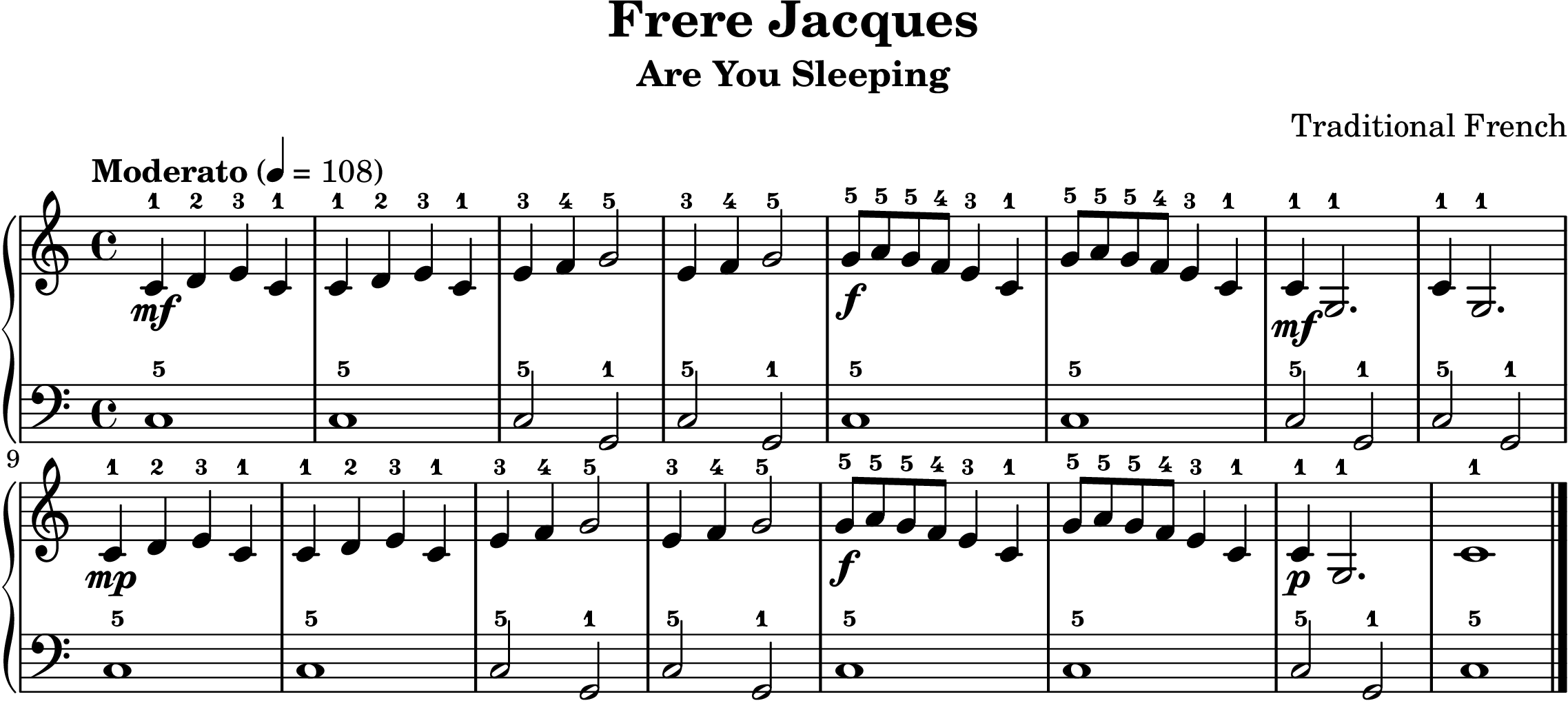
Frere Jacques
Traditional French | F Major | 4/4 | 16 measures
This French round is famous for a reason – the melody is so catchy it practically teaches itself. The arrangement gives the right hand the familiar tune while the left hand holds whole notes underneath, making it your first experience reading two staves at once. Practice the left hand alone until you can play it without looking at the keys, then add the right hand on top.
London Bridge Is Falling Down
Traditional | C Major | 4/4 | 16 measures
A simple descending melody that everyone knows by ear, paired with basic bass patterns in the left hand. The familiarity of the tune frees your attention to focus on what matters at this stage: keeping the left hand steady while the right hand moves. The descending motion (G-F-E-D-C) is excellent practice for smooth finger connections going downward.
When the Saints Go Marching In
Traditional | C Major | 4/4 | 16 measures
This gospel standard has a wider melodic range than the previous pieces, stretching your right hand across more of the keyboard. The left hand plays on beats 1 and 3, introducing a basic “oom-pah” feel that underpins thousands of songs. The upbeat energy makes it fun to practice – tap your foot on beats 1 and 3 to lock the left hand into the groove.
Alouette
Traditional French-Canadian | C Major | 4/4 | 16 measures
This call-and-response folk song from Quebec gives you a different musical texture. The melody alternates between question phrases and answer phrases, and the left hand provides a basic accompaniment that supports both. Playing Alouette trains your ear to hear musical phrases as conversations – a skill you will use in every piece from here on.
Lightly Row
Traditional German | C Major | 4/4 | 16 measures
The final piece in Level 2 introduces broken thirds in the left hand – your fingers alternate between two notes instead of holding a single tone. This is a direct preparation for the accompaniment patterns in Level 3. The gentle, rocking melody sits comfortably in the right hand while your left hand gets its first taste of real movement. Master this piece and you are ready for hands together.
How to Practice Level 2
- Always learn hands separately first. Play the right hand part three times cleanly, then the left hand part three times. Only after each hand is confident on its own should you try putting them together. Rushing to combine hands is the most common beginner mistake.
- Use a metronome at 60 BPM. A free metronome app on your phone is fine. Set it to 60 beats per minute and play each piece at that tempo until it feels easy. Speed comes from accuracy, not from pushing faster before you are ready.
- Watch your left hand posture. Beginners tend to flatten the left hand and play with straight fingers. Keep the same gentle curve you use for the right hand. Your left thumb (finger 1) should rest naturally, not tuck under the palm.
- Play Lightly Row last. It has the most complex left hand part in this level. Use the other four pieces as preparation, building your left hand confidence before tackling the broken thirds.
Every Piece Includes
Real Sheet Music
Professionally engraved with treble and bass clef.
Fingering Guide
Every note mapped to the correct finger.
Practice Steps
Right hand, left hand, then hands together.
Good posture prevents injuries and makes playing easier. If you have been hunching over the keyboard or tensing your shoulders, check our article on common piano posture mistakes – small adjustments can make a big difference in comfort during longer practice sessions. Ready to explore more levels? Browse our full free piano sheet music collection.
Browse Other Levels
First Steps | Simple Hands Together | First Classical Pieces | Advanced Beginner