
Für Elise is Beethoven’s most famous piano miniature, and this easy A minor version is built around the interactive player below: hear the theme at half speed, watch the notes and keys light up, and drag the score to replay any phrase. The sheet music, fingering, and free PDF come next.
Learn it with the interactive player
- Slow it down: x0.5 or x0.75 while you learn the notes, back to x1 once they flow.
- Pause anywhere: the current keys stay lit so you can find them on your own piano.
- Drag the score left or right, or use the 15s buttons, to replay a phrase.
The sheet music, section by section

Work on Section A first, right hand alone: the E-D#-E oscillation must feel automatic before anything else. Set the player to x0.5 - the D# should sit naturally under finger 4 even at half speed.
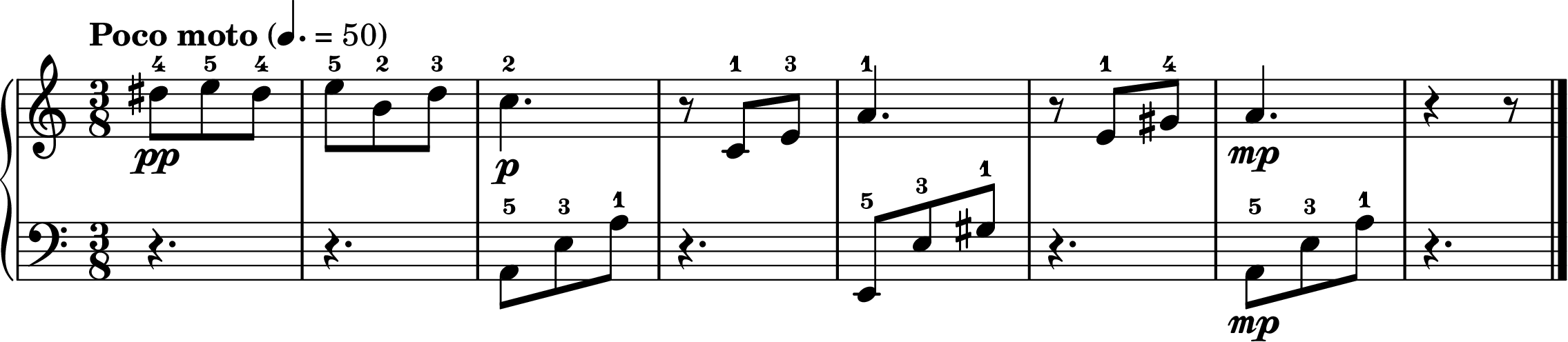
Section B repeats the motif and resolves it into A minor. Practice the transition where the left-hand arpeggio enters, since switching from right hand alone to both hands together is the trickiest moment of the piece.
The full score
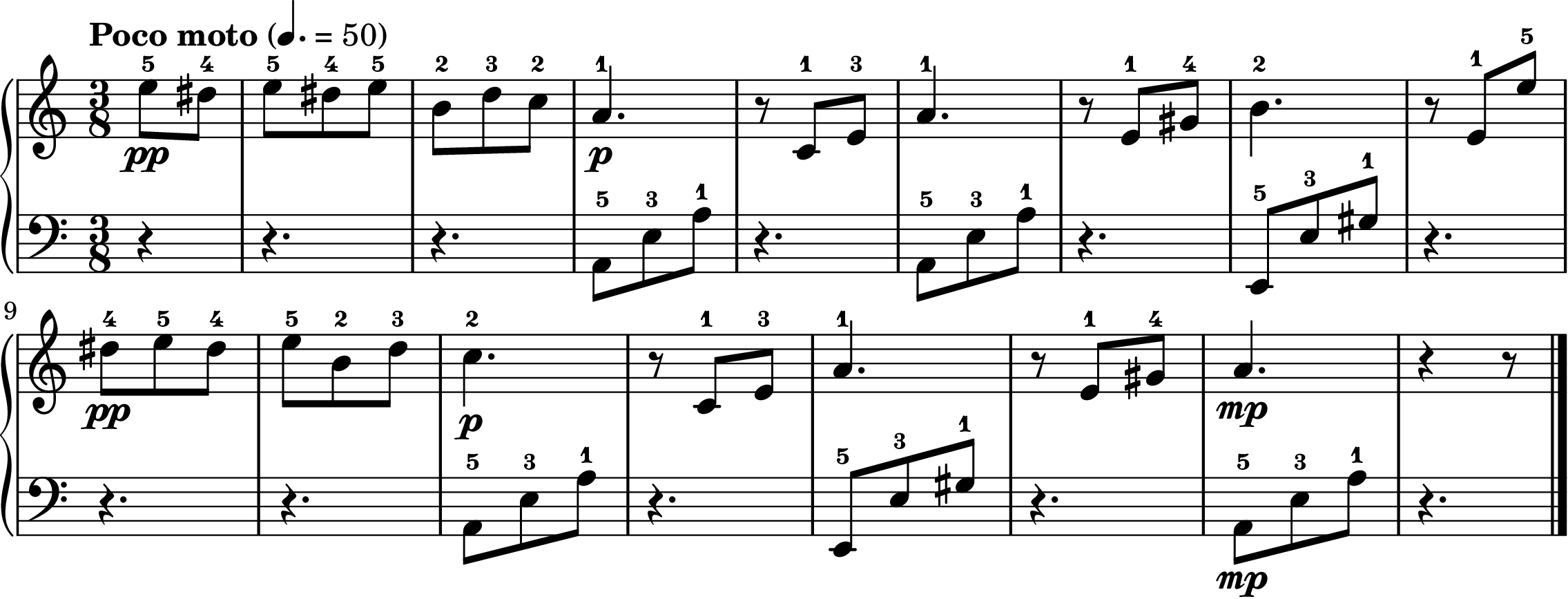
When both sections flow separately, connect them in the full score and let the tempo rise only once every transition feels effortless.
Note by note: keys and fingering
- Right hand: A4, B4, C5, D5, E5, D#5 - A minor position with chromatic D# for the famous oscillating motif.
- Left hand: A2, E3, A3, C3, G#3 - Arpeggiated Am and E chords.
| Note | On the Staff | On the Keyboard | Finger |
|---|---|---|---|
| A4 | Second space of treble staff | Between last two of three black keys | RH Thumb (1) |
| B4 | Third line of treble staff | Right of three black keys | RH Index (2) |
| C5 | Third space of treble staff | White key left of two black keys (above middle C) | RH Index (2) |
| D5 | Fourth line of treble staff | Between two black keys, above C5 | RH Middle (3) |
| D#5 | Between D5 and E5 | Black key right of D5 | RH Ring (4) |
| E5 | Fourth space of treble staff | Right of two black keys, above C5 | RH Pinky (5) |
| A2 | First space of bass staff | Between last two of three black keys, low | LH Pinky (5) |
| E3 | Fourth line of bass staff | Right of two black keys, below middle C | LH Middle (3) |
| G#3 | Between G3 and A3 | Black key right of G3 | LH Thumb (1) |
| A3 | Above top line of bass staff | Between last two of three black keys | LH Thumb (1) |
Prefer a video? Watch the keys light up
Same color code as the player: green marks the right hand, blue the left hand, with the score and keyboard in one vertical video.
The story behind Für Elise
Beethoven composed Für Elise (WoO 59) around 1810, but the piece stayed unpublished until 1867, forty years after his death. The identity of Elise remains a mystery: some scholars believe the dedication was misread and should say Für Therese, pointing to Therese Malfatti, a student Beethoven reportedly hoped to marry. The full piece is a rondo with stormier middle episodes, but it is the opening A minor theme - the one everyone recognizes - that this easy version keeps. That oscillating motif has made Für Elise one of the most played piano pieces in history.
Get the printable PDF
The printable PDF of this easy Für Elise - full score, hand positions, and a step-by-step practice guide - ships inside our free Level 4 pack together with four other intermediate favorites.
The oscillating motif rewards long, patient repetition, and as a bench maker I will simply say this: an Adjustable Piano Bench with Back Support makes those longer sessions kinder, with a backrest to lean on between passages.
FAQ
How hard is Fur Elise on piano?
The complete piece is an intermediate work, mostly because of its faster middle episodes. The famous opening theme, which is what this easy version keeps, is far more approachable: one oscillating right-hand motif plus a simple broken-chord left hand. We rank this arrangement Level 4 in our five-level collection.
How long does it take to learn Fur Elise?
For the theme alone, plan on two to four weeks of regular practice if you already play simple beginner pieces. The full original takes most learners several months. The key milestone is making the E to D sharp oscillation automatic, which usually happens within the first week.
What level is Fur Elise?
The original is usually placed around grade 4 to 5 on graded exam scales. This simplified theme-only arrangement sits at Level 4 of our collection: comfortable five-finger positions, but with a black key inside the motif and arpeggiated left-hand chords to coordinate.
What are the first notes of Fur Elise?
The piece opens with E5, D sharp 5, E5, D sharp 5, E5, B4, D5, C5, then lands on A4. The left hand answers with a rising A minor arpeggio: A2, E3, A3. That nine-note opening is one of the most recognized motifs ever written for piano.