
Chopin’s Funeral March is the most famous funeral music ever written, and this easy A minor theme starts with the interactive player below: hear the tread at half speed, watch the notes and keys light up, and drag the score to replay any measure. Sheet music, fingering, and a free printable PDF follow.
Learn it with the interactive player
- Slow it down: x0.5 or x0.75 while you learn the notes, back to x1 once they flow.
- Pause anywhere: the current keys stay lit so you can find them on your own piano.
- Drag the score left or right, or use the 15s buttons, to replay a phrase.
The sheet music, section by section
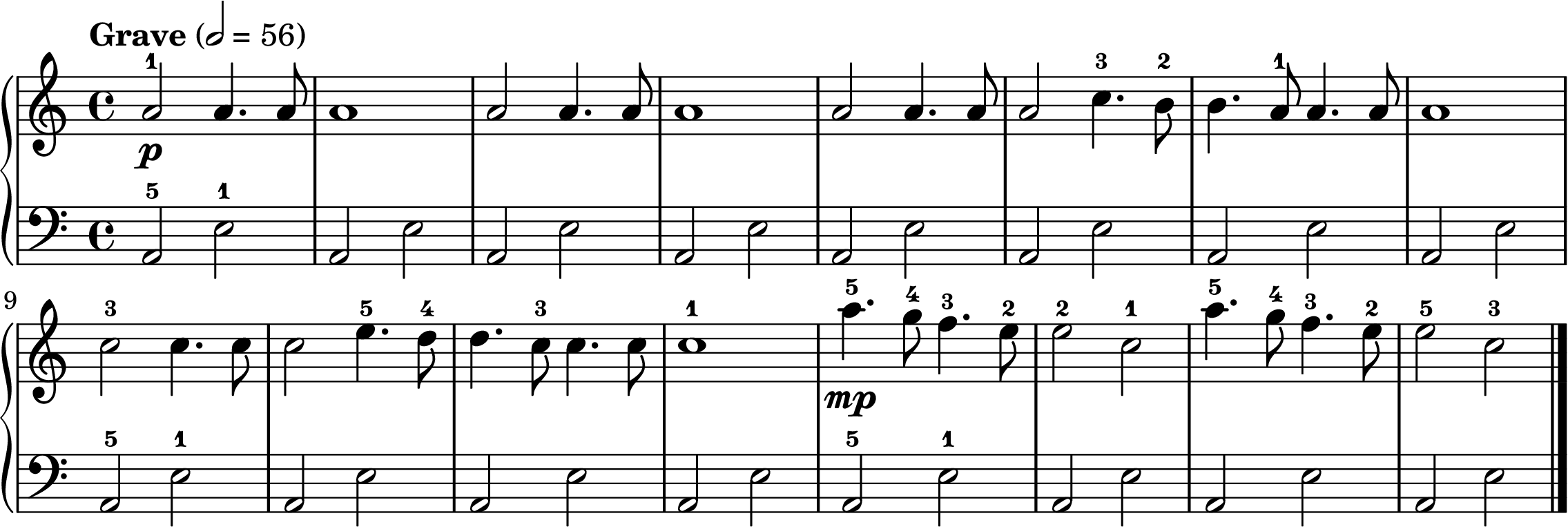
Set the player to x0.5 for Section A, bars 1 to 16. The tread is one A4 played long, then long-short, then held for a whole bar, with the short eighth leading into the next long note as Chopin writes it. Bars 9 to 12 move the tread up to C5. Then comes the high answer, A5-G5-F5-E5 falling to C5, played twice; the thumb takes the repeated C5 in bar 12 so the pinky can reach A5.
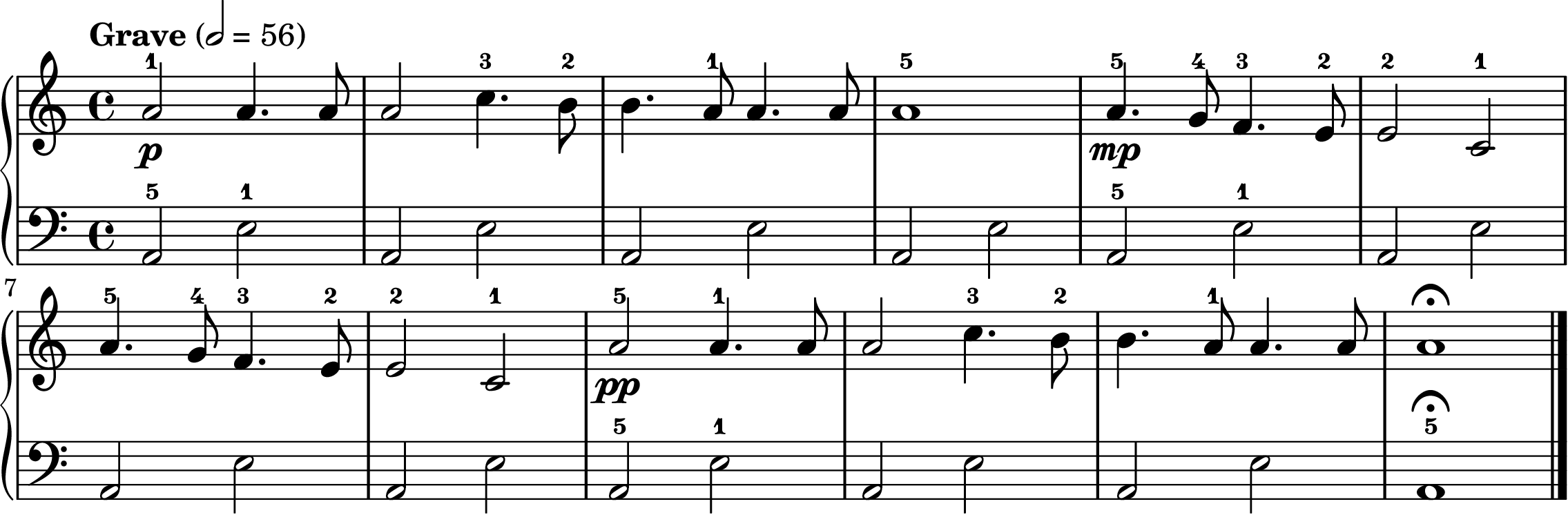
Section B, bars 17 to 28, opens with the tread and then plays the answer an octave lower, A4-G4-F4-E4 down to middle C, twice. Chopin takes it an octave higher; ours goes down to stay within reach. The closing tread is pianissimo and ends on a long A4 under a fermata, while the left hand keeps the same A2-E3 step in every bar until the held final A2.
The full score
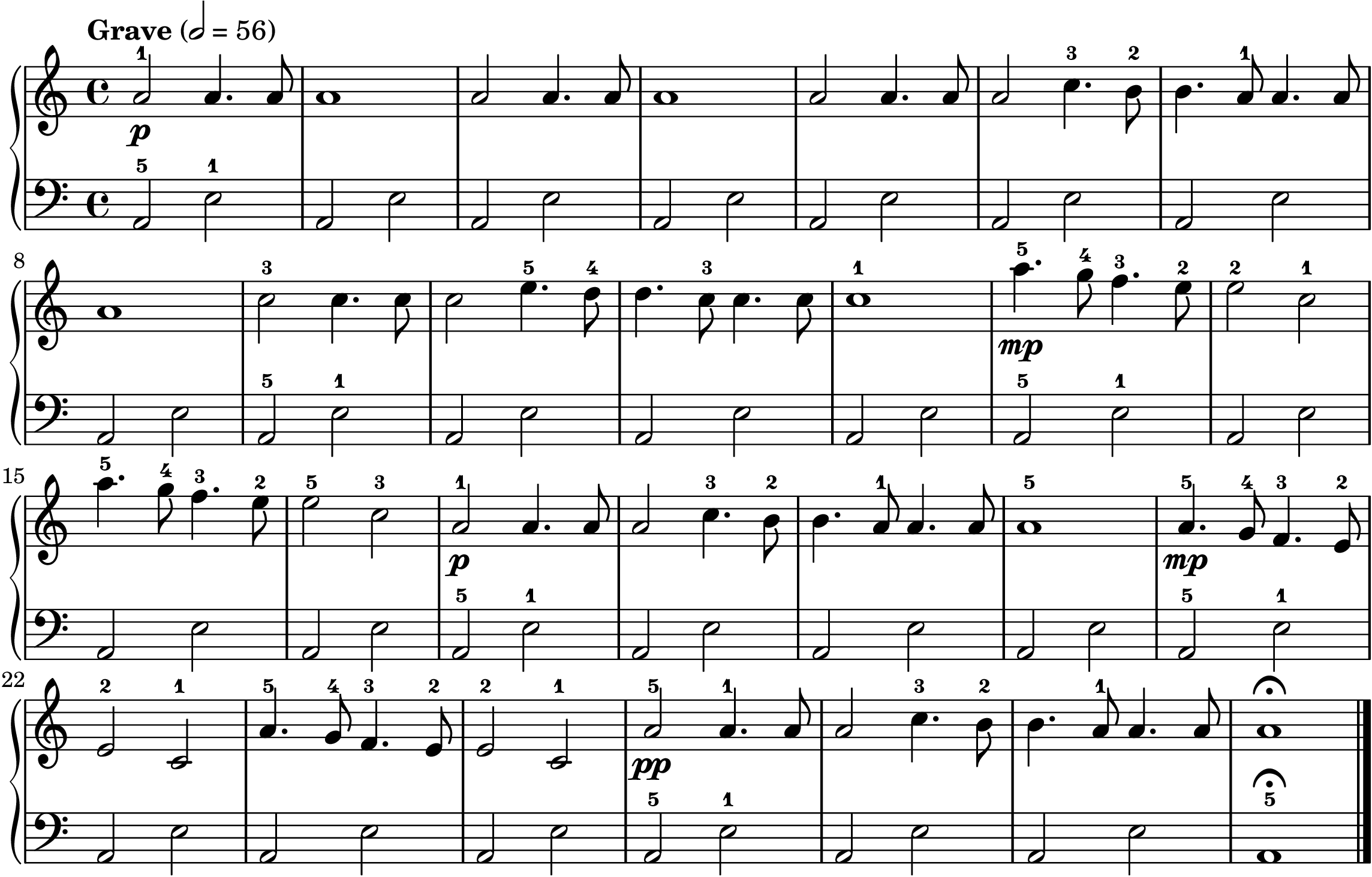
Grave means heavy and slow. The full score counts two half-note beats per bar at 56 per minute, so keep it strict and unhurried and let the dotted rhythm, not volume, carry the weight.
Note by note: keys and fingering
- Right hand: White keys only, in three five-finger positions. The tread sits in the A position: thumb (1) on A4, B4 (2), C5 (3), D5 (4), pinky (5) on E5. For the high answer the thumb takes the repeated C5 in bar 12 and the hand covers C5 to A5 (E5 2, F5 3, G5 4, A5 5). The low answer uses the same shape an octave down, C4 to A4, after the pinky takes the held A4 in bar 20.
- Left hand: Two keys in every bar but the last, single half notes: pinky (5) on A2 and thumb (1) on E3, ending on a held A2.
| Note | On the Staff | On the Keyboard | Finger |
|---|---|---|---|
| A4 | Second space of treble staff | White key between the last two of three black keys | RH Thumb (1) |
| A4 (low answer) | Second space of treble staff | White key between the last two of three black keys | RH Pinky (5) |
| B4 | Third line of treble staff | White key right of the three black keys | RH Index (2) |
| C5 | Third space of treble staff | White key left of the two black keys above middle C | RH Middle (3) |
| C5 (high answer) | Third space of treble staff | White key left of the two black keys above middle C | RH Thumb (1) |
| D5 | Fourth line of treble staff | White key between the two black keys above C5 | RH Ring (4) |
| E5 | Fourth space of treble staff | White key right of the two black keys above C5 | RH Pinky (5) |
| E5 (high answer) | Fourth space of treble staff | White key right of the two black keys above C5 | RH Index (2) |
| F5 | Fifth line of treble staff | White key left of the three black keys above C5 | RH Middle (3) |
| G5 | Space above the treble staff | White key between the first two of three black keys above C5 | RH Ring (4) |
| A5 | First ledger line above the treble staff | White key between the last two of three black keys above C5 | RH Pinky (5) |
| G4 | Second line of treble staff | White key between the first two of three black keys above middle C | RH Ring (4) |
| F4 | First space of treble staff | White key left of the three black keys above middle C | RH Middle (3) |
| E4 | First line of treble staff | White key right of the two black keys above middle C | RH Index (2) |
| C4 | Ledger line below the treble staff (middle C) | White key left of the two black keys in the middle of the keyboard | RH Thumb (1) |
| A2 | First space of bass staff | White key between the last two of three black keys, two octaves down | LH Pinky (5) |
| E3 | Third space of bass staff | White key right of the two black keys below middle C | LH Thumb (1) |
Prefer a video? Watch the keys light up
Same color code as the player: green marks the right hand, blue the left hand, with the score and keyboard in one vertical video.
The story behind the Funeral March
Frederic Chopin wrote this march in 1837 and placed it two years later at the heart of his Piano Sonata No. 2 in B-flat minor, Op. 35, first published in 1840. The movement became so iconic that it detached from the sonata entirely: it was played at Chopin's own funeral in Paris in 1849, and later at the state funerals of figures from John F. Kennedy to Winston Churchill. The original alternates a tolling minor tread with a consoling major trio. This arrangement takes the opening of the march, a semitone lower in A minor with the note values doubled. It keeps Chopin's tread rhythm and his high answer over single half notes in the left hand.
Get the printable PDF
The printable PDF of this easy Funeral March theme - full score, hand positions, and a step-by-step practice guide - ships inside our free Halloween pack together with fourteen other spooky pieces.
At half note = 56 you will sit with this piece a long while, and an Adjustable Piano Bench with Back Support keeps those slow, heavy sessions comfortable from first tread to last.
Piano teacher? Track your students' practice. Join the early list
FAQ
How hard is the Funeral March on piano?
Chopin's original, inside the Sonata Op. 35, is an advanced work in B-flat minor with thick chords. This arrangement of the march is a different matter: in A minor, on white keys only, with a single-note left hand, it sits in Level 1 of our Halloween collection. The work is in the dotted rhythm and in two hand moves, up to A5 and down to middle C, each made on a repeated note.
How long does it take to learn the Funeral March?
Most beginners have this arrangement under their hands in a week or two. The tread repeats one A4 for bars at a time, the second answer is the first one an octave lower, and at half note = 56 there is plenty of time between notes.
What level is the Funeral March?
The original movement is graded around level 7 on exam scales. Our easy version is Level 1 of the Halloween collection: no black keys, three five-finger positions joined on repeated notes, and a left hand limited to A2 and E3 in slow half notes.
What are the notes for the Funeral March?
The tread repeats A4 as a half note, a long-short pair and a whole note, with a turn through C5 and B4 in bars 6 and 7. Bars 9 to 12 repeat it on C5, turning through E5 and D5. The high answer falls A5, G5, F5, E5 to C5, twice. After the tread returns, the answer comes an octave lower, A4, G4, F4, E4 to middle C, and the closing tread ends on A4. The left hand alternates A2 and E3 in half notes. The full table is above.