
Brahms’ Lullaby is the most famous cradle song ever written, and this easy C major version is built around the interactive player below: hear it at half speed, watch the notes and keys light up, and drag the score to replay any phrase. The sheet music, fingering, and free printable PDF come next.
Learn it with the interactive player
- Slow it down: x0.5 or x0.75 while you learn the notes, back to x1 once they flow.
- Pause anywhere: the current keys stay lit so you can find them on your own piano.
- Drag the score left or right, or use the 15s buttons, to replay a phrase.
The sheet music, section by section

Set the player to x0.5 for Section A: the melody opens with an E-E-G pickup and then sways through the rocking E-C-E-C pattern. Keep everything truly soft while the waltz bass rocks ONE-two-three underneath.

Section B arcs higher before sinking back down to rest, like a gentle sigh. Let the final measure fade to the softest touch you can produce - the ending should feel like falling asleep.
The full score
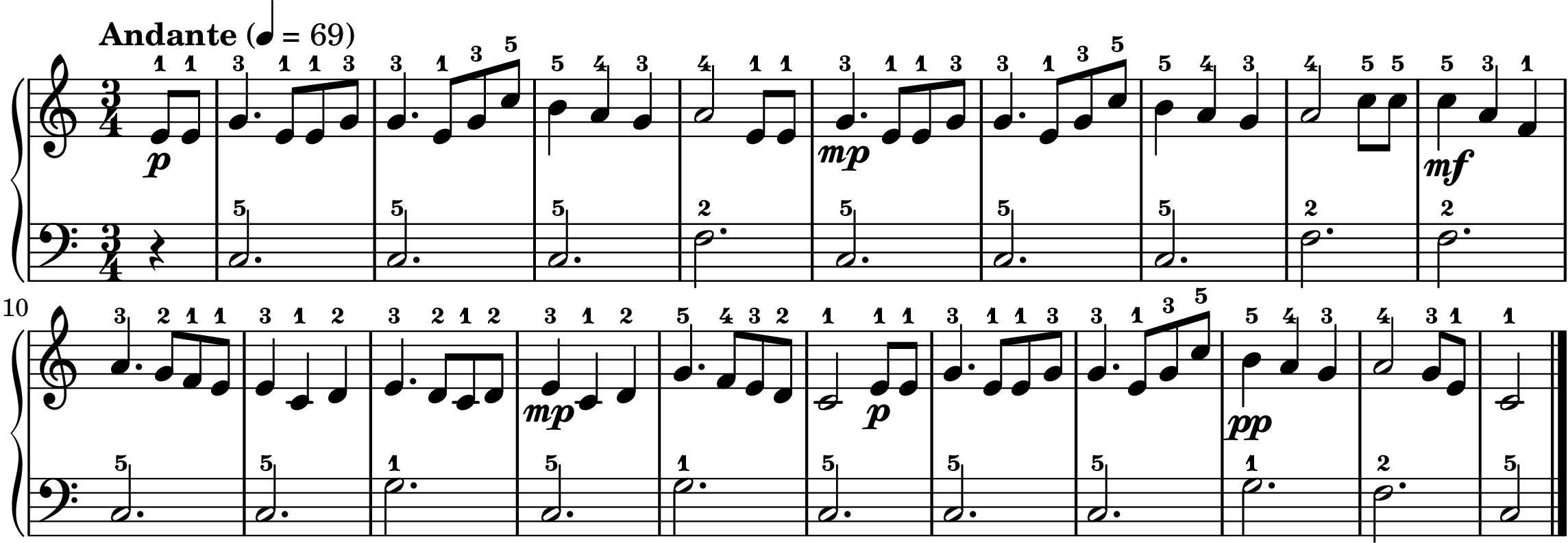
Take the full score at 50 BPM until the waltz bass and melody meet comfortably on beat 1, then let it settle at a soft, rocking 72 BPM.
Note by note: keys and fingering
- Right hand: C4, D4, E4, F4, G4, A4 - C position with extension to A. Gentle, rocking motion.
- Left hand: C3, E3, F3, G3 - Waltz-style bass: root on beat 1, chord tones on beats 2-3.
| Note | On the Staff | On the Keyboard | Finger |
|---|---|---|---|
| C4 (Middle C) | One ledger line below treble staff | White key left of two black keys, center | RH Thumb (1) |
| D4 | Just below bottom line of treble staff | Between the two black keys | RH Index (2) |
| E4 | On the bottom line of treble staff | Right of two black keys | RH Middle (3) |
| F4 | First space of treble staff | Left of three black keys | RH Ring (4) |
| G4 | Second line of treble staff | Between first two of three black keys | RH Pinky (5) |
| A4 | Second space of treble staff | Between last two of three black keys | RH stretched |
| C3 | Two ledger lines below bass staff | One octave below middle C | LH Pinky (5) |
| E3 | Fourth line of bass staff | Right of two black keys | LH Middle (3) |
| F3 | Fourth space of bass staff | Left of three black keys | LH Index (2) |
| G3 | Top line of bass staff | Between first two of three black keys | LH Thumb (1) |
Prefer a video? Watch the keys light up
Same color code as the player: green marks the right hand, blue the left hand, with the score and keyboard in one vertical video.
The story behind Brahms' Lullaby
Johannes Brahms composed his Wiegenlied, Op. 49 No. 4, in 1868 as a gift for his friend Bertha Faber on the birth of her second son. Brahms had known Bertha years earlier in Hamburg, and he wove into the accompaniment a hint of an Austrian song she used to sing to him. Published the same year, the lullaby was soon translated into dozens of languages and became the melody parents everywhere hum at the cradle. This easy arrangement moves it into C major, keeping the gentle 3/4 sway and stepwise melody that have rocked babies to sleep for more than 150 years.
Get the printable PDF
The printable PDF of this easy Brahms' Lullaby - full score, hand positions, and a step-by-step practice guide - ships inside our free Level 3 pack together with four other well-loved melodies.
Playing softly for a long stretch asks more of your posture than loud playing does, and an Adjustable Piano Bench with Back Support helps you stay relaxed to the very last bar.
FAQ
How hard is Brahms Lullaby on piano?
This easy arrangement is a Level 3 piece in our free collection. The right hand stays in C position with a stretch up to A4, and the left hand plays a waltz pattern - bass note on beat 1, chord tones on beats 2 and 3. The real challenge is control: keeping everything soft and even at the slow Andante tempo.
How long does it take to learn Brahms Lullaby?
Learners who already play simple hands-together pieces usually need one to two weeks. The melody is stepwise and only 16 measures long; most of the practice goes into timing the waltz bass against it, which is why starting at 50 BPM and anchoring both hands on beat 1 works so well.
What level is Brahms Lullaby?
It belongs to the Level 3 pack of our free sheet collection. The piece introduces the waltz-style accompaniment - root on beat 1, chord tones on beats 2 and 3 - in 3/4 time, along with soft dynamic control, which is what separates it from Level 2 pieces.
What are the notes for Brahms Lullaby on piano?
The melody starts with an E-E-G pickup, then sways through the rocking E-C-E-C pattern before arcing higher in measures 9 to 12 and coming back down to rest. The left hand plays C on beat 1 with E-G on beats 2 and 3, then the F major version with F under A-C. The full table is above.