
Count Your Blessings is the gospel song about making a gratitude list, and this easy C major arrangement is built around the interactive player below: hear the dotted bounce at half speed, watch the keys light up, and drag the score to replay any bar. The sheet music, fingering for both hands, and a free printable PDF come next.
Learn it with the interactive player
- Slow it down: x0.5 or x0.75 while you learn the notes, back to x1 once they flow.
- Pause anywhere: the current keys stay lit so you can find them on your own piano.
- Drag the score left or right, or use the 15s buttons, to replay a phrase.
The sheet music, section by section
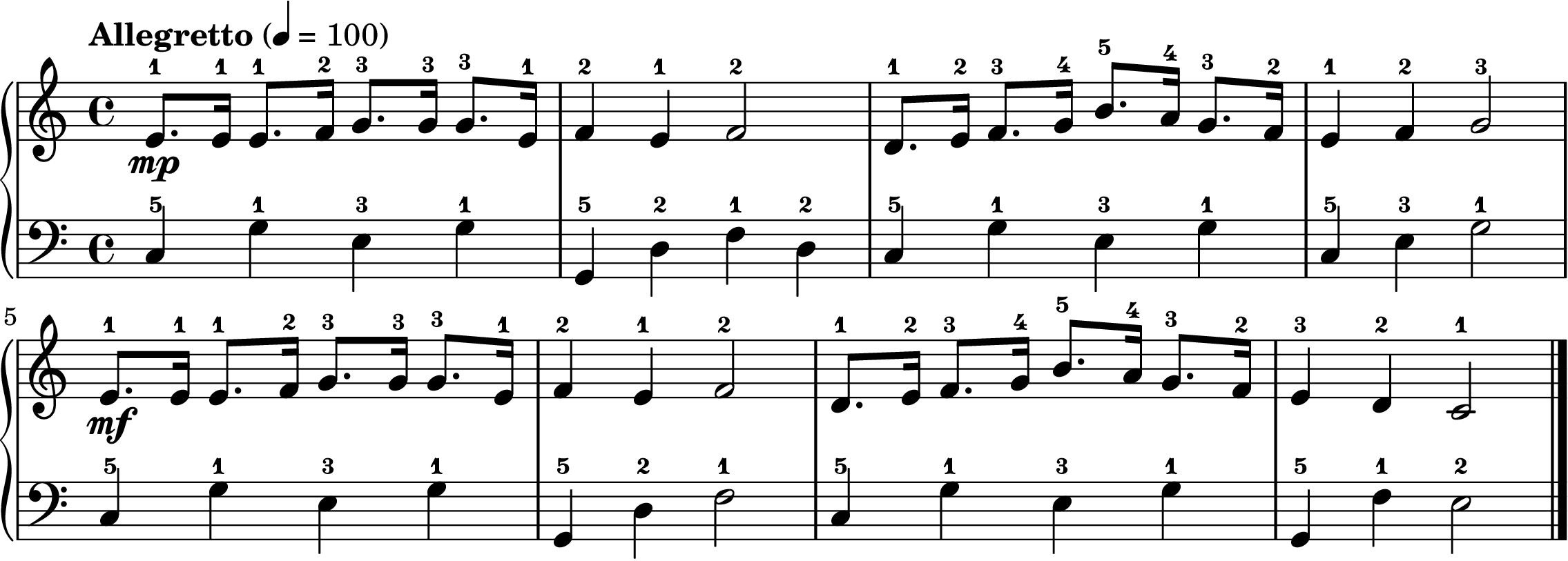
Take Section A (measures 1-8), the verse, at x0.5: everything is in dotted gospel rhythm, long-short, long-short, like a happy limp. The melody stays low around E4, rises to B4 on discouraged in measure 3, and lands each line on a solid half note; the second verse repeats the same music a notch louder and ends on middle C.
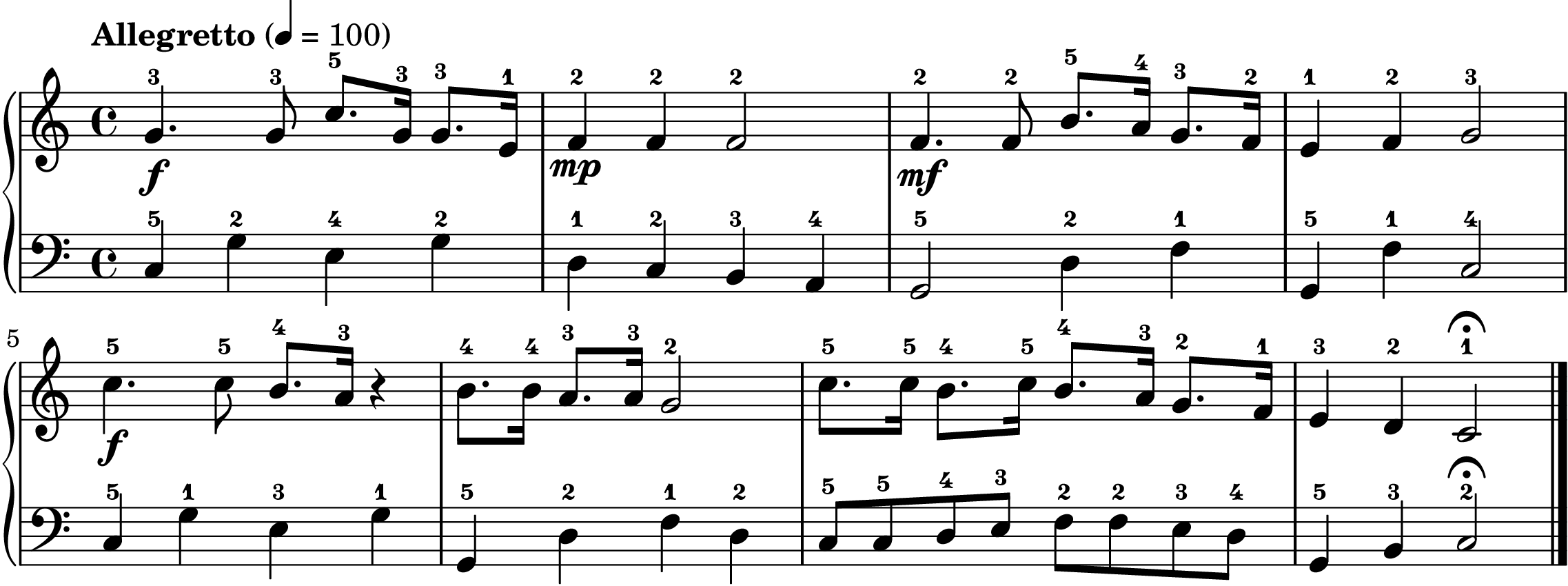
Section B (measures 9-16) is the famous refrain: Count your blessings rings out with C5 on top, then in measure 10 the melody freezes on three repeated F4s while the left hand sings the choir echo, walking down D3-C3-B2-A2. Measure 13 takes a real engraved breath, measure 15 adds a walking bass in eighth notes, and God has done closes E4-D4-C4 under a fermata.
The full score
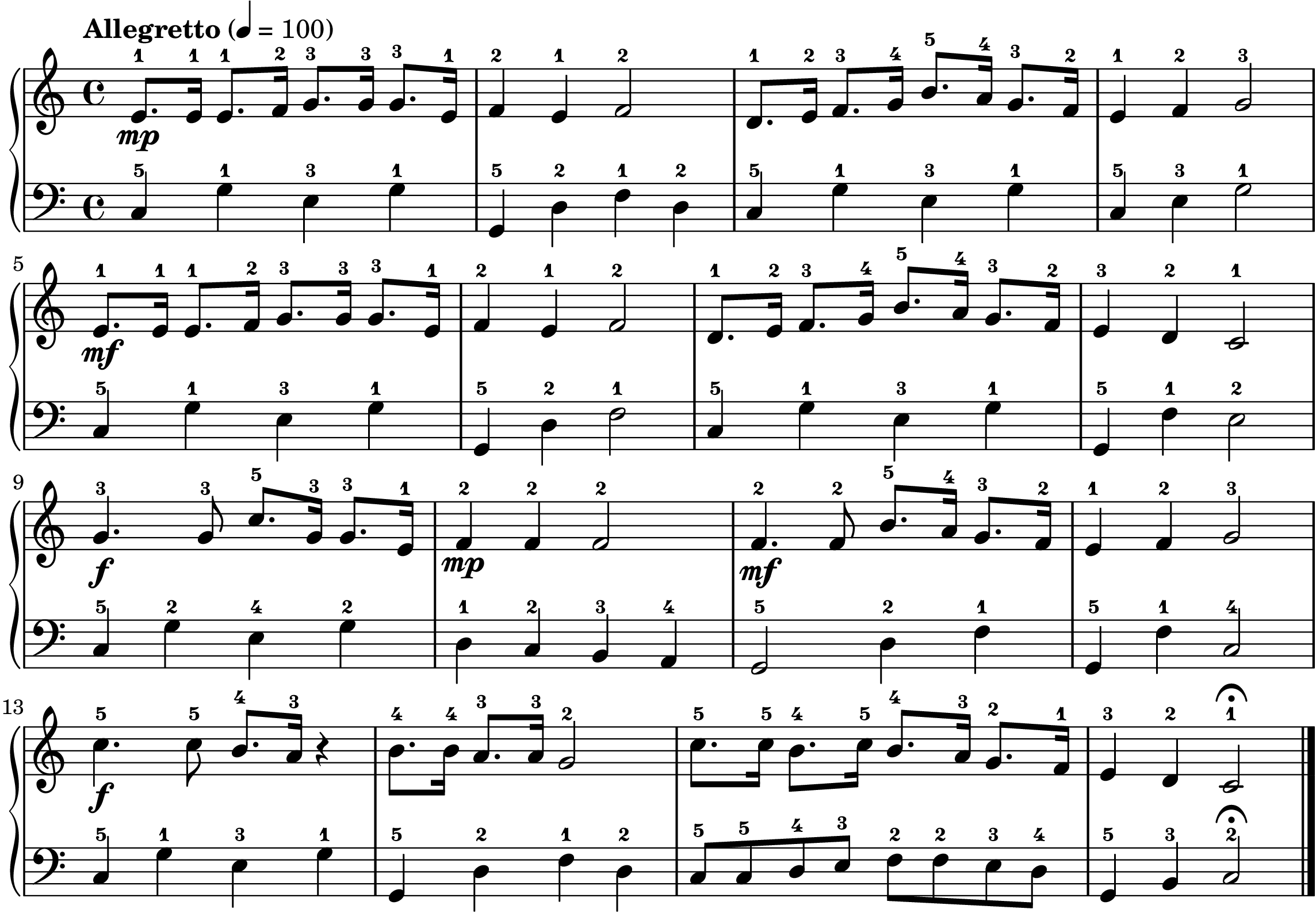
In the full score, play hands together at 60 BPM with straight eighths first, add the dotted bounce once the notes are secure, and build toward a bright 100 BPM with the last God has done broad under the fermata.
Note by note: keys and fingering
- Right hand: The verse sits low and warm with the thumb (1) on E4 and the middle finger (3) on G4, stretching to B4 with the pinky (5); the refrain moves the same hand shape up so the pinky rings out C5 on Count. One octave, two positions.
- Left hand: Gospel broken chords, pinky (5) on C3, thumb (1) on G3, middle finger (3) on E3, with two star moments: the measure 10 echo, where the left hand answers one by one walking down D3-C3-B2-A2 with 1-2-3-4, and the walking bass eighth notes C-C-D-E-F-F-E-D in measure 15.
| Note | On the Staff | On the Keyboard | Finger |
|---|---|---|---|
| C4 | Ledger line below treble staff | Middle C | RH Thumb (1) |
| D4 | Just below the bottom line | Right of middle C | RH Thumb (1) |
| E4 | Bottom line of treble staff | Two white keys above middle C | RH Thumb (1) |
| F4 | First space of treble staff | Left of three black keys | RH Index (2) |
| G4 | Second line of treble staff | Between first two black keys | RH Middle (3) |
| A4 | Second space of treble staff | Between last two of three black keys | RH Ring (4) |
| B4 | Middle line of treble staff | Right of three black keys | RH Pinky (5) |
| C5 | Third space of treble staff | One octave above middle C | RH Pinky (5) |
| G2 | Bottom line of bass staff | Second G below middle C | LH Pinky (5) |
| A2 | Bottom space of bass staff | Two octaves below middle C | LH Ring (4) |
| B2 | Second line of bass staff | Right of three black keys, below C3 | LH Middle (3) |
| C3 | Second space of bass staff | One octave below middle C | LH Pinky (5) |
| D3 | Third line of bass staff | Between the two black keys below middle C | LH Index (2) |
| E3 | Third space of bass staff | Right of two black keys | LH Middle (3) |
| F3 | Fourth line of bass staff | Left of three black keys, below middle C | LH Thumb (1) |
| G3 | Fourth space of bass staff | Between first two black keys | LH Thumb (1) |
Prefer a video? Watch the keys light up
Same color code as the player: green marks the right hand, blue the left hand, with the score and keyboard in one vertical video.
The story behind Count Your Blessings
When upon life's billows you are tempest-tossed, count your many blessings, name them one by one. Johnson Oatman Jr. wrote the words and the Chicago publisher Edwin O. Excell set them to a bouncing gospel tune in 1897, and it became one of the most loved songs in the history of American hymnody. It is the Thanksgiving hymn in the most literal sense: a song about making a gratitude list. The fun is in the rhythm, a snappy dotted gospel bounce, and in the refrain, where choirs traditionally echo one by one back and forth. In this arrangement your left hand plays that choir echo as a walking bass line under three repeated F4s.
Get the printable PDF
The printable PDF of Count Your Blessings - full score, hand positions, and a step-by-step practice guide - ships inside our free Thanksgiving pack together with fourteen other Thanksgiving pieces.
A bouncing gospel tune keeps its lift when your wrists are level and loose, and an Adjustable Piano Bench with Back Support set to your height keeps them there for the whole practice session.
Piano teacher? Track your students' practice. Join the early list
FAQ
How hard is Count Your Blessings on piano?
It is a Level 3 piece in our Thanksgiving collection. The right hand stays within one octave from C4 to C5 in two positions, but the dotted eighth-sixteenth rhythm runs through almost every bar, and the left hand plays gospel broken chords with a walking echo in measure 10 and walking eighth notes in measure 15.
How long does it take to learn Count Your Blessings?
Three to four weeks. Learn the notes with straight eighths at 60 BPM first, then add the dotted bounce; measure 10, where the right hand holds steady F4s while the left hand walks down, is the spot that needs the most hands-separate work.
What level is Count Your Blessings?
Level 3 of our Thanksgiving collection. It introduces a constant dotted gospel rhythm, a left hand that carries the melody for a bar, a walking bass in eighth notes, an engraved rest for breath, and a position shift up for the refrain.
What are the notes for Count Your Blessings?
The verse starts E4, E4, E4, F4, G4, G4, G4, E4, then F4, E4, F4, and rises D4, E4, F4, G4, B4, A4, G4, F4 to E4, F4, G4. The refrain begins G4, G4, C5, G4, G4, E4, then three F4s over the left-hand echo D3, C3, B2, A2. The bass groove is C3-G3-E3-G3. See the full table above.