
Frere Jacques, the French round every child knows, is a lovely early piano piece: start with the interactive player below, which plays it at half speed while the notes and keys light up, and drag the score to loop any phrase. Sheet music, fingering, and a free printable PDF follow.
Learn it with the interactive player
- Slow it down: x0.5 or x0.75 while you learn the notes, back to x1 once they flow.
- Pause anywhere: the current keys stay lit so you can find them on your own piano.
- Drag the score left or right, or use the 15s buttons, to replay a phrase.
The sheet music, section by section

Start with Section A, right hand alone: C-D-E-C played twice, then E-F-G twice. Set the player above to x0.5 and notice how each phrase repeats immediately - learn one, and you have learned two.

Section B brings the faster G-A-G-F-E-C run and the closing C-G-C bell figure. Slow the run right down first, then let it return to tempo over several days.
The full score
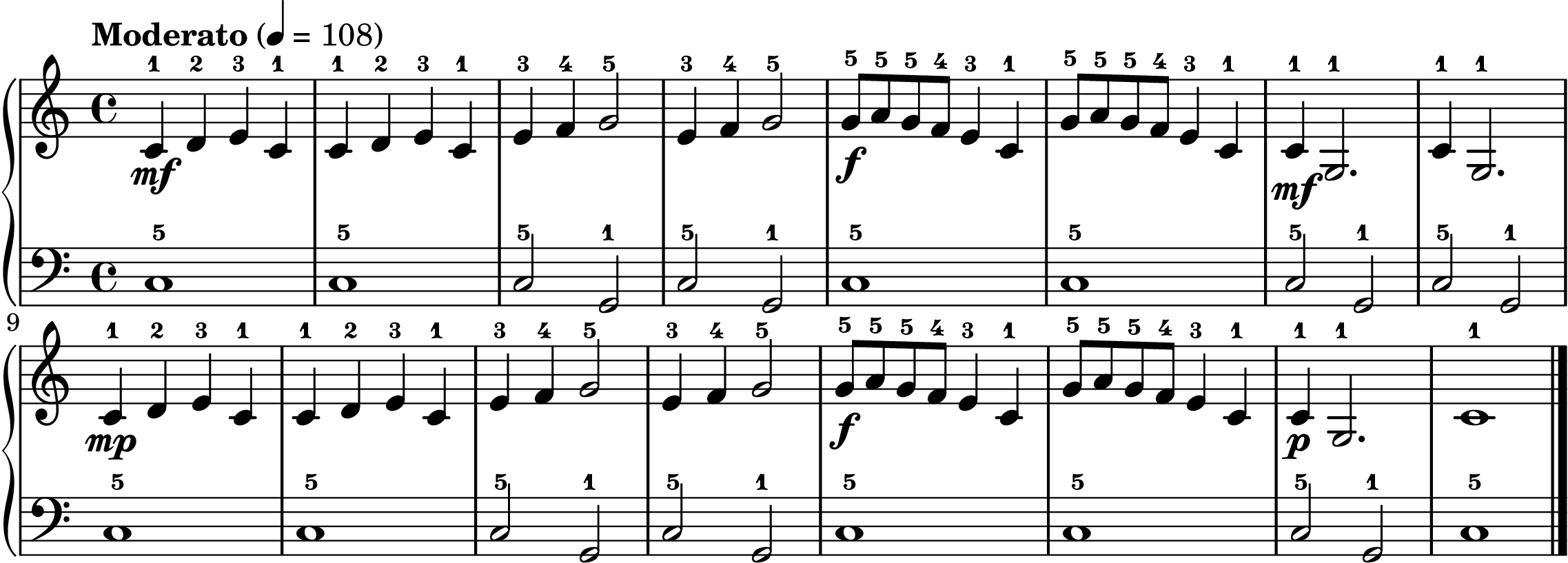
When all four phrase pairs are fluent, chain them in the full score over the gentle C-E-G broken-chord bass, aiming for a playful 100 BPM.
Note by note: keys and fingering
- Right hand: C4, D4, E4, F4, G4 - Standard C position. The melody flows smoothly from C to G.
- Left hand: C3, E3, G3 - Pinky on C3, middle on E3, thumb on G3. Broken chord pattern.
| Note | On the Staff | On the Keyboard | Finger |
|---|---|---|---|
| C4 (Middle C) | One ledger line below treble staff | White key left of two black keys, center | RH Thumb (1) |
| D4 | Just below bottom line of treble staff | Between the two black keys | RH Index (2) |
| E4 | On the bottom line of treble staff | Right of two black keys | RH Middle (3) |
| F4 | First space of treble staff | Left of three black keys | RH Ring (4) |
| G4 | Second line of treble staff | Between first two of three black keys | RH Pinky (5) |
| C3 | Two ledger lines below bass staff | One octave below middle C | LH Pinky (5) |
| E3 | Fourth line of bass staff | Right of two black keys, below middle C | LH Middle (3) |
| G3 | Top line of bass staff | Between first two of three black keys | LH Thumb (1) |
Prefer a video? Watch the keys light up
Same color code as the player: green marks the right hand, blue the left hand, with the score and keyboard in one vertical video.
The story behind Frere Jacques
Frere Jacques is a French nursery rhyme whose melody dates back to at least 1780, though its exact origins remain debated. It is traditionally sung as a round: one group starts, and the next enters when the first reaches the second phrase, the overlapping voices fitting together in harmony. The song has been translated into more than forty languages - English speakers know it as Are You Sleeping, Brother John - and it is used worldwide as a first song for children learning music. Gustav Mahler famously borrowed the tune for his First Symphony in 1888, slowing it into a minor-key funeral march.
Get the printable PDF
The printable PDF of Frere Jacques - full score, hand positions, and a step-by-step practice guide - ships inside our free Level 2 pack together with four other early favorites.
Rounds like this one invite family duets, and a Classic Piano Bench for kids plus a piano pedal extender let the youngest player sit just as comfortably as the grown-ups.
FAQ
How hard is Frere Jacques on piano?
It is a Level 2 piece in our collection: still centered on the five-finger C position, but with faster notes in the second half and a broken-chord left hand to coordinate. If you can already play a Level 1 tune like Twinkle Twinkle, this is a natural next step.
How long does it take to learn Frere Jacques?
Because every phrase repeats immediately - C-D-E-C twice, E-F-G twice, and so on - the piece is quick to memorize. Most learners have hands together within one to two weeks, with the faster G-A-G-F-E-C run in measures 9-12 taking the most practice.
What level is Frere Jacques?
It opens the Level 2 pack of our free sheet collection, in C major, 4/4 time, at a Moderato 100 BPM. Level 2 means fluent separate hands: the right hand carries a full melody while the left plays a C-E-G broken chord pattern beneath it.
What are the notes for Frere Jacques on piano?
The four phrases each repeat once: C-D-E-C, then E-F-G, then the faster G-A-G-F-E-C, and the closing C-G-C bell figure. The left hand outlines C-E-G broken chords, changing only every two measures. The full fingering table is above.