
Itsy Bitsy Spider is a story in three chapters and a perfect first piano piece: press play on the interactive player to hear it at half speed while the notes and keys light up, then drag the score to move around. The sheet music, fingering for both hands, and a free printable PDF follow below.
Learn it with the interactive player
- Slow it down: x0.5 or x0.75 while you learn the notes, back to x1 once they flow.
- Pause anywhere: the current keys stay lit so you can find them on your own piano.
- Drag the score left or right, or use the 15s buttons, to replay a phrase.
The sheet music, section by section
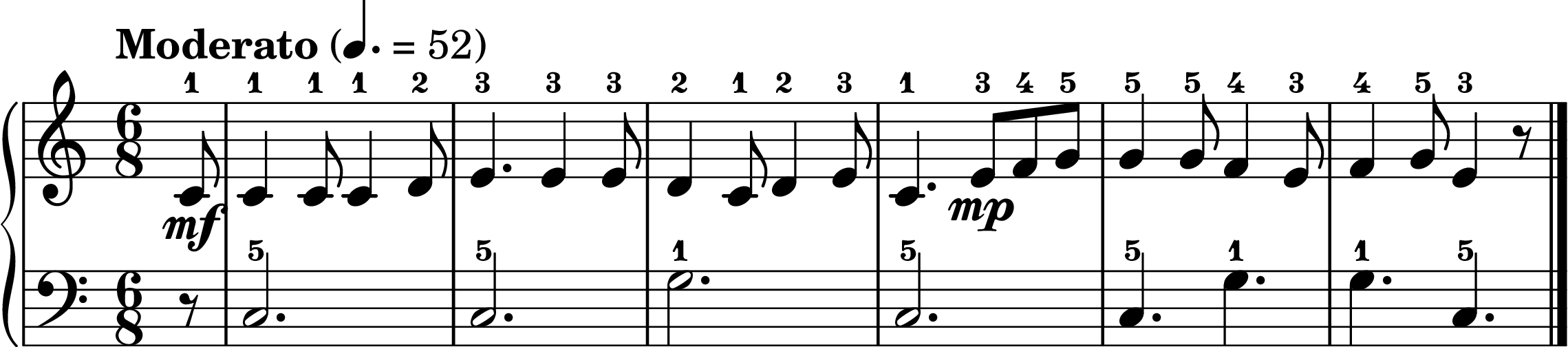
Start with Section A and the right hand alone: the pickup C on the thumb, itsy bitsy on repeated Cs up to E for spider, the up-the-water-spout wiggle D-C-D-E under fingers 2-1-2-3, then the rain rising to the pinky on G and washing back down F-E, F-G-E. Set the player above to x0.5 and keep the thumb parked on middle C.
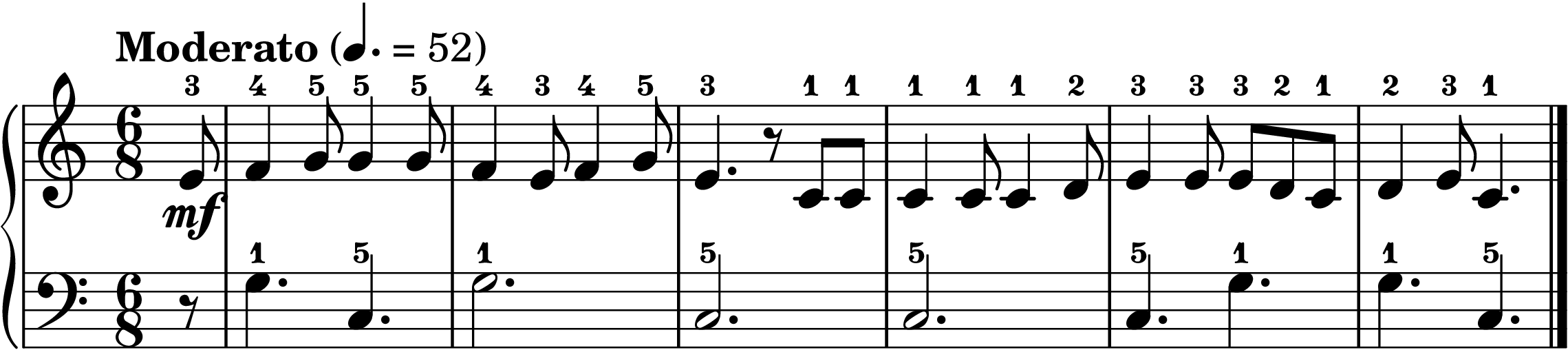
Section B opens on a tiny pickup, the note E under finger 3 for Out, then the sun dries up all the rain high on the pinky's G with the F-G turns, and the itsy bitsy climb returns to finish snug on the thumb's middle C. The left hand swings C3 and G3 under the last two measures like a final bow; take it at x0.5 first.
The full score
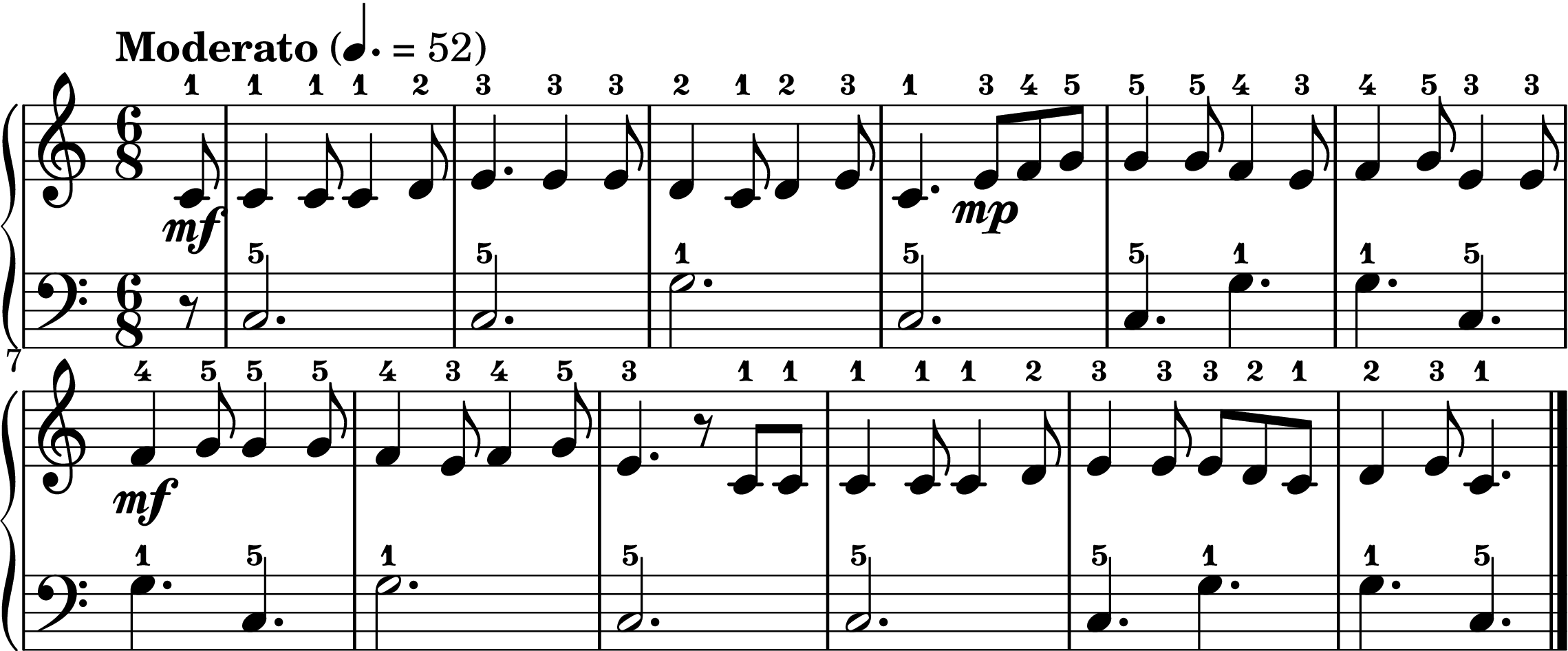
Then play the full 12 measures at a calm, rolling pulse, two soft rocks per measure, with the left hand as the steady spout while the spider climbs, and ease toward the Moderato target of dotted quarter = 52.
Note by note: keys and fingering
- Right hand: Pure five-finger C position: thumb (1) on middle C, then one finger per key, index (2) on D4, middle (3) on E4, ring (4) on F4 and pinky (5) on G4. Every note keeps the same finger for the whole piece, and the little pickup note The is played on C so small hands never leave home.
- Left hand: Just two notes: pinky (5) on C3 and thumb (1) on G3, mostly one long dotted half note per measure, with a few gentle C-to-G swings at the phrase turns like the spider swinging on its thread.
| Note | On the Staff | On the Keyboard | Finger |
|---|---|---|---|
| C4 | Ledger line below treble staff | Middle C, just left of two black keys | RH Thumb (1) |
| D4 | Just below the bottom line | Between the two black keys | RH Index (2) |
| E4 | Bottom line of treble staff | Right of the two black keys | RH Middle (3) |
| F4 | First space of treble staff | Left of the three black keys | RH Ring (4) |
| G4 | Second line of treble staff | Between first two of three black keys | RH Pinky (5) |
| C3 | Second space of bass staff | One octave below middle C | LH Pinky (5) |
| G3 | Fourth space of bass staff | Between first two of three black keys | LH Thumb (1) |
Prefer a video? Watch the keys light up
Same color code as the player: green marks the right hand, blue the left hand, with the score and keyboard in one vertical video.
The story behind Itsy Bitsy Spider
The Itsy Bitsy Spider first crawled into print in 1910 under the name the Spider Song, and generations of children have climbed the water spout with their fingers in the air ever since. It is a traditional song with no named composer. At the piano it is secretly a perfect first lesson, because the melody tells a story in three short chapters: the spider goes up the spout, down comes the rain and washes it out, then out comes the sun and the spider climbs back up again. The little hero never, ever gives up, and neither do young pianists who learn to play it one chapter at a time.
Get the printable PDF
The printable PDF of Itsy Bitsy Spider - full score, hand positions, and a step-by-step practice guide - ships inside our free Kids pack with big, easy-to-read notes, together with nine other first pieces.
Small feet that dangle make the gentle 6/8 rock harder to feel, and a piano pedal extender for kids gives a young spider-climber a solid floor under the piano.
Piano teacher? Track your students' practice. Join the early list
FAQ
How hard is Itsy Bitsy Spider on piano?
It is one of the easiest pieces in our Kids collection: the right hand stays in a pure five-finger C position, one finger per key, and the left hand plays only C3 and G3 in long dotted notes. The only thing to watch is the 6/8 rhythm, and the words carry it naturally.
How long does it take to learn Itsy Bitsy Spider?
Most children play the first line hands separately within a few sessions and the whole story hands together within a week or two. The F-E-F-G turns of the rain and the sun, under fingers 4-3-4-5, are the spot that needs a few extra repetitions.
What level is Itsy Bitsy Spider?
It belongs to our Kids collection of first pieces (the same level as our Level 1 pack). Five white keys, a two-note bass, 12 short measures in C major and a calm Moderato at dotted quarter = 52 make it an ideal early piece, and a gentle introduction to 6/8 time.
What are the notes for Itsy Bitsy Spider on piano?
The melody starts with a pickup C, then C-C-C-D, E-E-E, D-C-D-E and a long C for spout, before the rain rises E-F-G, G-G-F-E, F-G-E. Section B answers with F-G-G-G, F-E-F-G, E, and the itsy bitsy climb returns to end D-E-C. The left hand plays C3 and G3 only; the staff and keyboard positions are in the table above.