
For the Beauty of the Earth is the great gratitude hymn, and this easy C major arrangement is built around the interactive player below: hear the tune at half speed, watch the notes and keys light up, and drag the score to replay any line. The sheet music, fingering for both hands, and a free printable PDF follow.
Learn it with the interactive player
- Slow it down: x0.5 or x0.75 while you learn the notes, back to x1 once they flow.
- Pause anywhere: the current keys stay lit so you can find them on your own piano.
- Drag the score left or right, or use the 15s buttons, to replay a phrase.
The sheet music, section by section

Set the player to x0.5 for Section A (measures 1-8): the first line rocks around C5 with a light B4-C5 eighth-note pair under thumb and index and reaches F5 twice with the pinky, then the answering line drops to G position, climbs A4-B4-C5 and settles on three calm G4s. Measures 5-8 repeat it note for note.

Section B (measures 9-12) is the refrain: E5-D5-C5 walks down in C position, the melody blooms up to a dotted-quarter G5 with the pinky, and the last line climbs A4-B4-C5 with 1-2-3, stretches to F5, and closes E-D-C.
The full score
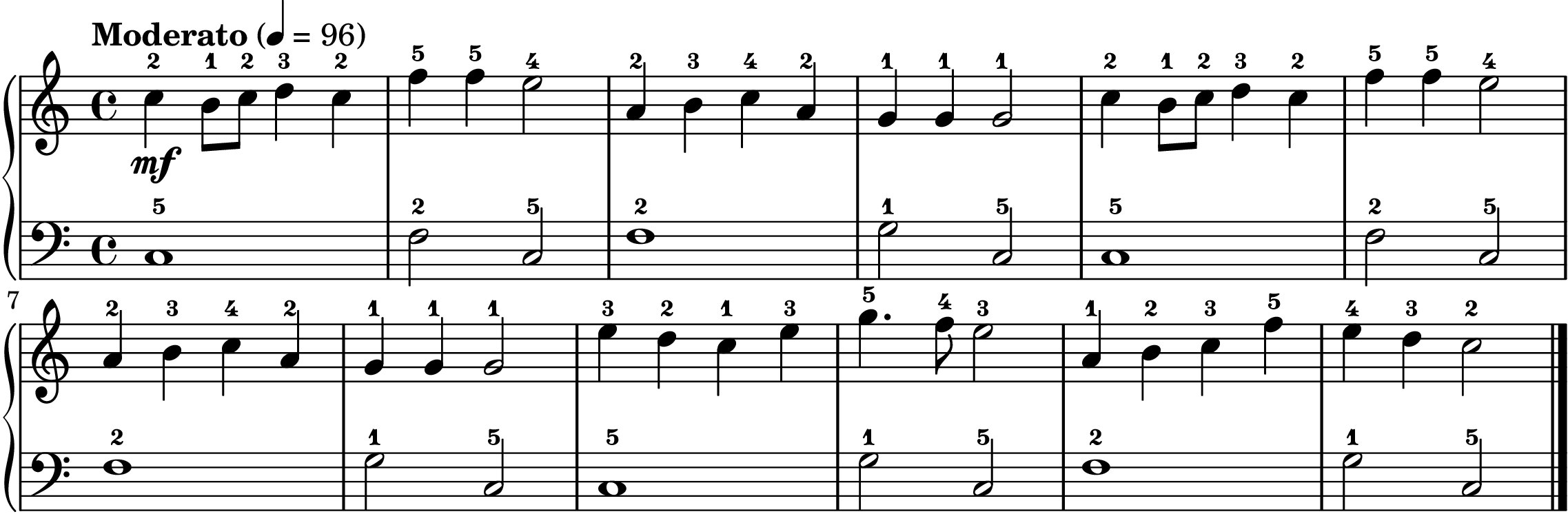
In the full score, begin around 66 BPM, breathe at the end of measure 8 before the refrain, and let the tune flow toward a thankful 96 BPM with a small crest on G5 in measure 10.
Note by note: keys and fingering
- Right hand: One five-finger position per line, all white keys from G4 to G5: the verse alternates between B position (thumb (1) on B4, index (2) on C5, pinky (5) on F5) and G position (thumb on G4, ring finger (4) on C5); the refrain opens in C position and ends in A position with one stretch of the pinky to F5.
- Left hand: Pinky (5) on C3, index (2) on F3, thumb (1) on G3: long anchor notes, one or two per measure, and the hand never moves.
| Note | On the Staff | On the Keyboard | Finger |
|---|---|---|---|
| G4 | Second line of treble staff | White key left of the three black keys | RH Thumb (1) |
| A4 | Second space of treble staff | Between last two of three black keys | RH Index (2) |
| B4 | Middle line of treble staff | Right of three black keys | RH Thumb (1) |
| C5 | Third space of treble staff | One octave above middle C | RH Index (2) |
| D5 | Fourth line of treble staff | Right of C5, between two black keys | RH Middle (3) |
| E5 | Fourth space of treble staff | Right of D5 | RH Ring (4) |
| F5 | Top line of treble staff | Left of the three black keys above C5 | RH Pinky (5) |
| G5 | Space above top line | Highest note of the refrain | RH Pinky (5) |
| C3 | Second space of bass staff | One octave below middle C | LH Pinky (5) |
| F3 | Fourth line of bass staff | Fourth white key above C3 | LH Index (2) |
| G3 | Top space of bass staff | Fifth white key above C3 | LH Thumb (1) |
Prefer a video? Watch the keys light up
Same color code as the player: green marks the right hand, blue the left hand, with the score and keyboard in one vertical video.
The story behind For the Beauty of the Earth
Conrad Kocher, a German organist, wrote this melody in 1838; it was later named Dix after the English poet William Chatterton Dix. In 1864 Folliott Pierpoint, walking the hills above Bath in late spring, wrote the words that made it the great gratitude hymn: for the beauty of the earth, for the glory of the skies. Since every line gives thanks for something, churches and families reach for it every Thanksgiving. The refrain, Lord of all to thee we raise, is the emotional high point, and in this arrangement it climbs to G5, the highest note of the piece, over a bass of just C3, F3 and G3.
Get the printable PDF
The printable PDF of For the Beauty of the Earth - full score, hand positions, and a step-by-step practice guide - ships inside our free Thanksgiving pack together with fourteen other Thanksgiving pieces.
Counting blessings out loud at the keyboard goes better when you are sitting well, and an Adjustable Piano Bench with Back Support keeps your posture easy through long, gentle hymn practice.
Piano teacher? Track your students' practice. Join the early list
FAQ
How hard is For the Beauty of the Earth on piano?
It is a Level 1 piece in our Thanksgiving collection. The right hand stays between G4 and G5 on white keys, one five-finger position per line, and the left hand plays whole and half notes on only C3, F3 and G3 without moving.
How long does it take to learn For the Beauty of the Earth?
About a week. Measures 1-4 and 5-8 are identical, so learning one couplet gives you the whole verse, and the four-bar refrain adds just one dotted rhythm and one pinky reach to F5 in measure 11.
What level is For the Beauty of the Earth?
Level 1 of our Thanksgiving collection. It uses simple positions with the thumb on B4, G4, C5 or A4, no black keys, one dotted rhythm in the refrain, and a three-note bass that spells the I, IV and V chords.
What are the notes for For the Beauty of the Earth?
The first line goes C5, then the eighth-note pair B4-C5, D5, C5, and F5, F5, E5. The answer is A4, B4, C5, A4, then G4, G4, G4. The refrain runs E5-D5-C5-E5, G5-F5-E5, A4-B4-C5-F5, E5-D5-C5. The left hand holds C3, F3 or G3 beneath. See the full table above.