
You’ve probably heard this tune and flinched. It plays under the aerial drive that opens The Shining. It swells as Luke Skywalker finds his family’s homestead burned, and it’s the voice calling Elsa in Frozen II. Its core is four notes, and composers reach for it when death or danger is close.
That tune is the Dies Irae. Looking up the Dies Irae meaning takes ten seconds; checking the film list took me much longer, and plenty of titles didn’t make it. There’s a free Halloween sheet pack at the end.
Fair warning: I’m not a musicologist. I build piano benches. We arranged this chant as piece 1 of our free Halloween pack, and I wanted to know what I was handing people.
Quick answers
- Meaning: Latin for “day of wrath,” the opening of a 13th-century poem about the Last Judgment.
- The motif: four notes. Down a half step, back up, then down a minor third.
- Jump to: the four notes · the 15 films · play it yourself
What Does Dies Irae Mean?
Dies irae is Latin for “day of wrath” (Merriam-Webster). They’re the first two words of a medieval poem about the Last Judgment, the day when, in Christian belief, the living and the dead stand before God.
The phrase is older than the poem. It comes from the prophet Zephaniah (1:15 in the Latin Vulgate), as the 1908 Catholic Encyclopedia notes. The poet built 19 stanzas on it, adding trumpets and judgment scenes from Revelation, Matthew and Paul’s letter to the Thessalonians (Wikipedia).
Dies Irae Lyrics: First Stanza in Latin and English
| Latin | Literal English |
|---|---|
| Dies irae, dies illa, | The day of wrath, that day, |
| Solvet saeclum in favilla, | will dissolve the world in ashes, |
| Teste David cum Sibylla. | as David and the Sibyl bear witness. |
Stanzas 1-17 are rhymed triplets full of fear. Stanzas 18 and 19, the “Lacrimosa” and the “Pie Iesu,” are a plea: grant the dead rest. Mozart’s Lacrimosa, completed by Süssmayr, sets those two stanzas to its own music, not the chant. Our Lacrimosa easy piano arrangement shows how different the same words can sound.
Who Wrote the Dies Irae, and Why Most Funerals Dropped It
Nobody knows for sure. The poem is traditionally attributed to Thomas of Celano, a Franciscan friar who died around 1265. The main rival candidate is Latino Malabranca Orsini, a Dominican who died in 1294. Older legends credited Gregory the Great, which shows how badly people wanted a famous name on it.
The paper trail is firmer. The earliest dated copy is in a Franciscan missal in Naples from 1253-1255 (Wikipedia). So the poem is at least 770 years old.
For centuries it was the sequence (a hymn sung just before the Gospel) of the Requiem Mass, sung at funerals and on All Souls’ Day. Then, in 1969-1970, the reform that followed Vatican II took it out of funeral Masses. Archbishop Annibale Bugnini, a leading figure in that reform, explained why.
They got rid of texts that smacked of a negative spirituality inherited from the Middle Ages. Thus they removed such familiar and even beloved texts as “Libera me, Domine,” “Dies irae,” and others that overemphasized judgment, fear, and despair.
Annibale Bugnini, The Reform of the Liturgy 1948-1975 (1990), p. 773
It didn’t disappear. The chant is still sung in the Traditional Latin Mass, which uses the 1962 Missal (Fr Kenneth Doyle, 2012). It also survives as an optional hymn in the Liturgy of the Hours for All Souls’ Day and the last week before Advent. Of the five old sequences, it’s the only one the new Missal dropped (Adoremus).
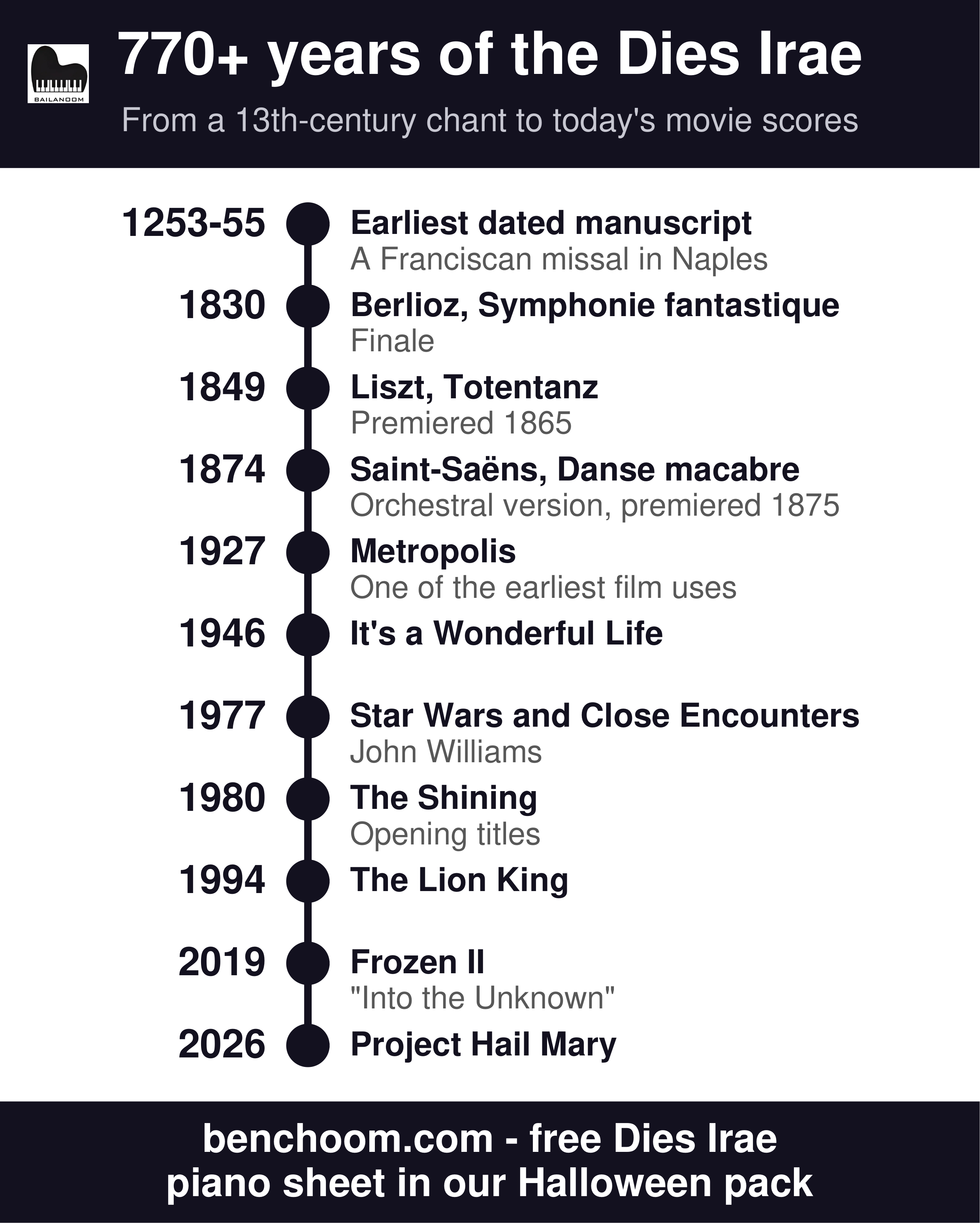
770+ Years of the Dies Irae, at a Glance
It runs from a Naples missal to a 2026 space movie.
Dies Irae Chant vs. Mozart and Verdi: The Words or the Tune?
This is the mix-up almost every article makes. It tripped me up too.
The words vs. the tune
- The words are the 19-stanza poem. Mozart (1791) and Verdi (1874) set them in their Requiems, to music they wrote themselves.
- The tune is the plainchant melody the poem was sung to. Berlioz, Liszt, Rachmaninoff and a century of film composers quote that tune, usually without a single word.
If a choir is shouting Latin over a full orchestra, it’s probably Verdi or Mozart. If you hear four slow notes that sink, that’s the chant.
Musician Ethan Hein notes that Mozart sets the text “to completely different music,” and so does Verdi. A playlist calling Verdi’s thunder “the Dies Irae melody” means the poem, but it’s Verdi’s tune.
The Dies Irae Motif: Why It Sounds Like Death
The chant is in mode 1, the Dorian mode, with D as home. In the standard Solesmes transcription it uses only white keys. Alex Ludwig names the two usual quote lengths (review of his book).
The 4-note motif
F-E-F-D. Down a half step, back up a half step, then down a minor third, which skips one white key. Ludwig calls a quote this short the “Ominous Echo.”
The 8-note phrase
F-E-F-D-E-C-D-D. The whole line “Dies irae, dies illa,” ending on a held home note. Ludwig calls this one the “Prelude to Evil.”
My non-expert guess at the grimness is that the tune hesitates, then sinks. A half step is the smallest move a piano can make, so the back-and-forth sounds unsure. Then the minor third drops onto the home note and stays, like a door closing. Two centuries of witches and graveyards do the rest.
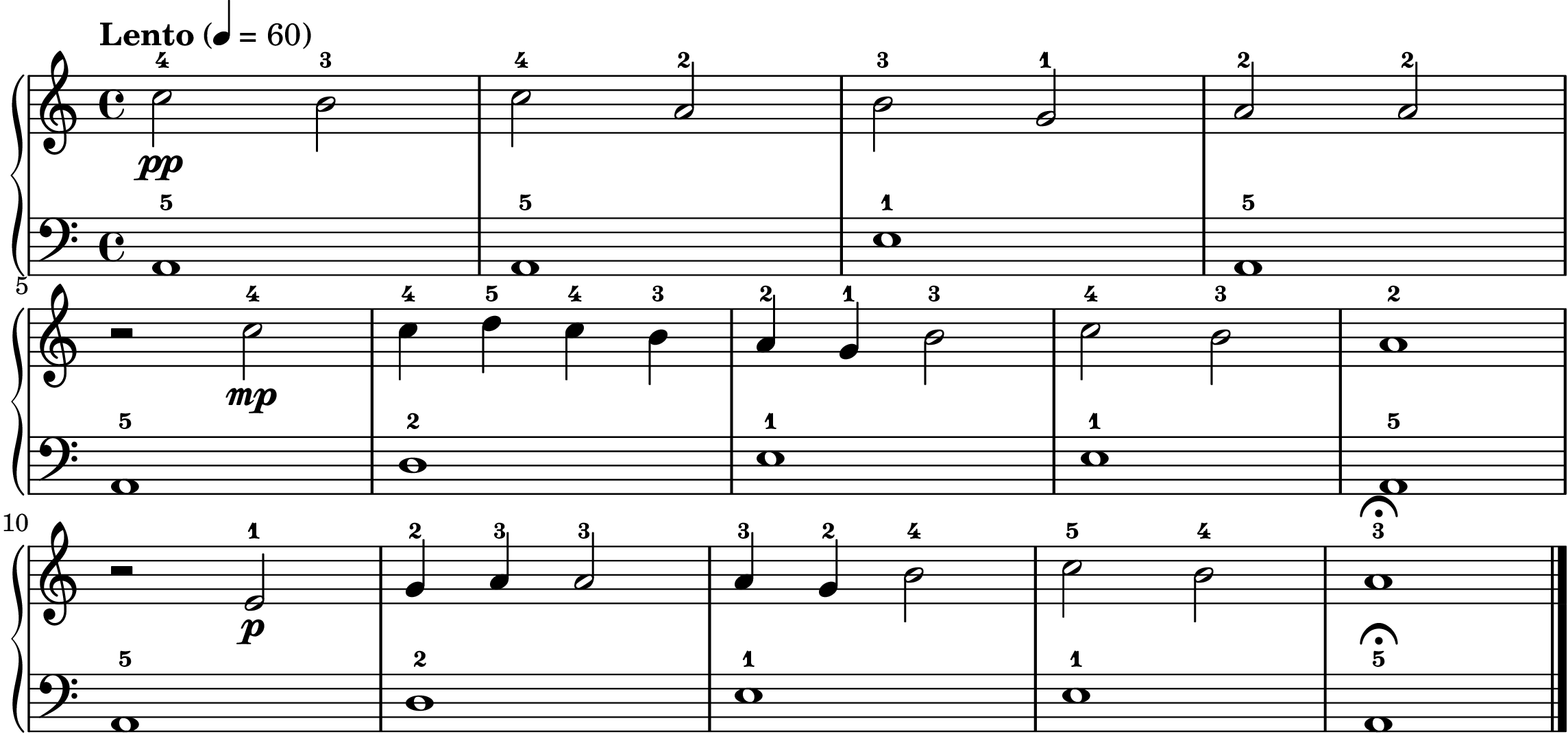
Our arrangement moves the same shape to A minor, still all white keys. The Dies Irae piano notes and easy sheet music page has the notes, fingering and a player that lights up each key.
Where to Hear It in Classical Music
Start with Berlioz. His 1830 symphony turned the chant into the concert hall’s shorthand for death, and Liszt, who transcribed that symphony for piano, likely took the hint (Bangor Symphony program notes).
| Work | Where to listen |
|---|---|
| Berlioz, Symphonie fantastique (1830) | Movement V, “Dream of a Witches’ Sabbath,” bar 127: bassoons and ophicleides (tubas today) in unison, after the bells. |
| Liszt, Totentanz (1849, premiered 1865) | The whole piece: variations on the chant for piano and orchestra. |
| Saint-Saëns, Danse macabre (1874) | A brief major-key quote in the woodwinds at rehearsal letter D, about a third of the way in. |
| Mussorgsky, “Trepak” (1875) | No. 3 of Songs and Dances of Death, for voice and piano. |
| Rachmaninoff, Rhapsody on a Theme of Paganini (1934) | Variation 7, a slow piano chorale (Houston Symphony). Also Isle of the Dead (1909) and Symphonic Dances (1940). |
The Saint-Saëns quote is quick and, in a major key, almost cheerful. That’s the joke. Our Danse Macabre easy piano arrangement puts the quote in Section B, in A minor rather than his major.
Dies Irae in Movies: 15 Films That Quote It
Every film here has at least two independent sources.
1927-1970s
- Metropolis (1927) · Gottfried Huppertz · the oldest example on Alex Ludwig’s list, analyzed in his 2025 book
- It’s a Wonderful Life (1946) · Dimitri Tiomkin · George Bailey at the snowy bridge (James Deaville, The Conversation)
- Star Wars: A New Hope (1977) · John Williams · “Burning Homestead,” as Luke finds his aunt and uncle’s farm in flames
- Close Encounters of the Third Kind (1977) · John Williams · as townspeople watch the alien lights in the sky, and again in the cue “The Mountain”
1980s-1990s
- The Shining (1980) · Wendy Carlos & Rachel Elkind · the main title over the mountain-road opening (Berklee Online)
- Poltergeist (1982) · Jerry Goldsmith · just after the mother crawls out of the skeleton-filled pool
- Home Alone (1990) · John Williams · the “Old Man Marley” motif, for the neighbor Kevin fears
- Jurassic Park (1993) · John Williams · the “fence motif,” around the electric fence the T. rex breaks through
- The Nightmare Before Christmas (1993) · Danny Elfman · “Making Christmas,” built on the four-note motif
- The Lion King (1994) · Hans Zimmer · the hyenas chasing Simba through the canyon after Mufasa’s death (Classic FM)
2000s-2026
- Harry Potter and the Chamber of Secrets (2002) · John Williams · on Tom Schneller’s list of Williams scores, though I couldn’t pin down the cue
- Sweeney Todd (2007) · Stephen Sondheim · “Epiphany,” kept from his 1979 stage score
- Doctor Sleep (2019) · The Newton Brothers · brings back The Shining‘s Dies Irae
- Frozen II (2019) · Kristen Anderson-Lopez & Robert Lopez · the siren call in “Into the Unknown,” confirmed by the songwriters to The New York Times
- Project Hail Mary (2026) · Daniel Pemberton · a hopeful, driving rework in cues like “Time Go Fishing” (No Film School)
Why Film Composers Keep Reaching for It
It works without explanation. After Berlioz, audiences heard death in it, and silent-film musicians inherited that vocabulary. On the Twenty Thousand Hertz podcast, the host calls it “basically a meme,” and Ludwig, who teaches at Berklee, agrees: it’s a thing that “grows and changes as it happens.”
John Williams keeps coming back to it. Tom Schneller’s 2025 study finds the chant in 21 of his scores. Ludwig also built the supercut behind Vox’s 2019 video, more than 30 films in a row.
If you’d rather have those four notes under your own hands, the play section is just past the myths.
Myths: Where the Dies Irae Is NOT
Lists online pad themselves out. These claims didn’t survive checking, or only half did.
- Mozart’s and Verdi’s Requiems. Their own music, as the box above explains.
- Night on Bald Mountain. One orchestra’s program note claims it, but the Wikipedia article and the St. Louis Symphony’s notes don’t mention it, so I’d call it unproven. Mussorgsky’s clear use is “Trepak.” Our Night on Bald Mountain arrangement is in the Halloween pack for the spookiness alone.
- The Halloween theme (1978). John Carpenter built it on the 5/4 rhythm his father taught him on bongos, played in octaves on the piano (PBS). No Dies Irae link has been shown.
- Mad Max: Fury Road (2015). That’s Verdi’s “Dies irae,” during the Bullet Farmer’s night attack (soundtrack).
- A Clockwork Orange (1971). The title music is built on Purcell’s Music for the Funeral of Queen Mary. Wendy Carlos’s own liner notes say the Dies irae is “also heard” in it. So it’s in there, just buried under Purcell.
Got a solid source for any of these? Write to me and I’ll update the page.
Hear It, Then Play It
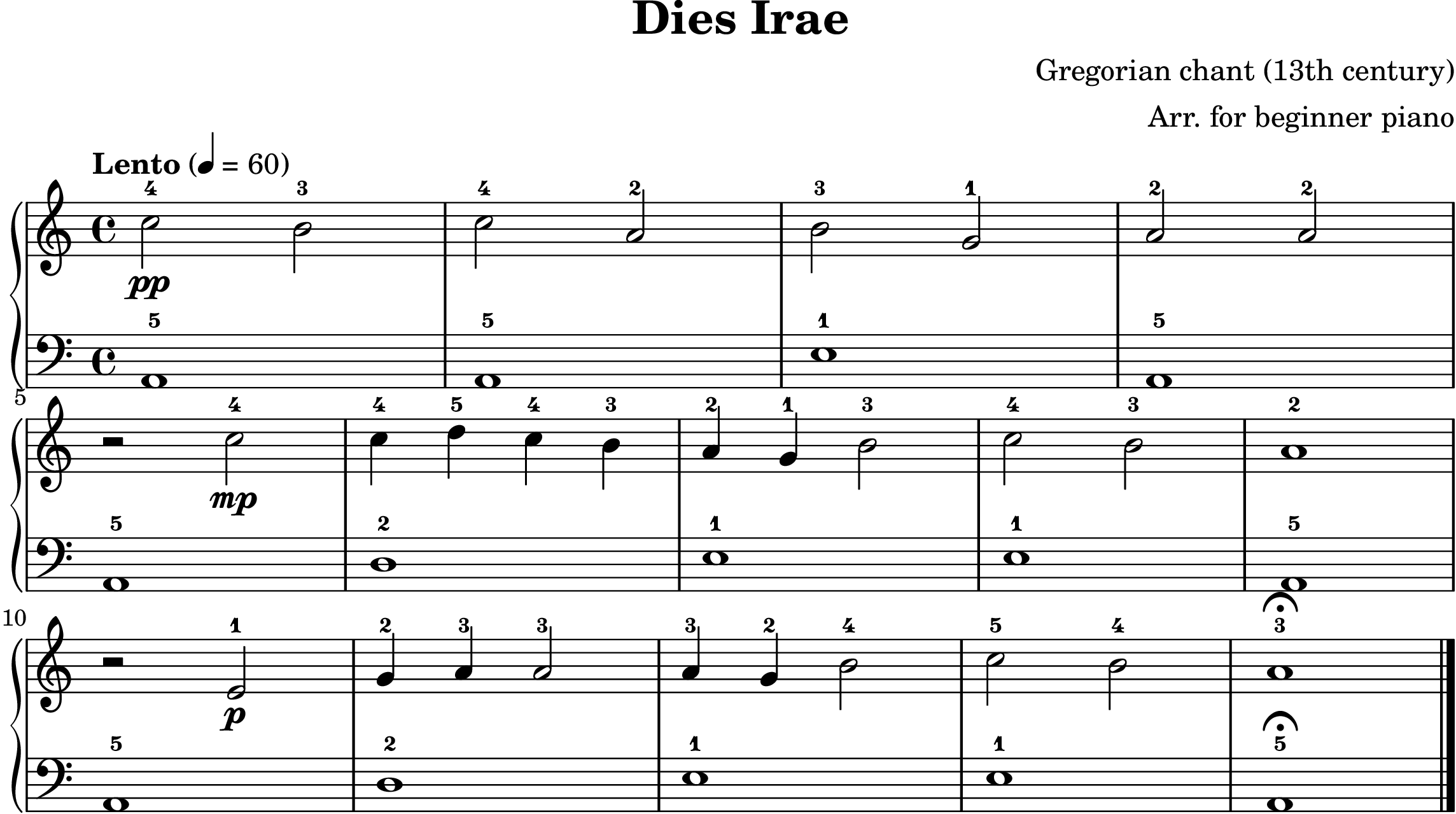
Our free Dies Irae sheet comes with an interactive player, so you can hear the arrangement before your hands touch the keys. Can’t read music yet? Start there: the notes and keys light up at half speed. It’s piece 1 of the pack’s Level 1, all white keys, right hand in one five-finger position.
One tip from my side of the business: sit centered, at a height where your forearms run roughly level with the keys. I spend my days on bench heights, and a slow chant played from a slouch sounds like a slouch. The piano bench height calculator gives you a number in seconds.
The pack has 15 pieces across 3 levels (Danse Macabre, Night on Bald Mountain and Lacrimosa among them). Level 1 is a 28-page PDF that downloads directly, no email. Levels 2 and 3 are free too; we send those by email.
Dies Irae FAQ
What does Dies Irae mean?
Dies irae is Latin for ‘day of wrath.’ It’s the opening of a 13th-century poem about the Last Judgment, borrowed from the prophet Zephaniah (1:15). The poem ends with a plea for mercy, asking Jesus to grant the dead rest.
Who wrote the Dies Irae?
Nobody knows for certain. It’s traditionally credited to the Franciscan friar Thomas of Celano, and the main alternative candidate is the Dominican Latino Malabranca Orsini. The earliest dated manuscript is a Franciscan missal in Naples from 1253-1255.
Is the Dies Irae still sung at Catholic funerals?
Not in the ordinary funeral Mass. It was removed from Masses for the Dead in the 1969-1970 reforms that followed Vatican II. It’s still part of the Traditional Latin Mass (1962 Missal) and survives as an optional hymn in the Liturgy of the Hours.
What movies use the Dies Irae?
The Shining, Star Wars: A New Hope, It’s a Wonderful Life, The Lion King, Home Alone, Jurassic Park and Frozen II all quote it. One of the earliest known film uses is Metropolis (1927); one of the newest is Project Hail Mary (2026).
What are the 4 notes of the Dies Irae?
Down a half step, back up a half step, then down a minor third, landing on the home note of the Dorian mode. They open the chant’s first line, ‘Dies irae, dies illa.’ The exact pitches and a play button are in this article’s motif section.
Does Mozart’s Requiem use the Dies Irae melody?
No. Mozart set the Dies irae words to his own music and never quotes the chant tune. Verdi’s Requiem does the same.
Is the Dies Irae in Frozen 2?
Yes. The four-note siren call in ‘Into the Unknown’ is the Dies irae. Songwriters Kristen Anderson-Lopez and Robert Lopez confirmed it to The New York Times in 2019.
Written down by 1255 and cut from most funerals around 1970, the day of wrath is still a composer’s quickest way to say someone won’t make it to the credits. I went looking for a quick Dies Irae meaning and came out oddly comforted, because the poem ends by asking for rest.
Sources are linked throughout. Mistakes are mine; tell me.
Want the tune under your own fingers? The Dies Irae is piece 1 of our free Halloween pack, and Level 1 is a 28-page PDF you can download without giving an email.
