
Level 3: Simple Hands Together
Sign up for free and receive this PDF with 5 pieces directly in your inbox.
Level 3 is the moment it all comes together. Your hands play simultaneously for the first time, with the left hand providing simple accompaniment patterns while the right hand carries melodies you already know by heart. You will also step outside 4/4 time – four of these five pieces are in 3/4, giving you the lilting waltz feel that shapes so much of the piano repertoire. This is where playing the piano starts to sound like real music.
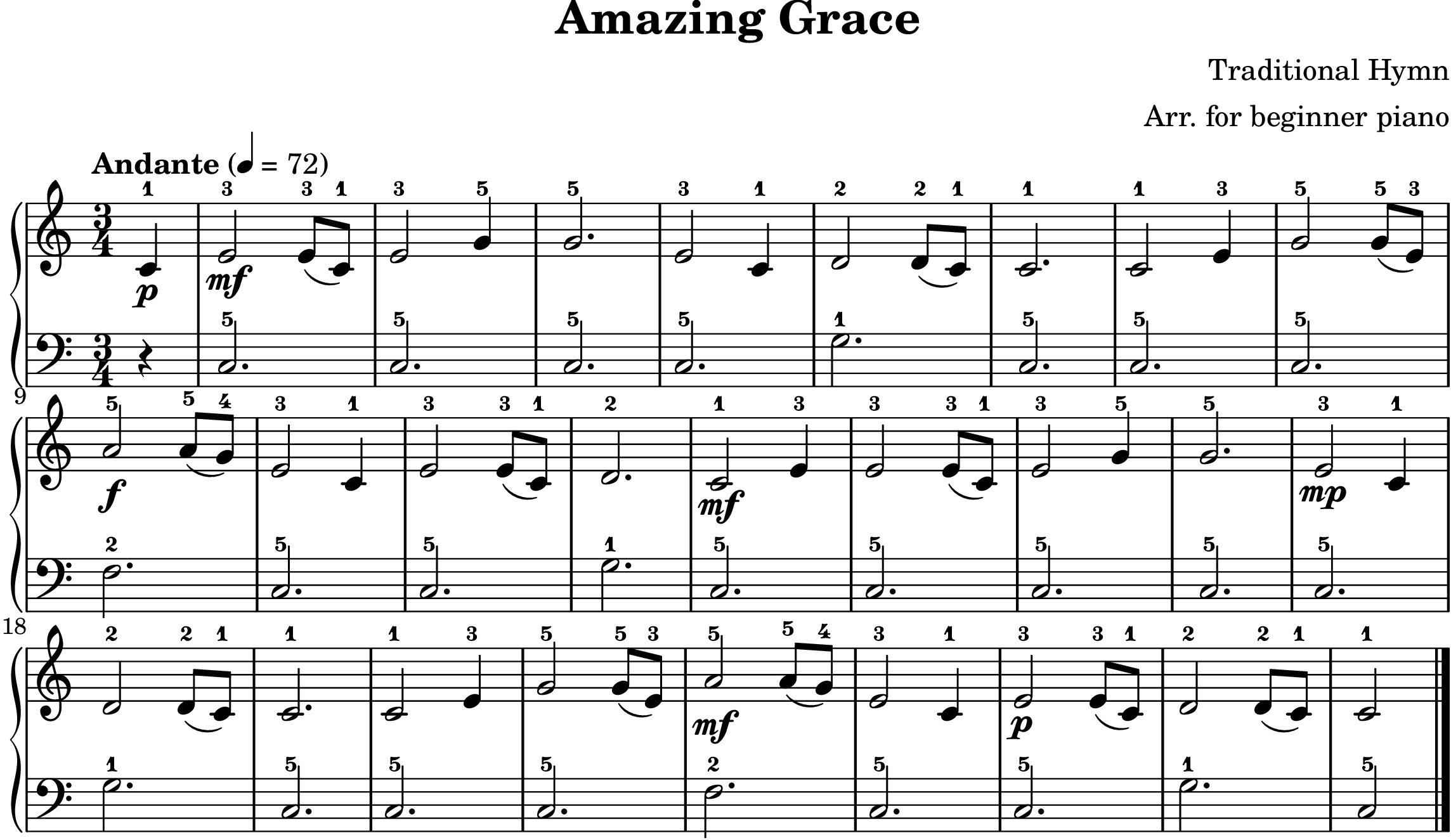
Score Preview
What You’ll Learn at This Level
- Hands-together coordination – The left hand plays on specific beats while the right hand moves independently. You will learn to keep one hand steady as an anchor while the other hand plays a melody above it – the core skill of piano playing.
- 3/4 time signature – Four of the five pieces use three beats per measure instead of four. This waltz-like pulse changes how music feels under your fingers and trains you to count in groups of three – essential for classical and folk repertoire.
- Your first minor key – Scarborough Fair is written in D minor, introducing flats and a darker, more melancholy sound. Playing in minor expands your emotional range as a musician and teaches you that not all music lives on white keys alone.
What’s Inside – 5 Pieces
Amazing Grace
John Newton | G Major | 3/4 | 24 measures
This hymn is one of the most recognizable melodies on Earth, and it sounds beautiful even in a simple arrangement. The left hand plays open fifths – just two notes at once – creating a spacious, resonant bass. The 3/4 time signature gives it a gentle, swaying pulse. Practice the left hand fifths slowly, letting each pair of notes ring fully before moving to the next. Your ear will tell you when the balance between hands is right.
Happy Birthday
Hill Sisters | C Major | 3/4 | 16 measures
The most practical piece in the entire collection. Learn this and you have a skill you will use for the rest of your life – at every birthday party, family gathering, and celebration. The left hand plays root-fifth patterns that support the melody without getting in the way. The real challenge is the pickup note at the start: the melody begins on beat 3, not beat 1. Count “1-2” silently, then play on “3.”
Scarborough Fair
Traditional English | D minor | 3/4 | 24 measures
Your first minor key piece, and it sounds haunting from the very first note. The left hand holds a drone bass with finger 5 anchored on D while the right hand traces the old English melody above it. The drone technique is ancient – used by bagpipes and hurdy-gurdies for centuries – and it creates a moody atmosphere with almost no effort. Let the D ring and do not rush the melody.
Auld Lang Syne
Robert Burns | G Major | 4/4 | 16 measures
The only 4/4 piece in Level 3 introduces the concept of an anacrusis – a pickup note before the first full measure. The melody starts before the downbeat, which gives the phrase a forward momentum that carries through the whole song. The left hand plays on beats 1 and 3, creating a steady foundation. Count the pickup note carefully: it falls on beat 4 of a silent “intro” measure.
Brahms’ Lullaby
Johannes Brahms | C Major | 3/4 | 16 measures
Brahms wrote this in 1868 as a gift for a friend’s newborn. The left hand plays a waltz pattern – bass note on beat 1, chord on beats 2 and 3 – which is the fundamental accompaniment pattern for hundreds of classical pieces. Play softly and slowly. This is your first lesson in dynamic control: the whole piece should feel like a whisper, never rising above mezzo-piano. If the baby would wake up, you are playing too loud.
How to Practice Level 3
- Learn hands separately, even though the goal is hands together. This is more important now than ever. Spend a full practice session on left hand alone before trying to combine. Your left hand needs to be on autopilot so your brain can focus on the right hand melody.
- Count in three for 3/4 pieces. Say “1-2-3, 1-2-3” out loud as you play Amazing Grace, Happy Birthday, Scarborough Fair, and Brahms’ Lullaby. The waltz pulse should become second nature – you will use it for the rest of your piano life.
- Start with Happy Birthday. It is the shortest piece and the melody is deeply familiar. Getting one hands-together piece under your belt builds the confidence to tackle the longer, more complex arrangements that follow.
- Practice the transitions between phrases. The hardest moment in any piece is where one phrase ends and the next begins. Isolate those two-bar transitions and repeat them until they flow smoothly. In Amazing Grace, the move from measure 8 to measure 9 is the spot most beginners stumble.
Every Piece Includes
Real Sheet Music
Professionally engraved with treble and bass clef.
Fingering Guide
Every note mapped to the correct finger.
Practice Steps
Right hand, left hand, then hands together.
Hands-together playing requires longer practice sessions, and longer sessions require a comfortable seat. If you are wondering how much time to spend at the keys each day, our guide on how long to practice piano breaks it down by level and goal. For the full collection of free beginner sheet music, visit our free piano sheets page.
Browse Other Levels
First Steps | Fluent Separate Hands | First Classical Pieces | Advanced Beginner