
Level 5: Advanced Beginner
Sign up for free and receive this PDF with 5 pieces directly in your inbox.
Level 5 is the final step before intermediate repertoire. These five pieces demand sustain pedal control, even broken-chord playing, flowing melodies, and the ability to create mood through touch alone. You will play music by Bach, Pachelbel, Satie, Joplin, and Debussy – spanning more than two centuries of piano writing, from the Baroque to ragtime and Impressionism. Each piece requires you to listen as much as you play, shaping tone and dynamics to bring the music to life. This is where technique becomes expression.
Score Preview
What You’ll Learn at This Level
- Sustain pedal technique – Gymnopedie, Clair de Lune, and the Bach Prelude all rely on the sustain pedal to blend notes into shimmering washes of sound. You will learn when to press, when to lift, and how to change the pedal cleanly without creating a muddy blur.
- Syncopation and rhythmic independence – The Entertainer’s ragtime syncopation puts the melody accent between the beats while the left hand plays on the beats. Pachelbel’s Canon layers a melody that doubles its speed over a bass line that never changes. Both pieces train your hands to live in different rhythmic worlds at the same time.
- Expressive tone control – Every piece in Level 5 requires you to play softly without losing clarity. Satie marked Gymnopedie “Lent et douloureux” (slow and sorrowful). Debussy’s Clair de Lune needs a floating, moonlit quality. Learning to control how hard you press each key – and how quickly you release it – is the skill that separates mechanical playing from musical playing.
What’s Inside – 5 Pieces
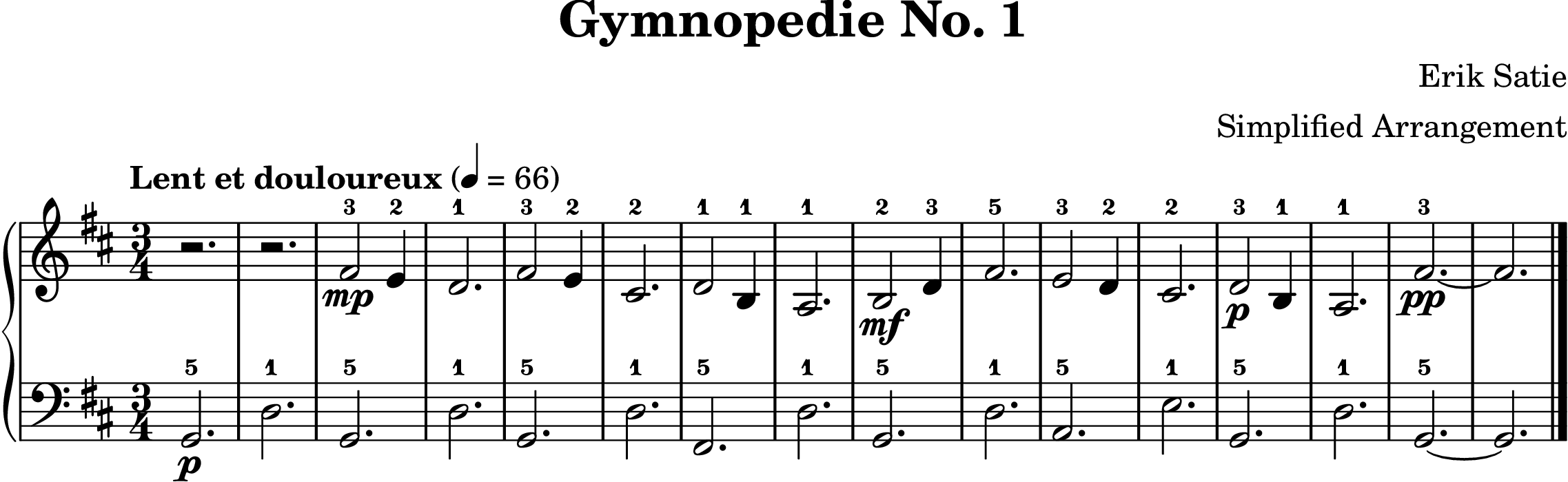
Gymnopedie No. 1
Erik Satie | D Major | 3/4 | 40 measures
Satie composed this in Paris in 1888, and it became one of the most meditative pieces in the piano repertoire. The left hand plays wide chords – stretching across fifths and sixths – while the right hand floats a spare, unhurried melody above. The sustain pedal is essential here: hold it through each bar to let the harmonies blend. Play at a tempo where you have time to listen to each chord decay before the next one arrives. If it does not feel slow enough, slow down more. Satie would have approved.
The Entertainer
Scott Joplin | C Major | 2/4 | 36 measures
Joplin published this ragtime classic in 1902 and wrote “Not fast” at the top of the score – a direction most pianists ignore. Do not be one of them. The magic of ragtime is in the lilt, not the speed. The right hand plays syncopated rhythms that land between the left hand’s steady oom-pah bass. Practice the right hand alone first, clapping the rhythm before playing it on keys. When you add the left hand, keep it metronomically steady – the right hand bounces off that foundation.
Clair de Lune Theme
Claude Debussy | Db Major | 9/8 | 24 measures
The third movement of Debussy’s Suite bergamasque, written in a key with five flats. That key signature looks intimidating, but Db Major actually sits comfortably under the hands because the black keys create a natural hand shape. The 9/8 time signature means nine eighth notes per measure, grouped in threes – count “1-2-3, 1-2-3, 1-2-3.” Use the pedal generously and let the notes shimmer into each other. This arrangement captures the dreamy opening theme that makes Clair de Lune one of the most beloved piano pieces ever written.
Canon in D (Theme)
Johann Pachelbel | D Major | 4/4 | 16 measures
Written around 1694 and rediscovered in the 20th century, Pachelbel’s Canon is now the most played classical piece at weddings worldwide. The left hand plays the famous eight-note ground bass – single half notes, no chords – repeating unchanged through the entire piece, while the right hand melody builds from calm half notes into flowing quarter notes. Practice the bass loop until your fingers find the notes automatically, then let the melody unfold on top of it.
Prelude in C Major (BWV 846)
Johann Sebastian Bach | C Major | 4/4 | 12 measures
The opening piece of Bach’s Well-Tempered Clavier (1722) has been the first classical piece of piano students for three hundred years. There is no melody in the usual sense – just one broken chord per measure, rippling from bottom to top in perfectly even eighth notes, over two calm single bass notes. Its hypnotic quality comes from that evenness. Practice the climbing hand shape of measure one until it feels like a single gesture, then apply it to every measure that follows.
How to Practice Level 5
- Practice pedaling as a separate skill. Before playing any notes, just practice pressing and releasing the sustain pedal with your right foot. Press smoothly – not with a stomp. Release cleanly. Then practice changing the pedal (release and press in one motion) while holding a single chord. Clean pedal changes are the difference between a beautiful wash of sound and an ugly blur.
- Record yourself and listen back. Level 5 pieces are about nuance – soft dynamics, tone color, phrasing. You cannot hear these subtleties while you are focused on playing the notes. Record a practice run on your phone, then listen with fresh ears. You will immediately hear things to improve that you missed in the moment.
- Practice the left hand patterns in isolation for 5 minutes daily. The rippling broken chords in the Bach Prelude, the calm single notes in Gymnopedie, and the repeating ground bass in the Canon all need to become reflexive. Treat them like warm-up exercises. Five minutes of focused left-hand repetition at the start of each session pays enormous dividends.
- Do not rush The Entertainer. Joplin himself wrote “Not fast” on the original score. Ragtime played too quickly loses its rhythmic charm and turns into a scramble. Set your metronome to 72 BPM and stay there until the syncopation feels natural. Speed will come later, if you even want it – many pianists prefer The Entertainer at a relaxed tempo.
Every Piece Includes
Real Sheet Music
Professionally engraved with treble and bass clef.
Fingering Guide
Every note mapped to the correct finger.
Practice Steps
Right hand, left hand, then hands together.
Level 5 pieces demand long, focused practice sessions – sometimes 45 minutes or more. Your bench matters. A wobbly seat or a fixed-height stool limits your ability to maintain proper posture over extended playing. Our guide on the best piano bench for long practice sessions covers adjustable-height options that support your back for hours. If you play a digital piano, the Bailanoom collection offers ergonomic solutions designed for home studios. For the full set of all five levels, visit our free piano sheets page.
Browse Other Levels
First Steps | Fluent Separate Hands | Simple Hands Together | First Classical Pieces