
Come, Thou Fount of Every Blessing is printed here in its familiar NETTLETON form, in F major and 3/4, the key of the 1851 source. Its four lines follow an A A B A plan, so once one line is learned, three of the four are done.
Learn it with the interactive player
- Slow it down: x0.5 or x0.75 while you learn the notes, back to x1 once they flow.
- Pause anywhere: the current keys stay lit so you can find them on your own piano.
- Drag the score left or right, or use the 15s buttons, to replay a phrase.
The sheet music, section by section

The main line is played twice in section A, the second time at mp. Each line starts with a pickup of two eighths, A4 and G4, and lands on F4 with the thumb. Most bars are two quarters and two eighths: F4, F4, then A4 and C5 on fingers 3 and 4. The line peaks on D5, the pinky, in measure 3 and comes back to a half-note F4. Only the left hand plays the B-flat of the key signature.

In section B the melody climbs to F5. At the end of measure 8 an eighth C5 and two sixteenths, D5 and E5, lead up on fingers 2, 3, 4, and the pinky lands on F5 at mf. Measure 10 repeats that quick lift, and measure 12 holds F5 for two beats. Under it the left hand moves between F3 and C4, with Bb3 in measure 10. The main line comes back at mp for the last four bars, ending on a dotted-half F4 with a fermata.
The full score
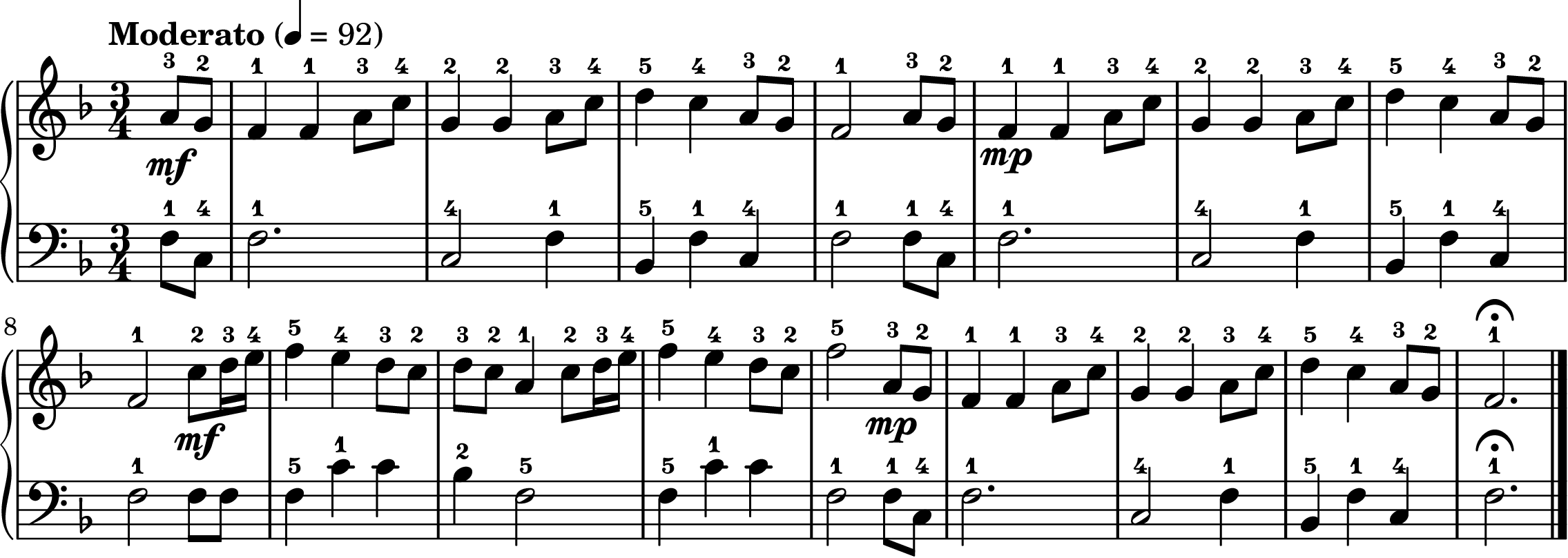
Sixteen bars and a pickup in 3/4, Moderato, 92 to the quarter. Lean slightly on beat 1 of each bar and keep the eighths even, then let the sixteenths in measures 8 and 10 pass lightly. About 70 to the quarter is a good working speed before you try 92.
Note by note: keys and fingering
- Right hand: The A lines fit one spread position on F: thumb (1) on F4, index (2) on G4, middle (3) on A4, ring (4) on C5 and pinky (5) on D5, with no finger needed for B-flat. For section B the hand moves up so that fingers 2, 3, 4 and 5 sit on C5, D5, E5 and F5, and in measure 10 the thumb reaches back to A4. The pickup A4, G4 on fingers 3 and 2 returns the hand to F4 for the last line.
- Left hand: The thumb (1) keeps F3 for most of the piece, the ring finger (4) takes C3 and the pinky (5) Bb2 in measure 3. In section B the hand turns around, with the pinky (5) on F3, thumb (1) on C4, and the index (2) on Bb3 in measure 10. Most pickups are pairs of eighths, F3 and C3 on fingers 1 and 4. The final F3 is a dotted half, held with the thumb.
| Note | On the Staff | On the Keyboard | Finger |
|---|---|---|---|
| F4 | First space of treble staff | White key left of the three black keys above middle C | RH Thumb (1) |
| G4 | Second line of treble staff | White key between the first two of three black keys above middle C | RH Index (2) |
| A4 | Second space of treble staff | White key between the last two of three black keys above middle C | RH Middle (3) |
| C5 | Third space of treble staff | One octave above middle C | RH Ring (4) |
| D5 | Fourth line of treble staff | White key between the two black keys above C5 | RH Middle (3) |
| E5 | Fourth space of treble staff | White key right of the two black keys above C5 | RH Ring (4) |
| F5 | Top line of treble staff | White key left of the three black keys above C5 | RH Pinky (5) |
| Bb2 | Second line of bass staff (B-flat in the key signature) | Black key just left of B2, the last of the three black keys, an octave and a step below middle C | LH Pinky (5) |
| C3 | Second space of bass staff | One octave below middle C | LH Ring (4) |
| F3 | Fourth line of bass staff | White key left of the three black keys below middle C | LH Thumb (1) |
| Bb3 | Space above the bass staff (B-flat in the key signature) | Black key just left of B3, the last of the three black keys below middle C | LH Index (2) |
| C4 | Ledger line above the bass staff (middle C) | Middle C | LH Thumb (1) |
Prefer a video? Watch the keys light up
Same color code as the player: green marks the right hand, blue the left hand, with the score and keyboard in one vertical video.
The story behind Come, Thou Fount
The tune is an anonymous American folk hymn. It was first printed as HALLELUJAH in John Wyeth's Repository of Sacred Music, Part Second (Harrisburg, 1813), but that print differs from the tune people sing: notes 4 to 6, a passing note, the even rhythm and the second strain are not the same. The familiar form, NETTLETON, is first verified in Temple Melodies, edited by Darius E. Jones (New York: Mason & Law, 1851), page 199, and that is the version we follow, in its own key of F major. No source supports crediting the tune to Asahel Nettleton. The words, written by Robert Robinson (died 1790) in 1758, are left out. We wrote out the A A B A form, lengthened the last note and simplified the bass.
Get the printable PDF
The free PDF of Come, Thou Fount downloads directly, without an email address. Inside are the full score, fingered for both hands, a practice plan, and one tip for every section. More pieces for the season are on the Thanksgiving pack page below; Level 1 downloads free and Levels 2 and 3 come by email.
The sixteenth-note lifts in measures 8 and 10 come out lighter from a loose wrist level with the keys, a height the piano bench height calculator works out for you and the Adjustable Piano Bench with Back Support keeps.
FAQ
What level is Come, Thou Fount on piano?
We place it at Level 3. The repeated main line keeps the reading light. The eighth and two sixteenths at the end of measures 8 and 10 and the reach up to F5 put it above Level 2.
Is this the original tune of Come, Thou Fount?
It is the familiar form, called NETTLETON, as printed in Temple Melodies in 1851. The tune first appeared in 1813 under the name HALLELUJAH, with different notes in the first line and a different second strain. We chose the 1851 form because it is the melody people sing today.
How should I practice Come, Thou Fount?
Spend the first week on the main line alone, since it is played three times. Then add section B with its sixteenths, and play all four lines hands together before raising the tempo. Two to three weeks at 15 minutes a day is a fair plan.
How does Come, Thou Fount go, note by note?
Pickup A4, G4, then F4, F4, A4, C5, then G4, G4, A4, C5, then D5, C5, A4, G4 and a half-note F4. Section B starts at the end of measure 8 with C5, D5, E5 and reaches F5.