
This is Schubert’s Ave Maria: the voice line of the first verse in its original B-flat major and 4/4, with his rhythm left as written. The interactive player can slow it to half speed while the keys light up. Fingering for both hands and a free printable PDF are further down.
Learn it with the interactive player
- Slow it down: x0.5 or x0.75 while you learn the notes, back to x1 once they flow.
- Pause anywhere: the current keys stay lit so you can find them on your own piano.
- Drag the score left or right, or use the 15s buttons, to replay a phrase.
The sheet music, section by section
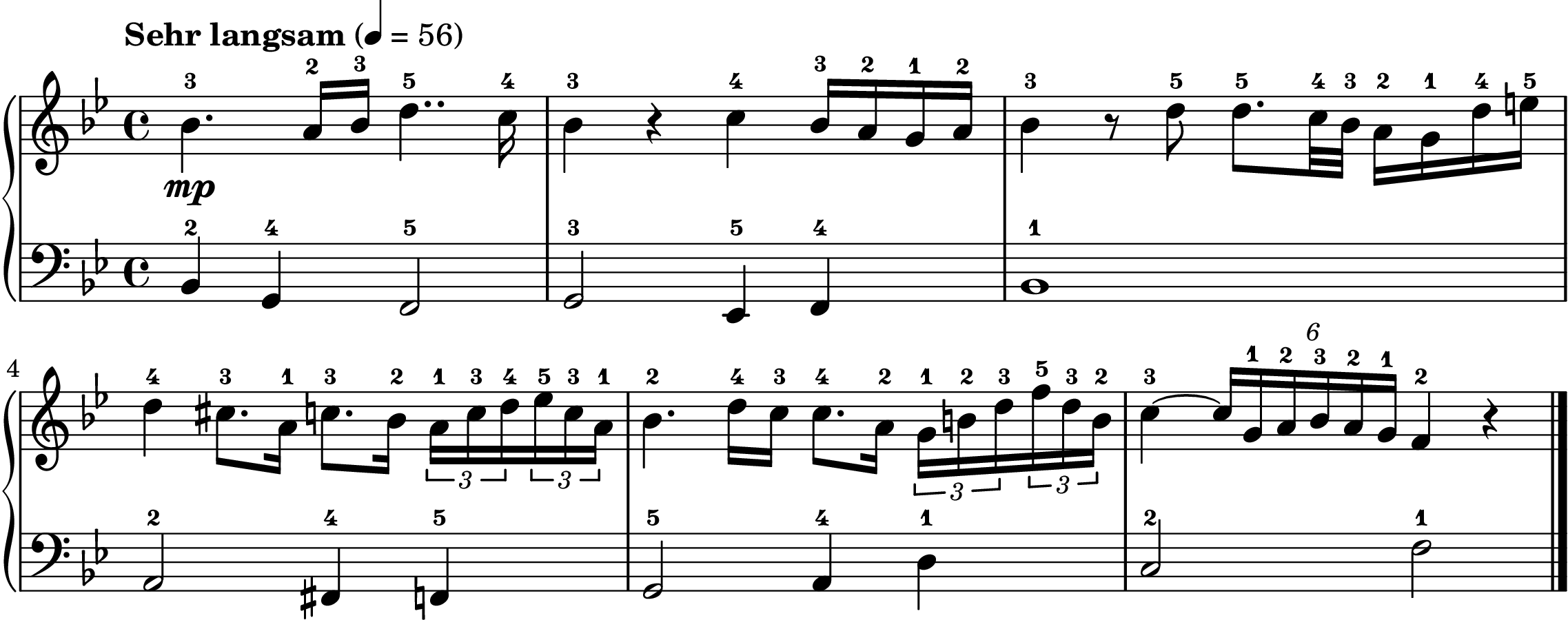
Section A, measures 1-6, is the first half of the verse, marked mezzo-piano. It opens on a dotted-quarter Bb4 with finger 3, two sixteenths A4 and Bb4, and a double-dotted D5 with the pinky. Measure 3 brings the first 32nd notes, C5 and Bb4 after a dotted-eighth D5, and ends on E5, an E natural. Measures 4 and 5 add 16th-note triplets, with C#5 in measure 4 and a B natural in the broken chord G4, B4, D5, F5 of measure 5. In measure 6 the tied C5 runs into a sextuplet, C5, G4, A4, Bb4, A4, G4, played in one hand position, and the section closes on F4. Practice at x0.5 and count in sixteenths.
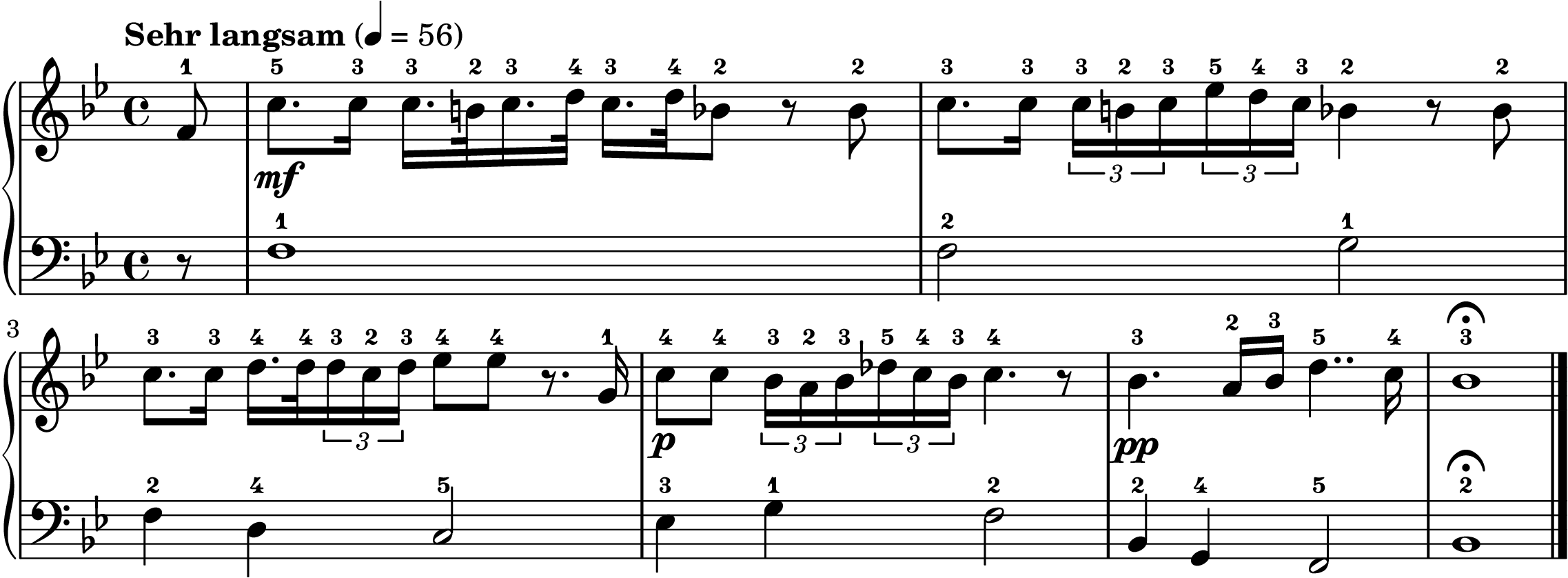
Section B starts with the F4 pickup at the end of measure 6 and runs to measure 12. Measure 7 is mezzo-forte: a dotted-eighth C5 with the pinky, finger 3 on the repeated C5, then three dotted-16th and 32nd pairs, C5-B4, C5-D5, C5-D5. Measures 8 and 9 bring back the 16th-note triplets and climb to two Eb5 eighths. Measure 10 drops to piano, with a Db5 for the pinky, and measure 11 repeats the opening bar at pianissimo before the whole-note Bb4 under the fermata. In measures 7-9, keep every 32nd short, even at x0.5.
The full score
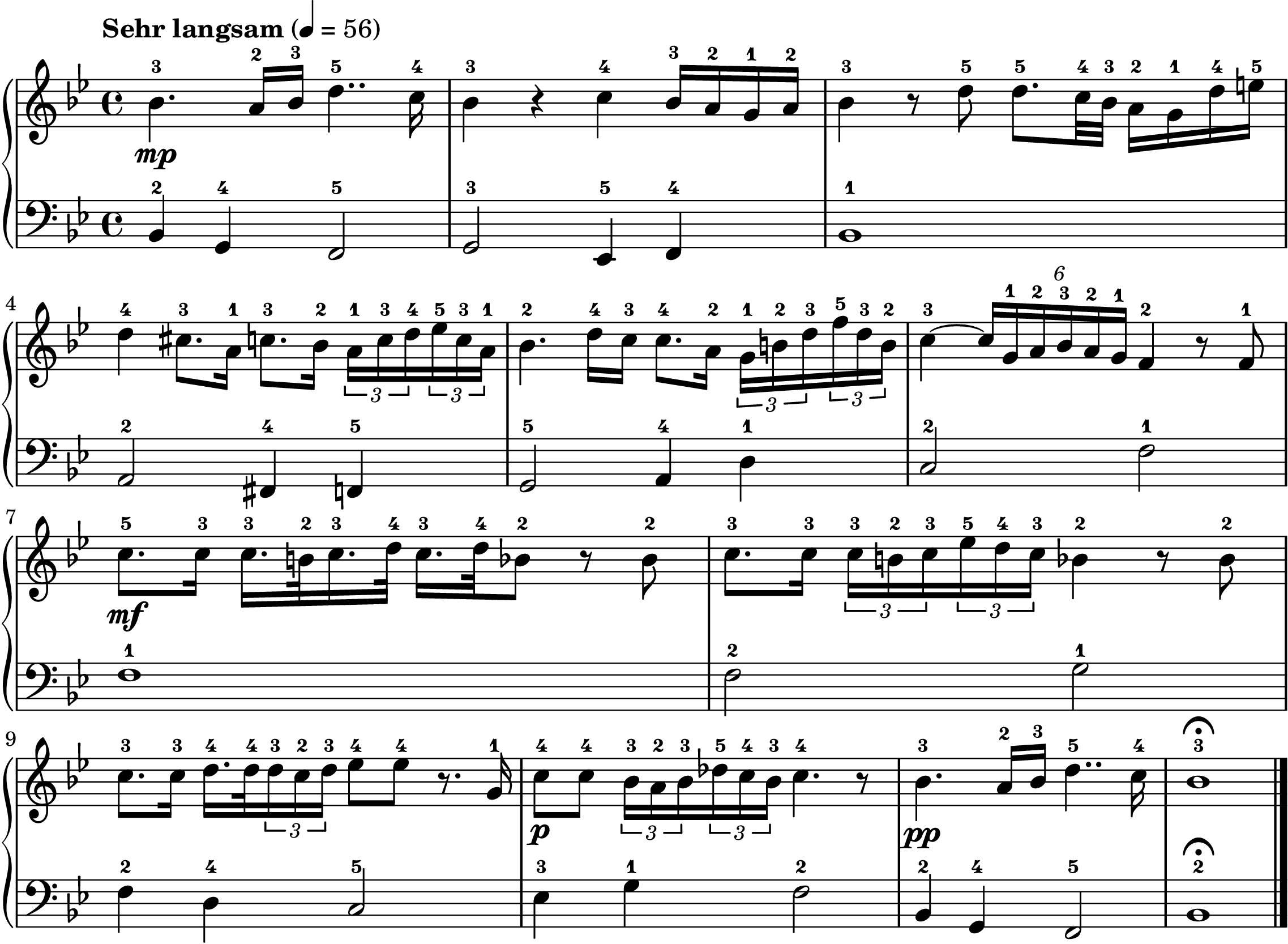
The 12 bars are marked Sehr langsam, very slowly, at 56 to the quarter. The left hand plays Schubert's bass in quarters, halves and whole notes, from Eb2 up to G3. Count eight eighths per bar at x0.5, and add the left hand only once the right-hand rhythm is steady. The dynamics go mp at the start, mf in measure 7, p in measure 10 and pp in measure 11.
Note by note: keys and fingering
- Right hand: The hand moves with the phrase, and the printed fingers mark every move. The opening sits with the thumb (1) on G4, index (2) on A4, middle (3) on Bb4, ring (4) on C5 and pinky (5) on D5. In measure 3 the ring finger takes D5 so the pinky can reach E5, and in measure 5 the 16th-note triplets G4, B4, D5, F5 take 1-2-3-5. Repeated notes change finger so the hand can shift: C5 from 3 to 4 in measure 5 and from 5 to 3 in measure 7, D5 from 4 to 3 in measure 9. In measure 6 the index crosses over the thumb to F4, and after the eighth rest the thumb plays F4 again. The Db5 in measure 10 takes the pinky.
- Left hand: One note at a time, following Schubert's bass, one note per harmony. Measure 1 plays Bb2 with the index (2), G2 with the ring finger (4) and F2 with the pinky (5), and the same three notes come back in measure 11. The pinky takes the lowest note, Eb2, in measure 2, and the ring finger plays F#2 in measure 4. Measure 5 moves to a G position: pinky on G2, ring on A2, thumb (1) on D3. From measure 6 the hand sits higher, with F3 and G3 under the thumb or index and C3 and D3 below them. The last note is a whole-note Bb2 under the fermata, finger 2.
| Note | On the Staff | On the Keyboard | Finger |
|---|---|---|---|
| F4 | First space of treble staff | White key left of the three black keys above middle C | RH Index (2) |
| G4 | Second line of treble staff | White key between the first two of three black keys above middle C | RH Thumb (1) |
| A4 | Second space of treble staff | White key between the last two of three black keys above middle C | RH Index (2) |
| Bb4 | Middle line of treble staff, flat in the key signature | Black key right of A4, the last of the three black keys above middle C | RH Middle (3) |
| B4 | Middle line of treble staff, with a natural sign | White key right of the three black keys above middle C | RH Index (2) |
| C5 | Third space of treble staff | One octave above middle C | RH Middle (3) |
| C#5 | Third space of treble staff, with a sharp sign | Black key right of C5, the first of the two black keys above C5 | RH Middle (3) |
| Db5 | Fourth line of treble staff, with a flat sign | Same black key as C#5, the first of the two black keys above C5 | RH Pinky (5) |
| D5 | Fourth line of treble staff | White key between the two black keys above C5 | RH Ring (4) |
| Eb5 | Fourth space of treble staff, flat in the key signature | Black key right of D5, the second of the two black keys above C5 | RH Pinky (5) |
| E5 | Fourth space of treble staff, with a natural sign | White key right of the two black keys above C5 | RH Pinky (5) |
| F5 | Top line of treble staff | White key left of the three black keys above C5 | RH Pinky (5) |
| Eb2 | First ledger line below bass staff, flat in the key signature | Black key right of D2, the second of the two black keys an octave and a sixth below middle C | LH Pinky (5) |
| F2 | Space just below the bass staff | White key left of the three black keys, an octave and a fifth below middle C | LH Pinky (5) |
| F#2 | Space just below the bass staff, with a sharp sign | Black key right of F2, the first of those three black keys | LH Ring (4) |
| G2 | Bottom line of bass staff | White key between the first two of three black keys, an octave and a fourth below middle C | LH Ring (4) |
| A2 | First space of bass staff | White key between the last two of three black keys, an octave and a third below middle C | LH Index (2) |
| Bb2 | Second line of bass staff, flat in the key signature | Black key right of A2, the last of the three black keys below C3 | LH Index (2) |
| C3 | Second space of bass staff | One octave below middle C | LH Index (2) |
| D3 | Middle line of bass staff | White key between the two black keys below middle C | LH Thumb (1) |
| Eb3 | Third space of bass staff, flat in the key signature | Black key right of D3, the second of the two black keys below middle C | LH Middle (3) |
| F3 | Fourth line of bass staff | White key left of the three black keys below middle C | LH Index (2) |
| G3 | Fourth space of bass staff | White key between the first two of three black keys below middle C | LH Thumb (1) |
Prefer a video? Watch the keys light up
Same color code as the player: green marks the right hand, blue the left hand, with the score and keyboard in one vertical video.
The story behind Ave Maria (Schubert)
Franz Schubert wrote this song in 1825: Ellens dritter Gesang, D 839, Op. 52 No. 6, one of the Sieben Gesänge aus Walter Scott's Fräulein vom See. The words are Walter Scott's, set in Adam Storck's German translation, and they are not printed here. Matthias Artaria in Vienna published the first edition in 1826. Our right hand plays the voice line of the first verse, source bars 3-14, in the original B-flat major and in the rhythm of the German words; the piano introduction is not used. We left out four groups of grace notes and one mordent, and held the final Bb4 as a whole note. Do not confuse it with the Bach-Gounod Ave Maria, a separate piece.
Get the printable PDF
Free to download, no email asked: the Ave Maria PDF has the full score with every printed finger and a practice tip for each section. The Christmas page links to more free pieces for easy piano.
When a teenager or a parent plays this Ave Maria at a Christmas service or a family gathering, the piano bench height calculator gives a seat height for their size, and the younger children who sit down at the piano next can use our solid-wood kids piano bench.
FAQ
How hard is Ave Maria (Schubert) on piano?
It is a Level 4 piece in our Christmas collection. The notes stay close together, but the rhythm is Schubert's own: 32nd notes, dotted-16th and 32nd pairs, 16th-note triplets and a sextuplet in measure 6. We kept them because an easier rhythm would change the sound of the opening. The left hand is simpler, one note per harmony.
How long does it take to learn Ave Maria (Schubert)?
Four to six weeks for an adult who already reads both clefs. Clap each bar with the player at x0.5 before playing it, and take measures 3-6 and 7-9 one bar a day. Measure 11 repeats measure 1, so the ending comes quickly.
What level is Ave Maria (Schubert)?
Ave Maria is Level 4 of our Christmas collection: 12 measures in B-flat major and 4/4, marked Sehr langsam at 56 BPM. The right hand plays Schubert's voice line from F4 to F5, and the left hand plays single notes from Eb2 to G3.
What are the notes for Ave Maria (Schubert)?
The melody begins Bb4, A4, Bb4, D5, C5, then Bb4, C5, Bb4, A4, G4, A4. Measure 3 goes Bb4, D5, D5, C5, Bb4, A4, G4, D5, E5, and measure 4 goes D5, C#5, A4, C5, Bb4. The left hand starts on Bb2, G2 and F2.