
London Bridge Is Falling Down is a cheerful first-year piano piece, and the interactive player below is the fastest way in: hear it at half speed, watch the notes and keys light up, and drag the score to replay any measure. Sheet music, fingering, and a free printable PDF come next.
Learn it with the interactive player
- Slow it down: x0.5 or x0.75 while you learn the notes, back to x1 once they flow.
- Pause anywhere: the current keys stay lit so you can find them on your own piano.
- Drag the score left or right, or use the 15s buttons, to replay a phrase.
The sheet music, section by section

Begin with Section A, right hand alone: the main phrase G-A-G-F-E-F-G. Set the player above to x0.5 and settle the mix of quarter and half notes - the half notes give each phrase room to breathe.

Section B repeats the opening phrase and then resolves with E-G-C-C. That downward jump to the home note is the one spot worth drilling on its own.
The full score
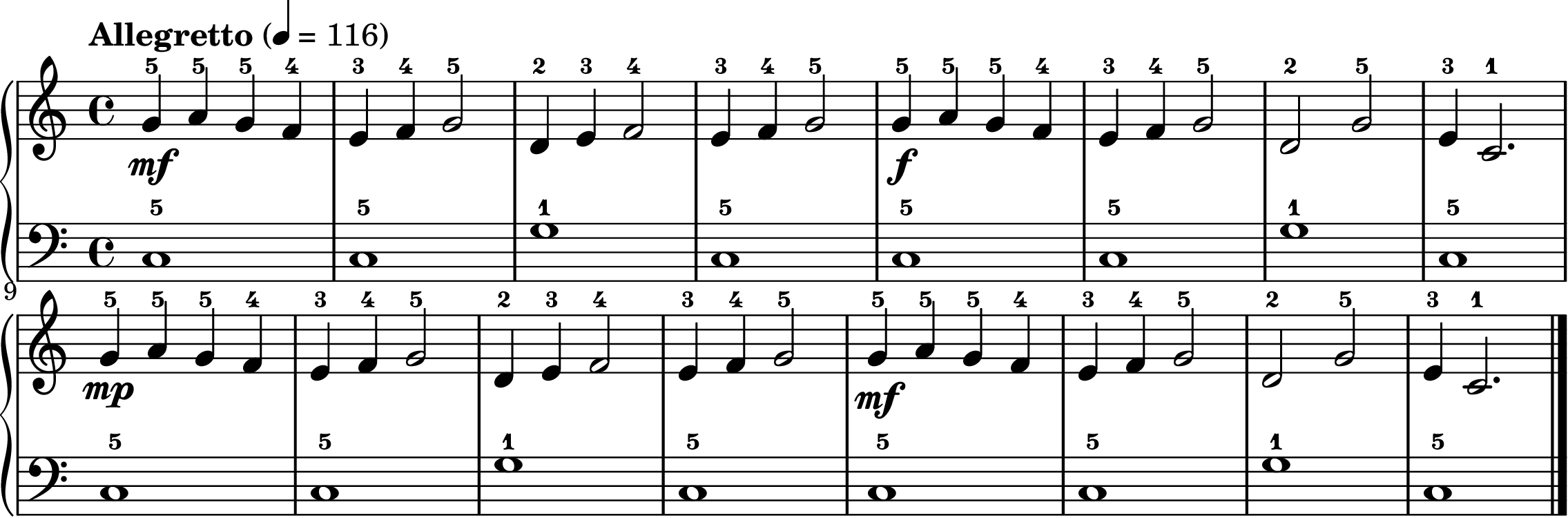
Then play all 8 measures straight through over the alternating C3-G3 bass, keeping the pulse cheerful and even up to the 110 BPM Allegretto.
Note by note: keys and fingering
- Right hand: C4, D4, E4, F4, G4 - Standard C position. Mix of quarter and half notes.
- Left hand: C3, G3 - Pinky on C3, thumb on G3. Simple alternating bass.
| Note | On the Staff | On the Keyboard | Finger |
|---|---|---|---|
| C4 (Middle C) | One ledger line below treble staff | White key left of two black keys, center | RH Thumb (1) |
| D4 | Just below bottom line of treble staff | Between the two black keys | RH Index (2) |
| E4 | On the bottom line of treble staff | Right of two black keys | RH Middle (3) |
| F4 | First space of treble staff | Left of three black keys | RH Ring (4) |
| G4 | Second line of treble staff | Between first two of three black keys | RH Pinky (5) |
| C3 | Two ledger lines below bass staff | One octave below middle C | LH Pinky (5) |
| G3 | Top line of bass staff | Between first two of three black keys | LH Thumb (1) |
Prefer a video? Watch the keys light up
Same color code as the player: green marks the right hand, blue the left hand, with the score and keyboard in one vertical video.
The story behind London Bridge
London Bridge Is Falling Down was first published as a nursery rhyme around 1744, though the singing game attached to it - two children forming an arch that falls to catch a player - is older still. The words may recall the many disasters that struck London Bridge over the centuries, from Viking raids to fires and slow decay; the medieval bridge itself was finally replaced in 1831. The melody is simple and repetitive in the best sense: short phrases that return again and again, with a mix of quarter and half notes, making it an excellent early piece for building rhythmic confidence at the piano.
Get the printable PDF
The printable PDF of London Bridge Is Falling Down - full score, hand positions, and a step-by-step practice guide - ships inside our free Level 2 pack together with four other early favorites.
A steady rhythm starts with a steady seat: a Classic Piano Bench for kids and a piano pedal extender keep young players grounded while they practice.
FAQ
How hard is London Bridge Is Falling Down on piano?
It is a Level 2 piece: the hand stays around the C position with a mix of quarter and half notes, over a simple alternating bass on C3 and G3. The only jump is the closing E-G-C resolution, which takes a little targeted practice.
How long does it take to learn London Bridge?
The whole piece is just 8 measures, and measures 5-6 repeat measures 1-2 exactly, so there is very little new material to absorb. Most learners play it hands together within a week, then spend a few more days polishing the E-G-C-C ending.
What level is London Bridge Is Falling Down?
It belongs to the Level 2 pack of our free sheet collection: C major, 4/4 time, and an Allegretto target of 110 BPM. The predictable left hand, alternating C3 and G3 every two measures, makes it a good piece for building rhythmic confidence.
What are the notes for London Bridge on piano?
The main phrase is G-A-G-F-E-F-G, followed by the two short answers D-E-F and E-F-G. Measures 5-6 repeat the opening phrase, and the piece resolves with E-G-C-C. The left hand alternates half notes on C3 and G3; full fingerings are in the table above.