
Level 1: First Steps
The simplest melodies using 3-5 notes. Right hand only focus. 5 pieces with sheet music, fingerings, and step-by-step practice guides.
Level 1 is where your piano journey begins. These five pieces use only the right hand in a fixed five-finger position on C-D-E-F-G (with one piece reaching up to A). You will learn to read treble clef notes, play quarter notes and half notes at a steady tempo, and build the finger independence that every pianist needs. Whether you picked up piano yesterday or you are returning after years away, these arrangements meet you exactly where you are.
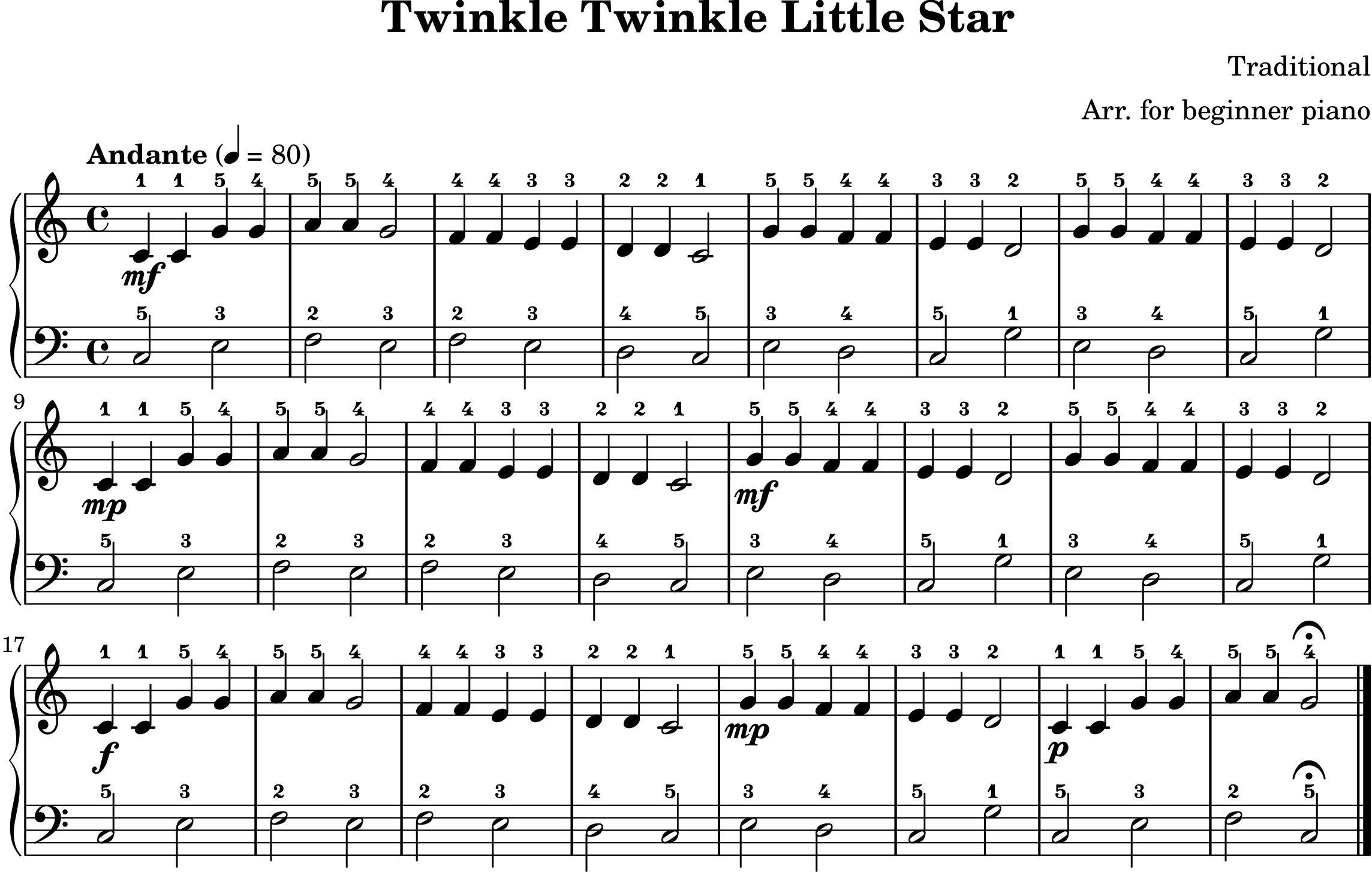
Score Preview
What You’ll Learn at This Level
- Five-finger position in C Major – Place your right hand thumb on Middle C and keep each finger on its own key. Every piece in this collection stays within that hand shape, so you never need to shift position mid-phrase.
- Quarter notes and half notes – You will internalize the difference between one-beat and two-beat notes by playing them in real melodies, not abstract exercises. Counting out loud helps lock the rhythm into muscle memory.
- Reading treble clef – Each piece comes with fingering numbers above every note. Over five pieces, you will start recognizing note positions on the staff without checking the fingering – the first real sign of reading fluency.
What’s Inside – 5 Pieces
Twinkle Twinkle Little Star
Traditional | C Major | 4/4 | 24 measures
The melody that has launched millions of piano careers. This arrangement uses six notes (C through A), introducing the widest reach in the collection. The repeated C-C-G-G-A-A-G pattern trains your ear to hear intervals while your fingers learn to strike cleanly. Practice tip: play the first four bars at half speed until every note rings evenly, then gradually bring the tempo up.
Mary Had a Little Lamb
Traditional | C Major | 4/4 | 16 measures
Only three notes – E, D, and C – played with fingers 3, 2, and 1. That simplicity is the point. With so few pitches to track, you can focus entirely on producing an even tone and keeping steady time. The stepwise motion (no skips) makes this the gentlest possible introduction to reading notes on the staff. Try playing it with your eyes on the sheet, not your hand.
Ode to Joy
Beethoven | C Major | 4/4 | 16 measures
A Beethoven masterpiece on your very first day. This theme from the Ninth Symphony sits perfectly in the five-finger position and uses only stepwise motion, so it feels natural under the hand. The payoff is enormous: you are playing one of the most celebrated melodies in Western music. Focus on making each note sing with equal weight – Beethoven wrote this as a hymn, and it should feel like one.
Jingle Bells
J.L. Pierpont | C Major | 4/4 | 32 measures
At 32 measures, this is the longest piece in Level 1 and your first test of stamina. The repeated E-E-E pattern in the chorus builds rhythmic consistency – you have to keep the same note interesting over multiple beats. The verse section introduces wider melodic movement. Practice the chorus and verse as separate blocks before connecting them, and count “1-2-3-4” out loud through every bar.
Hot Cross Buns
Traditional English | C Major | 4/4 | 8 measures
Eight measures. Three notes. The shortest piece in the collection, and a perfect warm-up before tackling the longer ones. The descending E-D-C pattern teaches your fingers to move smoothly downward. Because it is so brief, you can play it multiple times in a row, experimenting with dynamics – try it soft, then loud, then somewhere in between.
How to Practice Level 1
- Start with Hot Cross Buns as a warm-up. Its 8 measures take under a minute. Play it three times to get your fingers loose and your ear tuned in before moving to longer pieces.
- Count out loud on every piece. Say “1-2-3-4” with each measure. It feels awkward at first, but counting aloud is the single fastest way to build solid rhythm. Drop the counting only after you can play a piece flawlessly three times in a row.
- Practice in small sections. Never grind through a full piece hoping for improvement. Pick four bars, play them slowly until they are clean, then add the next four. Jingle Bells, for example, breaks naturally into four 8-bar phrases.
- Keep your wrist relaxed. Beginners often tense up, locking the wrist and pressing keys with stiff fingers. Let your hand rest on the keys with a gentle curve in the fingers, as if holding a small ball. If your forearm starts to ache, stop and shake your hands loose.
Every Piece Includes
Real Sheet Music
Professionally engraved with treble and bass clef.
Fingering Guide
Every note mapped to the correct finger.
Practice Steps
Right hand, left hand, then hands together.
Before you sit down to play, make sure your bench height is right. A seat that is too low forces your wrists to bend upward, which causes tension and slows your progress. Our guide on setting the right height and posture at the piano covers the exact measurements. When you are ready for more free sheet music across all five difficulty levels, visit our complete collection page.
Want 20 More Pieces?
Get Levels 2 through 5 delivered to your inbox for free.