
Waltz of the Flowers is in D major and 3/4 here, with Tchaikovsky’s horn waltz first and the violin tune second. The interactive player below can slow it to x0.5 while you get used to counting three in a bar. There is a free printable PDF at the end of the page.
Learn it with the interactive player
- Slow it down: x0.5 or x0.75 while you learn the notes, back to x1 once they flow.
- Pause anywhere: the current keys stay lit so you can find them on your own piano.
- Drag the score left or right, or use the 15s buttons, to replay a phrase.
The sheet music, section by section
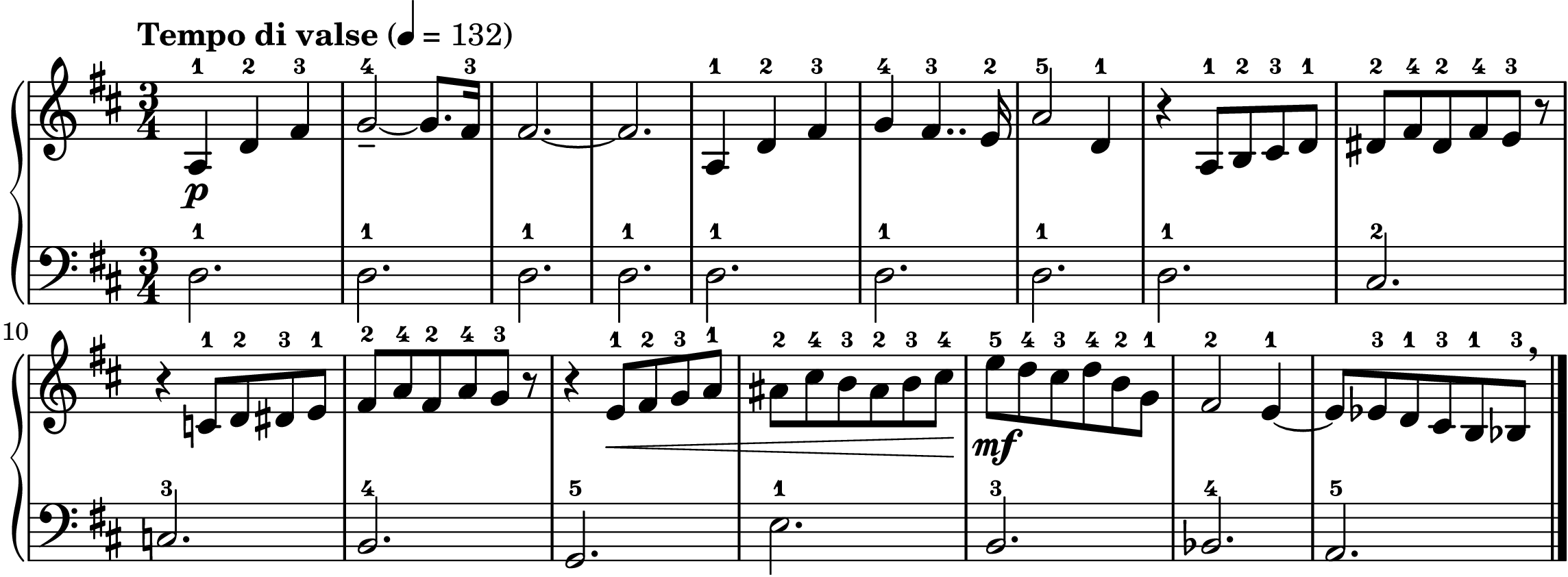
Section A, measures 1-16, is the horn waltz at p. It starts low on A3 with the thumb, rises through D4 and F#4 to a long G4, and settles on an F#4 held through measures 3 and 4. After the same start in measure 5, the pinky reaches A4 in measure 7. From measure 8 the clarinet answer runs in eighth notes, brings in D#4, C4 and A#4, and climbs to E5 at mf in measure 14. Measure 16 slides down from Eb4 to Bb3 and ends with a breath mark. Under all this the left hand holds D3 for eight bars, then changes note each bar, mostly downward.
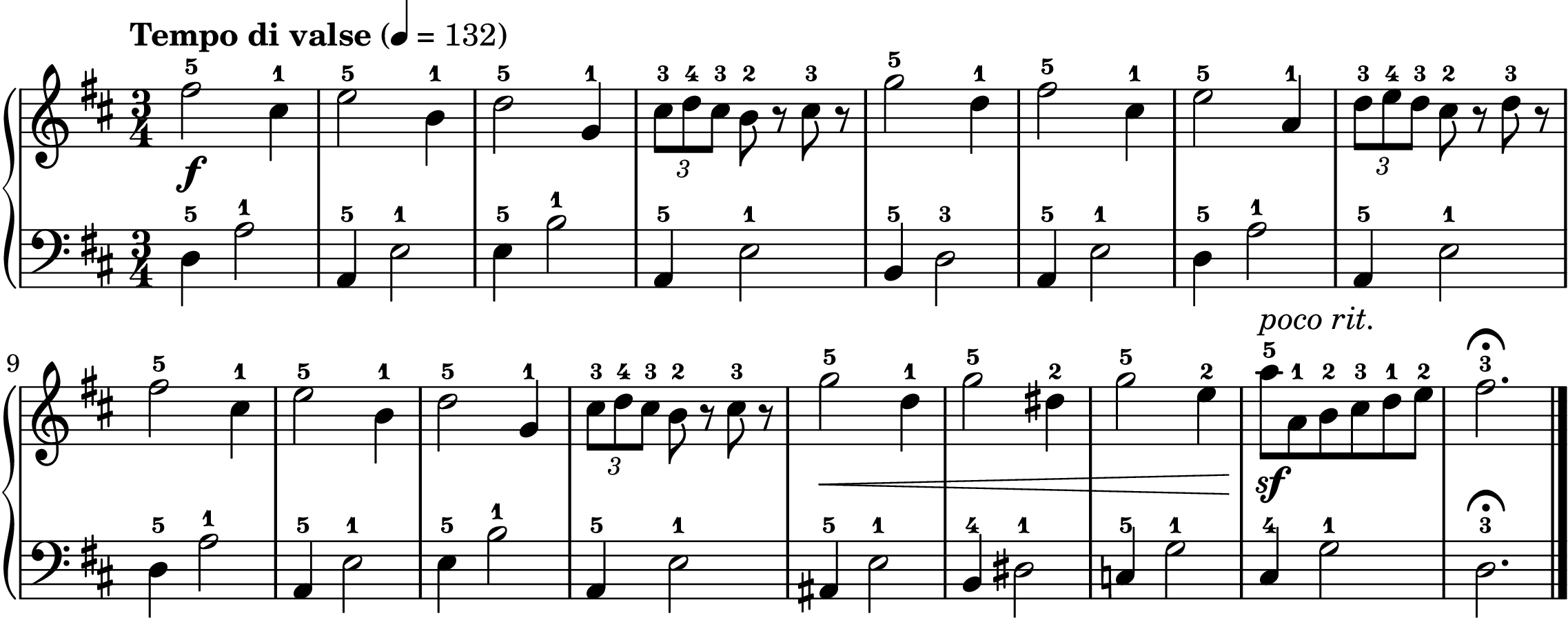
The violin tune of section B, measures 17-33, is played f. Each bar has a half note on the pinky and a quarter on the thumb a fourth or fifth lower: F#5 and C#5, E5 and B4, D5 and G4. Measures 20, 24 and 28 are the flute fill-ins, a quick triplet such as C#5, D5, C#5 on 3-4-3 and two short notes, an octave lower than in the source so the hand stays in place. From measure 29 the pinky keeps G5 while the lower note climbs D5, D#5, E5 under a crescendo. Measure 32 drops from A5 to A4 at sf with poco rit., and the piece ends on a held F#5 over D3. Loop measures 29-33 at x0.75.
The full score
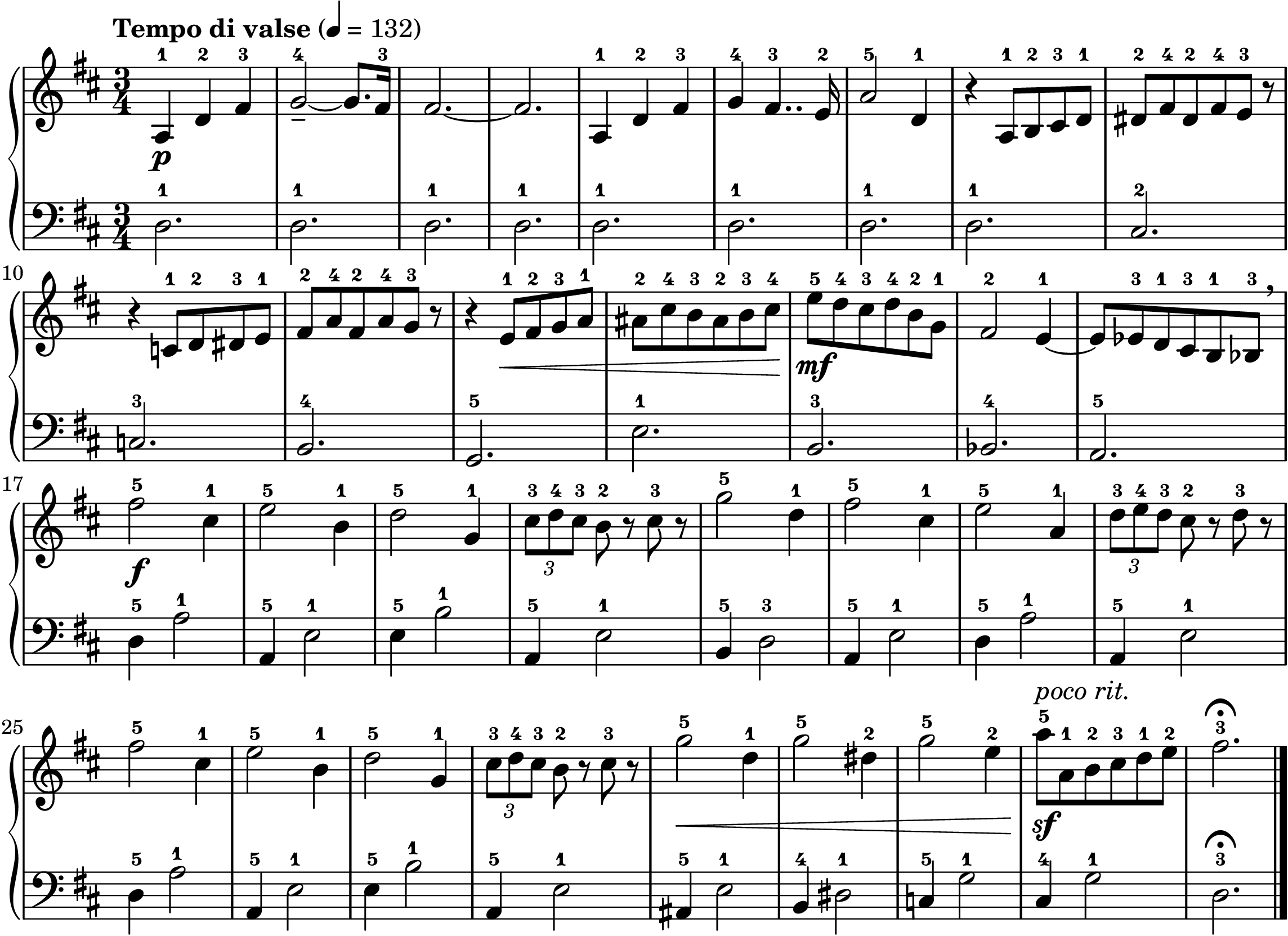
All 33 measures are in 3/4, Tempo di valse at 132 to the quarter. In section A the left hand plays one long note per bar; in section B it plays a quarter on beat 1 and a half note on beats 2 and 3, with the pinky low and the thumb above. Count three out loud while you learn, then feel one beat per bar once the notes are secure. Take the breath before measure 17 and give the poco rit. in measure 32 time.
Note by note: keys and fingering
- Right hand: Section A starts with the thumb (1) on A3, index (2) on D4 and middle (3) on F#4, with the ring finger (4) on G4 and the pinky (5) reaching A4 in measure 7. From measure 8 the hand shifts with each phrase, and the thumb always lands on a white key: A3, C4 and E4 start the eighth-note runs, and measure 16 goes down 3-1-3-1-3 from Eb4 to Bb3. In section B the pinky (5) takes the half notes (F#5, E5, D5, G5) and the thumb (1) the quarter notes below them; the triplets in measures 20, 24 and 28 are 3-4-3. Measures 30-31 use the index (2) for D#5 and E5, and the last note, F#5, is on the middle finger (3).
- Left hand: The thumb (1) holds D3 for measures 1-8. Measures 9-16 have one long note per bar: C#3 (2), C3 (3), B2 (4), G2 (5), then up to E3 on the thumb, and down again with B2 (3), Bb2 (4) and A2 (5). In section B the pinky (5) plays the low note on beat 1 and the thumb (1) a half note on beat 2, usually a fifth higher (D3 to A3, A2 to E3, E3 to B3). Measure 21 uses B2 and D3 with 5-3, measures 30 and 32 use fingers 4-1, and the last D3 is on the middle finger (3).
| Note | On the Staff | On the Keyboard | Finger |
|---|---|---|---|
| A3 | Second ledger line below the treble staff | White key between the last two of three black keys below middle C | RH Thumb (1) |
| Bb3 | Just below the ledger line under the treble staff, with a flat sign | Black key, last of the three black keys below middle C | RH Middle (3) |
| B3 | Just below the ledger line under the treble staff | White key just left of middle C | RH Index (2) |
| C4 | Ledger line below the treble staff (middle C), with a natural sign | Middle C | RH Thumb (1) |
| C#4 | Ledger line below the treble staff, sharp in the key signature | Black key just right of middle C | RH Middle (3) |
| D4 | Space just below the treble staff | White key between the two black keys right of middle C | RH Index (2) |
| D#4 | Space just below the treble staff, with a sharp sign | Black key, second of the two black keys above middle C | RH Index (2) |
| Eb4 | Bottom line of treble staff, with a flat sign | Black key, second of the two black keys above middle C (same key as D#4) | RH Middle (3) |
| E4 | Bottom line of treble staff | White key right of the two black keys above middle C | RH Thumb (1) |
| F#4 | First space of treble staff, sharp in the key signature | Black key, first of the three black keys above middle C | RH Middle (3) |
| G4 | Second line of treble staff | White key between the first two of three black keys above middle C | RH Thumb (1) |
| A4 | Second space of treble staff | White key between the last two of three black keys above middle C | RH Thumb (1) |
| A#4 | Second space of treble staff, with a sharp sign | Black key, last of the three black keys above middle C | RH Index (2) |
| B4 | Middle line of treble staff | White key right of the three black keys above middle C | RH Index (2) |
| C#5 | Third space of treble staff, sharp in the key signature | Black key, first of the two black keys above C5 | RH Middle (3) |
| D5 | Fourth line of treble staff | White key between the two black keys above C5 | RH Ring (4) |
| D#5 | Fourth line of treble staff, with a sharp sign | Black key, second of the two black keys above C5 | RH Index (2) |
| E5 | Fourth space of treble staff | White key right of the two black keys above C5 | RH Pinky (5) |
| F#5 | Top line of treble staff, sharp in the key signature | Black key, first of the three black keys above C5 | RH Pinky (5) |
| G5 | Space just above the treble staff | White key between the first two of three black keys above C5 | RH Pinky (5) |
| A5 | First ledger line above the treble staff | White key between the last two of three black keys above C5 | RH Pinky (5) |
| G2 | Bottom line of bass staff | White key between the first two of three black keys, an octave and a fourth below middle C | LH Pinky (5) |
| A2 | First space of bass staff | White key between the last two of three black keys, an octave and a third below middle C | LH Pinky (5) |
| A#2 | First space of bass staff, with a sharp sign | Black key, last of the three black keys below C3 | LH Pinky (5) |
| Bb2 | Second line of bass staff, with a flat sign | Black key, last of the three black keys below C3 (same key as A#2) | LH Ring (4) |
| B2 | Second line of bass staff | White key right of the three black keys, an octave and a step below middle C | LH Ring (4) |
| C3 | Second space of bass staff, with a natural sign | One octave below middle C | LH Middle (3) |
| C#3 | Second space of bass staff, sharp in the key signature | Black key, first of the two black keys below middle C | LH Index (2) |
| D3 | Third line of bass staff | White key between the two black keys below middle C | LH Thumb (1) |
| D#3 | Third line of bass staff, with a sharp sign | Black key, second of the two black keys below middle C | LH Thumb (1) |
| E3 | Third space of bass staff | White key right of the two black keys below middle C | LH Thumb (1) |
| G3 | Fourth space of bass staff | White key between the first two of three black keys below middle C | LH Thumb (1) |
| A3 | Top line of bass staff | White key between the last two of three black keys below middle C | LH Thumb (1) |
| B3 | Space just above the bass staff | White key just left of middle C | LH Thumb (1) |
Prefer a video? Watch the keys light up
Same color code as the player: green marks the right hand, blue the left hand, with the score and keyboard in one vertical video.
The story behind Waltz of the Flowers
The Waltz of the Flowers is No. 8 of the Suite from The Nutcracker, Op. 71a, by P. I. Tchaikovsky (d. 1893), published by Jurgenson in Moscow in 1892. There are no words. As with our Nutcracker March, the notes come from Tchaikovsky's own piano solo arrangement of the Suite (Rahter reprint, 1898), checked against the full score, where the first tune belongs to the horns with a clarinet answer and the second to the first violins. Our measures 1-16 are source bars 38-53 and measures 17-32 are bars 70-85, in the source key of D major. The introduction and the harp cadenza are left out, the flute fill-ins of measures 20, 24 and 28 sit an octave lower, and the closing bar is ours.
Get the printable PDF
Download the Waltz of the Flowers PDF for free, straight from this page, with no email to give. Inside are the full score, fingering for both hands and one practice tip per section. The Christmas page links to more free pieces in the same format.
If a child later wants the sustaining pedal under the long bass notes of this waltz, a piano pedal extender brings the pedal up to their feet, and our solid-wood kids piano bench gives them a seat made for their size.
FAQ
How hard is Waltz of the Flowers on piano?
In our Christmas collection it is a Level 3 piece. The violin tune in section B is easy to read, a half note and a quarter in most bars. Section A asks more: eighth-note lines with D#4, C4 and A#4, a slide down to Bb3 in measure 16, and a first note, A3, on the second ledger line below the treble staff.
How long does it take to learn Waltz of the Flowers?
Plan on three to four weeks. Measures 25-28 are the same as measures 17-20, so section B goes faster than section A. Spend the first week on measures 8-16, hands separately at x0.5.
What level is Waltz of the Flowers?
Level 3 of our Christmas collection. D major, 3/4, Tempo di valse at 132 BPM, 33 measures. The right hand ranges from A3 to A5 and the left hand from G2 to B3, one note at a time in each hand.
What are the notes for Waltz of the Flowers?
The horn waltz opens A3, D4, F#4, a long G4 and F#4, then A3, D4, F#4, G4, F#4, E4 and A4. The violin tune in measure 17 begins with F#5 and C#5, then E5 and B4, D5 and G4. The left hand holds D3 under the first eight bars.