
The Twelve Days of Christmas starts here on two eighth-note middle Cs in F major, and two of its bars change from 4/4 to 3/4. Play those bars slower in the interactive player below, drag the score to loop them, and watch the keys light up. Then the sheet music, fingering for both hands and a free printable PDF.
Learn it with the interactive player
- Slow it down: x0.5 or x0.75 while you learn the notes, back to x1 once they flow.
- Pause anywhere: the current keys stay lit so you can find them on your own piano.
- Drag the score left or right, or use the 15s buttons, to replay a phrase.
The sheet music, section by section

Section A is verse 1: the pickup plus measures 1-4. After two eighth-note middle Cs on the thumb, measure 1 goes C4, F4-F4-F4, E4-F4 on fingers 1, 3 and 2-3. Measure 2 climbs G4-A4-Bb4-G4 on 1-2-3-1 into a dotted A4, and measure 3 peaks on C5 and D5 before falling to F4. The left hand alternates F2 and C3 in half notes. Practice at x0.5 and keep the eighths even.

Section B (measures 5-13) is verse 5. Measures 5-6 return to the opening (measure 6 ends on a half-note A4), then measure 7 jumps to forte: a half-note C5, D5 slurred to B natural with finger 3, and a whole-note C5. Measures 9 and 10 are in 3/4, C5-Bb4-A4-G4 falling to F4, then Bb4, D4 and F4 on 5-1-3, a chord shape you set during the F4 before it. Measure 11 returns to 4/4 and steps down G4-F4-E4-D4 to middle C. Take the meter changes at x0.5.
The full score
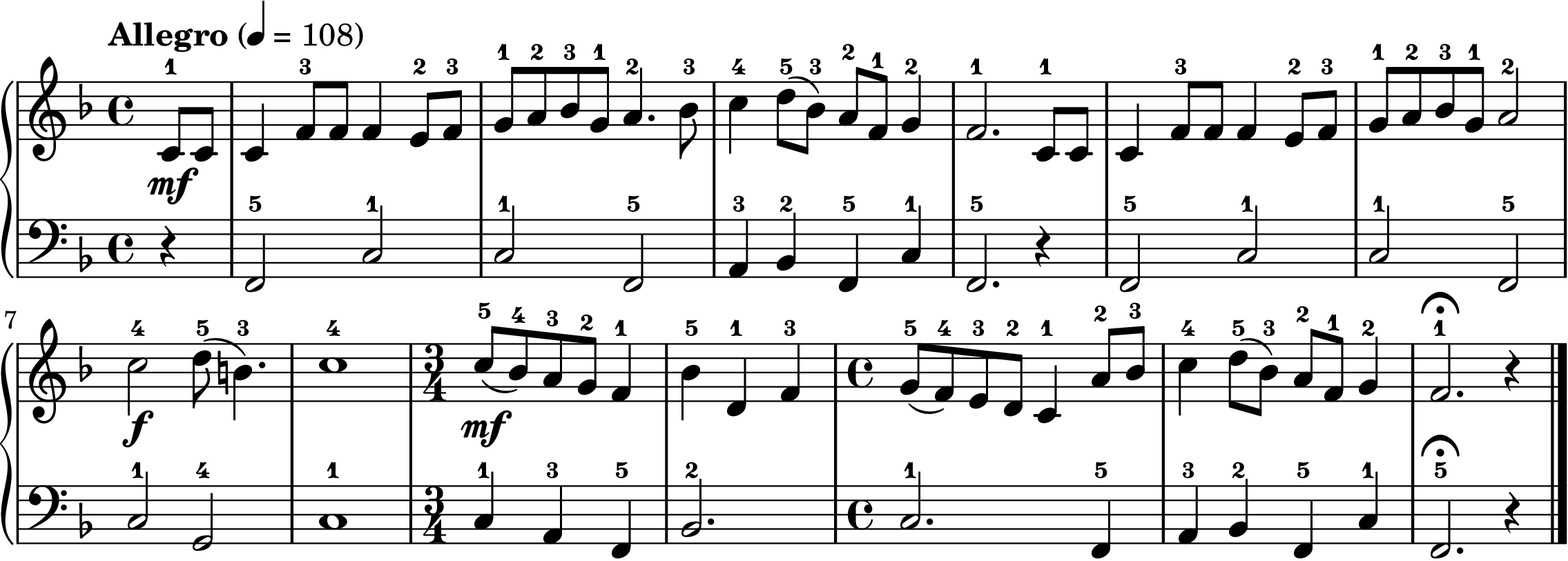
Played through, it is the pickup plus 13 measures (verse 1, then verse 5), and the left hand stays in one F position all the way. The traps are the two 3/4 bars and the B natural; count 1-2-3 out loud in measures 9 and 10. Use x0.5, then x0.75, on the way to the Allegro marking of 108 to the quarter. Let the final F4 ring under the fermata.
Note by note: keys and fingering
- Right hand: Four positions. The pickup and measure 1 start with the thumb (1) on middle C, index (2) on E4 and middle finger (3) on F4. From measure 2 the thumb moves to G4, with index (2) on A4, middle (3) on Bb4 (on B natural in measure 7), ring (4) on C5 and pinky (5) on D5; the thumb reaches back to F4 at each cadence. Measure 9 uses an F position (thumb on F4, pinky on C5). During its last F4 the hand opens into a B-flat chord shape for measure 10: pinky (5) on Bb4, thumb (1) on D4, middle (3) on F4. At the breath before measure 11 it moves one key down into a C position, pinky (5) on G4 down to the thumb on C4.
- Left hand: The left hand never leaves F position: pinky (5) on F2, ring (4) on G2, middle (3) on A2, index (2) on Bb2 and thumb (1) on C3. It plays mostly half notes on F2 and C3, with a quarter-note walk A2-Bb2-F2-C3 (3-2-5-1) before each cadence.
| Note | On the Staff | On the Keyboard | Finger |
|---|---|---|---|
| C4 | Ledger line below the treble staff (middle C) | Middle C | RH Thumb (1) |
| D4 | Just below the bottom line of the treble staff | White key between the two black keys right of middle C | RH Index (2) |
| E4 | Bottom line of treble staff | White key right of the two black keys above middle C | RH Index (2) |
| F4 | First space of treble staff | White key left of the three black keys above middle C | RH Middle (3) |
| G4 | Second line of treble staff | White key between the first two of three black keys above middle C | RH Thumb (1) |
| A4 | Second space of treble staff | White key between the last two of three black keys above middle C | RH Index (2) |
| Bb4 | Middle line of treble staff, flat in the key signature | Black key just left of B4, the highest of the three black keys above middle C | RH Middle (3) |
| B4 | Middle line of treble staff, with a natural sign in measure 7 | White key right of the three black keys above middle C | RH Middle (3) |
| C5 | Third space of treble staff | One octave above middle C | RH Ring (4) |
| D5 | Fourth line of treble staff | White key between the two black keys above C5 | RH Pinky (5) |
| F2 | Space just below the bass staff | White key left of the three black keys, an octave and a fifth below middle C | LH Pinky (5) |
| G2 | Bottom line of bass staff | White key between the first two of three black keys, an octave and a fourth below middle C | LH Ring (4) |
| A2 | First space of bass staff | White key between the last two of three black keys, an octave and a third below middle C | LH Middle (3) |
| Bb2 | Second line of bass staff, flat in the key signature | Black key just left of B2, the highest of the three black keys below C3 | LH Index (2) |
| C3 | Second space of bass staff | One octave below middle C | LH Thumb (1) |
Prefer a video? Watch the keys light up
Same color code as the player: green marks the right hand, blue the left hand, with the score and keyboard in one vertical video.
The story behind The Twelve Days of Christmas
This is the melody Frederic Austin published for voice and piano in London with Novello in 1909 (plate 13056), in F major. Austin died in 1952. The words are traditional and were printed in Mirth Without Mischief around 1780; they are not printed here. Our score keeps Austin's key and his changes between 4/4 and 3/4, and the melody is left as he wrote it, including the B natural in measure 7. It plays his verse 1 and then his verse 5, the first verse in which the long held phrase of measures 7-8 appears. The flourish Austin gives that phrase in the last verse is not used. The single-note left hand is ours.
Get the printable PDF
The Twelve Days of Christmas is door 9 of the Free Piano Advent Calendar (doors open December 1-24). Its printable PDF, with the full score, fingering for both hands and one practice tip per section, is a free direct download, no email needed.
Our kids piano bench is solid wood, and the piano pedal extender for kids adjusts from 1.5 to 5.4 inches, so a child getting this carol ready for the family can reach the pedals.
FAQ
How hard is The Twelve Days of Christmas on piano?
It is Level 2 in our Advent calendar collection, and most of the practice goes to the two bars that switch from 4/4 to 3/4. The right hand also moves through four hand positions and plays eighth notes, while the left hand stays in one F position, mostly in half notes.
How long does it take to learn The Twelve Days of Christmas?
Two to three weeks for most beginners. Measures 5 and 6 nearly repeat measures 1 and 2, and measure 12 repeats measure 3, so the new work is the forte phrase in measures 7-8 and the 3/4 bars in measures 9-10.
What level is The Twelve Days of Christmas?
Level 2. It runs a pickup plus 13 measures in F major, Allegro at 108 BPM, in 4/4 with two bars of 3/4. Both hands play one note at a time: middle C to D5 on the right, F2 to C3 on the left.
What are the notes for The Twelve Days of Christmas?
The pickup is two eighth-note middle Cs, then C4, F4, F4, F4, E4, F4, then G4, A4, Bb4, G4, A4, Bb4 and C5, D5, Bb4, A4, F4, G4 to a long F4. Verse 5 adds C5, D5, B natural and a long C5 at forte. The left hand begins F2, C3. The table above gives each note's staff position, key and finger.