
O Come, O Come, Emmanuel is arranged here in E minor, its key in the 1861 hymnal, and every half note of that print becomes a quarter note. Start with the interactive player at x0.5; the score, the fingering and a free printable PDF follow.
Learn it with the interactive player
- Slow it down: x0.5 or x0.75 while you learn the notes, back to x1 once they flow.
- Pause anywhere: the current keys stay lit so you can find them on your own piano.
- Drag the score left or right, or use the 15s buttons, to replay a phrase.
The sheet music, section by section

Section A is the verse: the pickup and measures 1-12, played mp. The thumb takes the pickup E4, then G4, B4, B4, B4 and A4, C5, B4, A4 lead to a long G4 in measure 3. The second phrase falls from B4 to D4 and settles on E4 in measure 6, and the third goes down to a held D4 in measure 9. The fourth comes back to the shape of the first and ends on G4 in measure 12. Each long note is a breath, and that is where the hand moves. Play the right hand alone at x0.5 first.

Section B, the refrain, starts on the last beat of measure 12 with a forte D5 on the pinky and runs to measure 19. Two long notes, D5 and B4, and the line A4, C5, B4, A4 lead to the short 2/4 measure 16: only G4 and A4, two beats, with mf on the A4. Measures 17-19 repeat measures 4-6, B4, G4, E4, G4, A4, F#4, E4, D4, and close on E4 under a fermata. Measures 15-17 are worth looping at x0.75 until the two-beat bar stops catching you out.
The full score
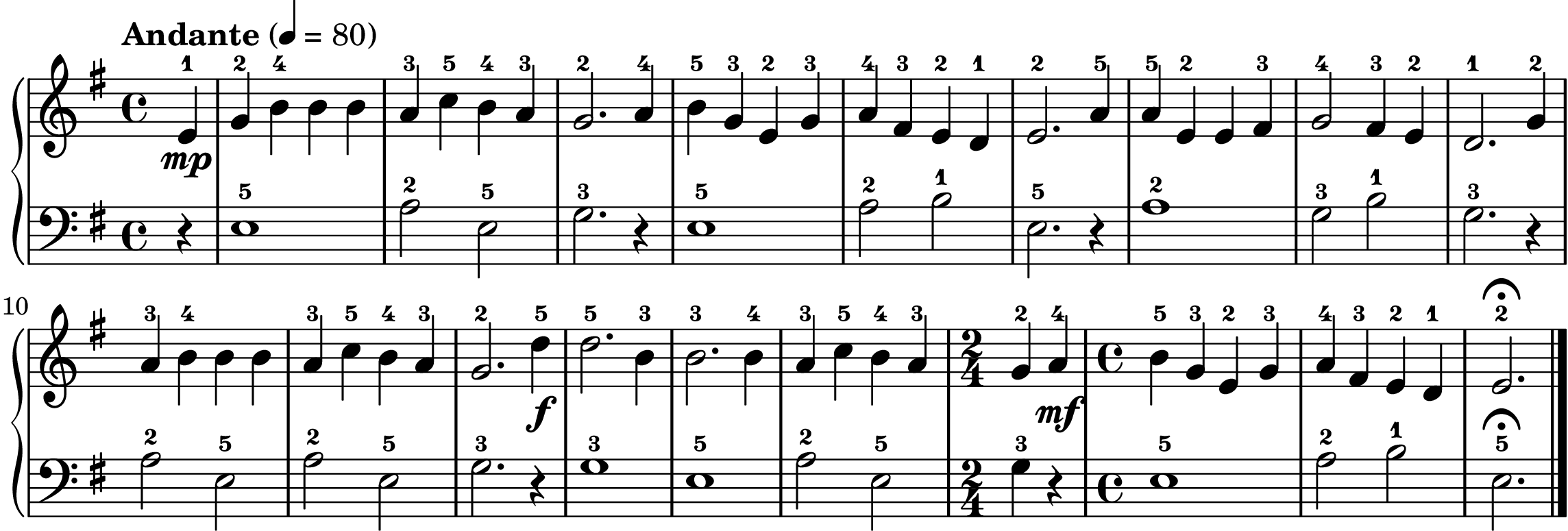
The carol has a pickup and 19 measures at Andante, 80 to the quarter, all in 4/4 except measure 16. The left hand plays long E3, G3, A3 and B3 notes, one or two per bar, so it can stay in place while the right hand moves. Count the 2/4 bar as one, two, and go straight on to the next downbeat; hearing it a few times at x0.5 helps.
Note by note: keys and fingering
- Right hand: The hand changes position on the long notes at the ends of the phrases. For the pickup and measures 1-3 the thumb (1) is on E4, index (2) on G4, middle (3) on A4, ring (4) on B4 and pinky (5) on C5. From the last beat of measure 3 the hand sits one step lower, thumb on D4 and pinky on B4, with F#4 and G4 both on the middle finger (3). Measures 6-9 use a D position, D4 to A4 on fingers 1 to 5, and the G4 on 2 in measure 9 brings back the opening shape. The refrain reaches D5 with the pinky; the second B4 in measure 14 takes finger 4, and the A4 on 4 in measure 16 moves the hand down again for measures 17-19.
- Left hand: One five-finger position for the whole piece: pinky (5) on E3, middle (3) on G3, index (2) on A3 and thumb (1) on B3. Each 4/4 bar holds a whole note, two half notes, or a dotted half and a rest (measures 3, 6, 9 and 12). The left hand is silent on the pickup, and in the 2/4 measure 16 it plays a quarter-note G3 followed by a rest.
| Note | On the Staff | On the Keyboard | Finger |
|---|---|---|---|
| D4 | Space just below the treble staff | White key between the two black keys above middle C | RH Thumb (1) |
| E4 | Bottom line of treble staff | White key right of the two black keys above middle C | RH Index (2) |
| F#4 | First space of treble staff, sharp in the key signature | Black key, first of the three black keys above middle C | RH Middle (3) |
| G4 | Second line of treble staff | White key between the first two of three black keys above middle C | RH Index (2) |
| A4 | Second space of treble staff | White key between the last two of three black keys above middle C | RH Middle (3) |
| B4 | Middle line of treble staff | White key right of the three black keys above middle C | RH Ring (4) |
| C5 | Third space of treble staff | One octave above middle C | RH Pinky (5) |
| D5 | Fourth line of treble staff | White key between the two black keys above C5 | RH Pinky (5) |
| E3 | Third space of bass staff | White key right of the two black keys below middle C | LH Pinky (5) |
| G3 | Fourth space of bass staff | White key between the first two of three black keys below middle C | LH Middle (3) |
| A3 | Top line of bass staff | White key between the last two of three black keys below middle C | LH Index (2) |
| B3 | Space just above the bass staff | White key just left of middle C | LH Thumb (1) |
Prefer a video? Watch the keys light up
Same color code as the player: green marks the right hand, blue the left hand, with the score and keyboard in one vertical video.
The story behind O Come, O Come, Emmanuel
The tune, VENI EMMANUEL, comes from a 15th-century French processional chant adapted by Thomas Helmore (died 1890). He printed it as No. 65 in The Hymnal Noted, Part II (London: Novello), in plainsong notation a tone lower than here; the title page of the copy we read is dated 1856. Our pitches come from that page. The note values follow Hymns Ancient & Modern (Novello, 1861), No. 36, with music edited by W. H. Monk (died 1889), in E minor. All 59 of its notes match Helmore's pitches. We halved the values, so its half notes become quarter notes, and the short 2/4 measure 16 is as printed in 1861. The words by J. M. Neale (died 1866) are not printed here.
Get the printable PDF
The button below downloads the PDF straight away, free and with no email: full score, fingering for both hands, and a practice tip for each section. More free carols are on our Christmas piano sheets page.
This carol moves slowly, mostly in quarter notes, which makes it a good first Christmas piece for a child; our solid-wood kids piano bench gives them a seat of their own at the piano, and the piano bench height calculator shows which seat height fits their size.
FAQ
How hard is O Come, O Come, Emmanuel on piano?
It is a Level 2 piece. Every note is a quarter note or longer, and each hand plays one note at a time. The right hand changes position at the ends of the phrases, and the single 2/4 bar in measure 16 needs careful counting.
How long does it take to learn O Come, O Come, Emmanuel?
Most adult beginners need one to two weeks. Measures 17-19 repeat measures 4-6, and the last verse phrase is close to the first, so there is less new material than 19 bars suggest. Learn the right hand phrase by phrase, then add the left hand.
What level is O Come, O Come, Emmanuel?
O Come, O Come, Emmanuel is Level 2 of our Christmas collection. It is in E minor at Andante, 80 BPM, with a pickup and 19 measures, all in 4/4 except a 2/4 bar at measure 16. The right hand ranges from D4 to D5 and the left hand from E3 to B3.
What are the notes for O Come, O Come, Emmanuel?
The melody starts on E4, then G4, B4, B4, B4, A4, C5, B4, A4 and a long G4. The refrain begins with D5 twice, the second one held, then B4. The left hand uses only E3, G3, A3 and B3.