
Jolly Old Saint Nicholas opens with four repeated E5s, and the right hand never leaves the stretch from G4 to E5 in C major. Slow it down in the interactive player below, where the keys light up and you can drag the score to any bar. Sheet music, fingering for both hands and a free printable PDF follow.
Learn it with the interactive player
- Slow it down: x0.5 or x0.75 while you learn the notes, back to x1 once they flow.
- Pause anywhere: the current keys stay lit so you can find them on your own piano.
- Drag the score left or right, or use the 15s buttons, to replay a phrase.
The sheet music, section by section

Section A (measures 1-8) is two short phrases. The right hand plays E5 four times with finger 3, D5-D5-D5 with 2 and four C5s with the thumb, then holds E5 for a whole bar. In measure 5 the hand drops: four A4s with 2, G4-G4 with the thumb and a stretch up to C5 with 3, then B4-C5-D5-E5 on 2-3-4-5 and a long D5. Under it the left hand plays C3, G3, C3-E3, C3. Start at x0.5.

Measures 9-16 (Section B) repeat the opening at mp and come back to mf at measure 13. Only the ending is new: measure 15 turns D5-C5-D5-E5 on fingers 4-3-4-5 instead of climbing from B4, and the piece ends on a whole-note C5 with finger 3 over the left hand's C3, both under a fermata. Loop measures 15-16 at x0.75 until the 4-3-4 turn sounds even.
The full score
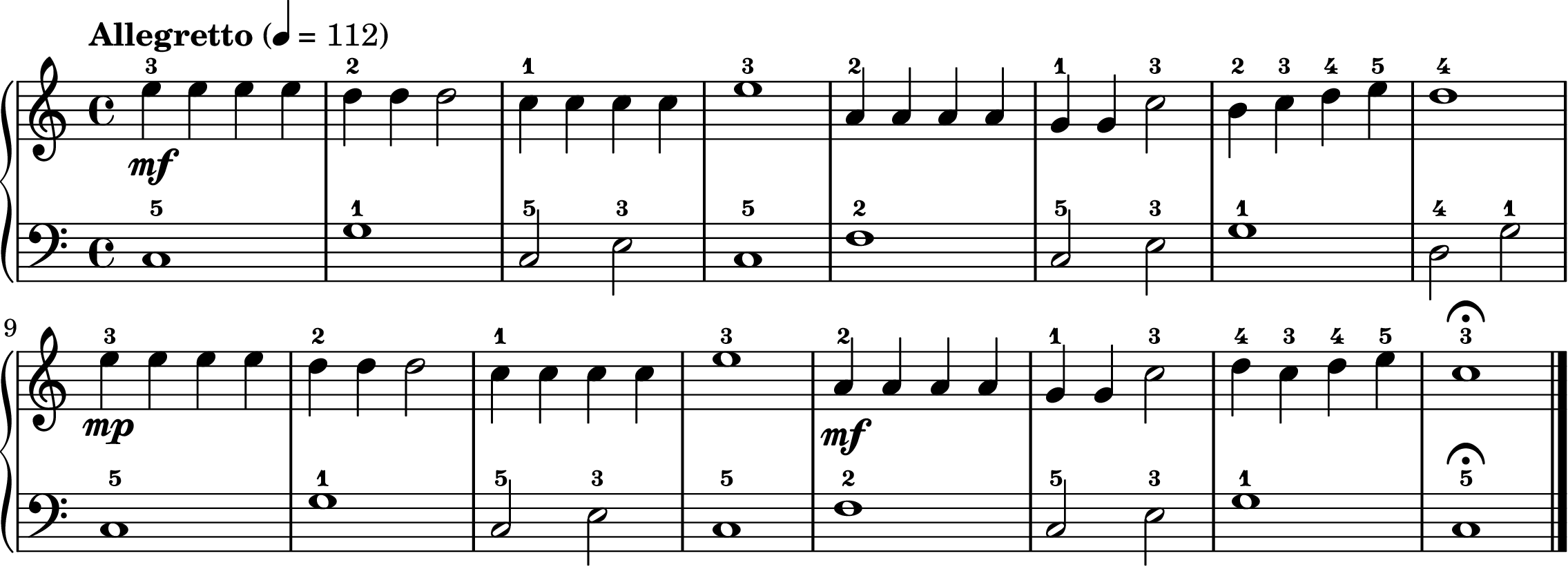
All 16 bars use quarter, half and whole notes, and the left hand holds one or two long notes per bar with the pinky on C3. Count four beats out loud so every repeated note gets the same length. Go from x0.5 to x0.75 before aiming for the Allegretto marking, 112 to the quarter.
Note by note: keys and fingering
- Right hand: The right hand uses two positions. In measures 1-4 and 9-12 the thumb (1) sits on C5, the index (2) on D5 and the middle finger (3) on E5. In measure 5 the hand moves down: index (2) on A4 and thumb (1) on G4, with the middle finger (3) stretching up to C5. The walk in measure 7 goes B4-C5-D5-E5 on 2-3-4-5, and measure 15 turns D5-C5-D5-E5 on 4-3-4-5.
- Left hand: Keep the left hand in C position from the first bar to the last: pinky (5) on C3, ring (4) on D3, middle (3) on E3, index (2) on F3 and thumb (1) on G3. Each bar is one whole note or two half notes.
| Note | On the Staff | On the Keyboard | Finger |
|---|---|---|---|
| G4 | Second line of treble staff | White key between the first two of three black keys above middle C | RH Thumb (1) |
| A4 | Second space of treble staff | White key between the last two of three black keys above middle C | RH Index (2) |
| B4 | Middle line of treble staff | White key right of the three black keys above middle C | RH Index (2) |
| C5 | Third space of treble staff | One octave above middle C | RH Thumb (1) |
| D5 | Fourth line of treble staff | White key between the two black keys above C5 | RH Index (2) |
| E5 | Fourth space of treble staff | White key right of the two black keys above C5 | RH Middle (3) |
| C3 | Second space of bass staff | One octave below middle C | LH Pinky (5) |
| D3 | Middle line of bass staff | White key between the two black keys below middle C | LH Ring (4) |
| E3 | Third space of bass staff | White key right of the two black keys below middle C | LH Middle (3) |
| F3 | Fourth line of bass staff | White key left of the three black keys below middle C | LH Index (2) |
| G3 | Fourth space of bass staff | White key between the first two of three black keys below middle C | LH Thumb (1) |
Prefer a video? Watch the keys light up
Same color code as the player: green marks the right hand, blue the left hand, with the score and keyboard in one vertical video.
The story behind Jolly Old Saint Nicholas
The tune was first printed in James R. Murray's School Chimes, A New School Music Book (Cleveland: S. Brainard's Sons, 1874), as No. 86 on page 43, in A major and 2/4 time. The page names no composer, so the attribution to Murray, who died in 1905, rests on his book. Emily Huntington Miller (died 1913) wrote the words, which appeared as Lilly's Secret in The Little Corporal in December 1865; this page leaves them out. For this arrangement the melody moves up a minor third, from A major to C major, and the note values are doubled, so the eighth notes of the 2/4 original become quarter notes in 4/4. The left hand, single notes in whole and half notes, was written for this arrangement.
Get the printable PDF
The printable PDF has the full score, fingering for both hands and a practice tip for each section, and it is a free direct download with no email asked. The same PDF is door 3 of the Free Piano Advent Calendar, whose doors open December 1-24.
A child learning this carol for Christmas needs the right seat first. The piano bench height calculator gives a seat height for the player's size, and our kids piano bench is built in solid wood.
Piano teacher? Track your students' practice. Join the early list
FAQ
How hard is Jolly Old Saint Nicholas on piano?
Level 1, the easiest level in our Advent calendar collection. The right hand plays only quarter, half and whole notes between G4 and E5 and switches between two positions (the higher one in measures 1-4 and 9-12). The left hand stays in one five-finger position from C3 to G3, with one or two long notes per bar.
How long does it take to learn Jolly Old Saint Nicholas?
Many beginners play it hands together within one to two weeks. Measures 9-14 repeat measures 1-6, so once the first eight bars are secure only measures 15 and 16 are new. Short daily sessions at half speed in the player work better than one long one.
What level is Jolly Old Saint Nicholas?
It is Level 1 in the Advent calendar collection: 16 measures of 4/4 in C major, Allegretto at 112 BPM. Each hand plays one note at a time, G4 to E5 in the right and C3 to G3 in the left.
What are the notes for Jolly Old Saint Nicholas?
The right hand starts with E5 four times, D5 three times and C5 four times, then a long E5. The second phrase is A4 four times, G4, G4, C5, then B4, C5, D5, E5 and a long D5. The piece ends on C5. The left hand opens C3, G3, then C3 and E3 (the table above lists each note with its finger).