
Jesu, Joy of Man’s Desiring stays in G major and 3/4 in this version, with Bach’s flowing triplet line first and the chorale tune after it. Try the interactive player at x0.5 to hear three even notes on every beat. The score, fingering and a free printable PDF are below it.
Learn it with the interactive player
- Slow it down: x0.5 or x0.75 while you learn the notes, back to x1 once they flow.
- Pause anywhere: the current keys stay lit so you can find them on your own piano.
- Drag the score left or right, or use the 15s buttons, to replay a phrase.
The sheet music, section by section
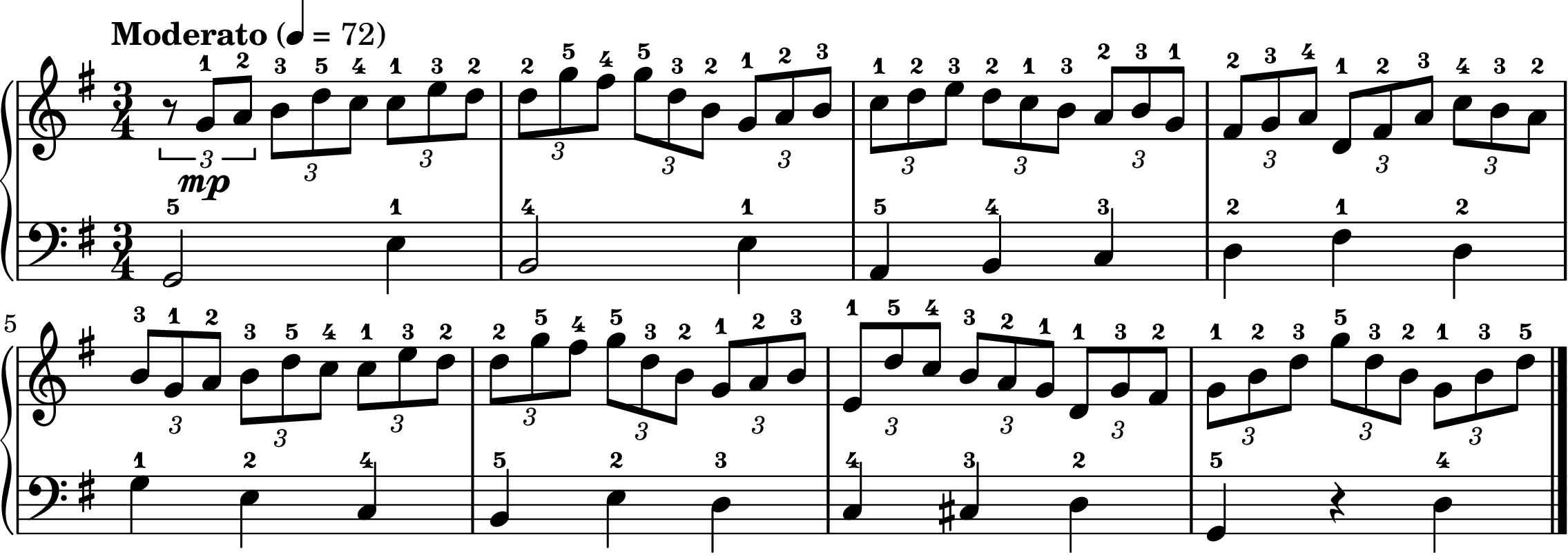
Bach gave the triplet line of section A, measures 1-8, to the first violins; here it is marked mp. Every beat holds three triplet eighths, and measure 1 opens with a rest before G4 and A4. Two finger patterns come back often: B4, D5, C5 on 3-5-4 followed by C5 on the thumb, and the broken G chord G5, D5, B4, G4 on 5-3-2-1 in measures 2 and 6. Measure 3 runs down with the middle finger crossing over the thumb, and measure 7 leaps from E4 up to D5, so lift the hand early there. Practice at x0.5 and keep the three notes of each beat equal.

Section B, measures 9-17, is Johann Schop's chorale tune at mf, in half notes and quarters: B4, C5, D5, D5, C5, B4, A4, A4. Bach's triplets come back for a short link at mp, on beat 3 of measure 12 and through measure 13, which ends like measure 4. The second phrase, measures 14-17, goes B4, C5, D5, B4, then A4 with a quick B4-C5 turn in sixteenths, B4, A4 and a long G4 under a fermata. Going from long notes to triplets and back is where the beat slips, so measures 12-14 at x0.5 deserve a few loops.
The full score
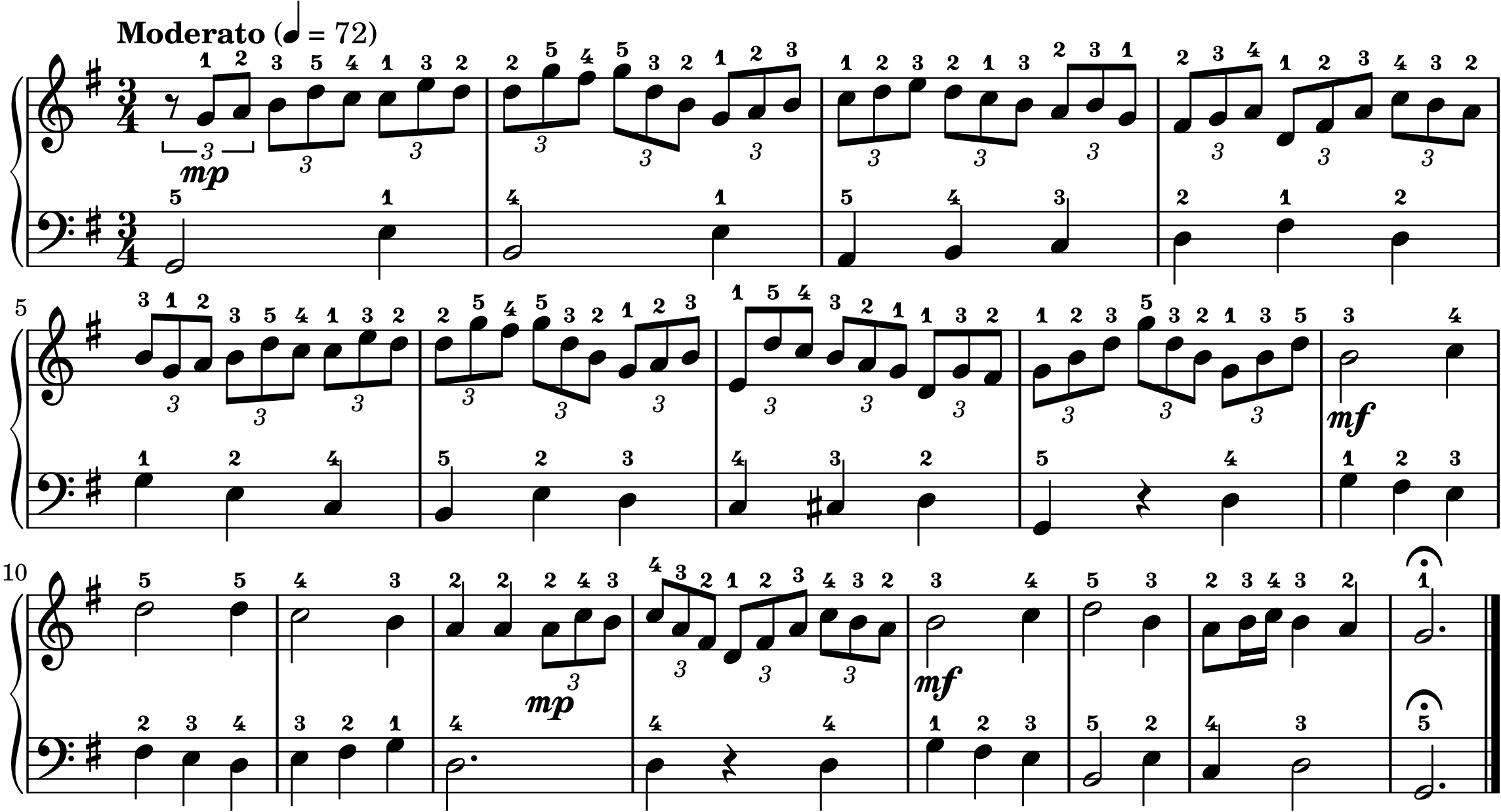
All 17 measures are in 3/4, Moderato at 72 to the quarter. The left hand plays Bach's bass line in quarters and halves, from G2 up to G3. In section A the right hand plays three notes to each beat, so count 1-trip-let, 2-trip-let, 3-trip-let. When the triplets stop in measure 9, keep the same beat: the chorale only sounds slower because its notes are longer.
Note by note: keys and fingering
- Right hand: Home position with the thumb (1) on G4, index (2) on A4, middle (3) on B4, ring (4) on C5 and pinky (5) on D5. The triplets move the hand often: in measures 1 and 5 the thumb takes the second C5 right after finger 4 plays the first, in measures 2 and 6 the pinky reaches G5 for the broken G chord G5, D5, B4, G4 on 5-3-2-1, and in measure 3 the middle finger crosses over the thumb to B4. Measures 4 and 13 put the thumb on D4, and measure 7 starts with the thumb on E4 before the leap to D5. The chorale notes of measures 9-17 sit in the home position, and the last G4 is on the thumb.
- Left hand: Bach's bass line, one note at a time. The pinky (5) plays G2 at the start and the end, with the thumb (1) on E3 in measures 1-2. Measure 3 walks up A2, B2, C3 on 5-4-3, measure 4 plays D3, F#3, D3 on 2-1-2, and measure 7 climbs C3, C#3, D3 on 4-3-2. In the chorale, G3, F#3, E3 go down on 1-2-3 (measures 9 and 14), F#3, E3, D3 on 2-3-4 (measure 10), and measure 11 comes back up on 3-2-1. D3 takes finger 4 in measures 12-13. B2 is on finger 4 in measures 2-3 and on the pinky in measures 6 and 15.
| Note | On the Staff | On the Keyboard | Finger |
|---|---|---|---|
| D4 | Space just below the treble staff | White key between the two black keys right of middle C | RH Thumb (1) |
| E4 | Bottom line of treble staff | White key right of the two black keys above middle C | RH Thumb (1) |
| F#4 | First space of treble staff, sharp in the key signature | Black key, first of the three black keys above middle C | RH Index (2) |
| G4 | Second line of treble staff | White key between the first two of three black keys above middle C | RH Thumb (1) |
| A4 | Second space of treble staff | White key between the last two of three black keys above middle C | RH Index (2) |
| B4 | Middle line of treble staff | White key right of the three black keys above middle C | RH Middle (3) |
| C5 | Third space of treble staff | One octave above middle C | RH Ring (4) |
| D5 | Fourth line of treble staff | White key between the two black keys above C5 | RH Pinky (5) |
| E5 | Fourth space of treble staff | White key right of the two black keys above C5 | RH Middle (3) |
| F#5 | Top line of treble staff, sharp in the key signature | Black key, first of the three black keys above C5 | RH Ring (4) |
| G5 | Space just above the treble staff | White key between the first two of three black keys above C5 | RH Pinky (5) |
| G2 | Bottom line of bass staff | White key between the first two of three black keys, an octave and a fourth below middle C | LH Pinky (5) |
| A2 | First space of bass staff | White key between the last two of three black keys, an octave and a third below middle C | LH Pinky (5) |
| B2 | Second line of bass staff | White key right of the three black keys, an octave and a step below middle C | LH Ring (4) |
| C3 | Second space of bass staff | One octave below middle C | LH Ring (4) |
| C#3 | Second space of bass staff, with a sharp sign | Black key, first of the two black keys below middle C | LH Middle (3) |
| D3 | Third line of bass staff | White key between the two black keys below middle C | LH Ring (4) |
| E3 | Third space of bass staff | White key right of the two black keys below middle C | LH Middle (3) |
| F#3 | Fourth line of bass staff, sharp in the key signature | Black key, first of the three black keys below middle C | LH Index (2) |
| G3 | Fourth space of bass staff | White key between the first two of three black keys below middle C | LH Thumb (1) |
Prefer a video? Watch the keys light up
Same color code as the player: green marks the right hand, blue the left hand, with the score and keyboard in one vertical video.
The story behind Jesu, Joy of Man's Desiring
The music is No. 10 (also numbered No. 6) of Cantata BWV 147 by J. S. Bach (d. 1750). Its chorale tune is by Johann Schop (d. 1667); the German text, by Martin Jahn (d. c. 1682), is not printed here. We read the notes from the Bach-Gesellschaft edition, vol. 30, edited by Paul Graf Waldersee (Leipzig: Breitkopf & Härtel, 1884), and checked them against B. Todt's vocal score from about 1890. Measures 1-8 are the triplet line of the first violins and oboes. Measures 9-17 give the chorale melody in the source key of G major; Bach's triplets under its second phrase are left out at this level. This is not Myra Hess's piano transcription.
Get the printable PDF
Our Jesu, Joy of Man's Desiring PDF downloads for free, directly, without an email address. It prints the full score with fingering for both hands, plus a practice tip for each section. Look on the Christmas page for more free pieces.
Even triplets need a loose arm, and a child who sits too low tends to tense up, so check the piano bench height calculator for their size; our solid-wood kids piano bench is made for young pianists.
FAQ
How hard is Jesu, Joy of Man's Desiring on piano?
It is one of the Level 3 pieces in our Christmas collection. Measures 1-8 move in steady triplets, with the middle finger crossing over the thumb in measure 3 and a leap from E4 to D5 in measure 7. The chorale in measures 9-17 has longer notes and stays near one hand position. The left hand plays one note at a time.
How long does it take to learn Jesu, Joy of Man's Desiring?
Three to four weeks for most adult beginners. Measure 6 repeats measure 2, and measures 14-15 begin like measures 9-10, so there is less to learn than it looks. Give the triplets of section A most of the time, hands separately at x0.5.
What level is Jesu, Joy of Man's Desiring?
Level 3 of our Christmas collection. The 17 measures are in G major and 3/4 at Moderato, 72 BPM, with the right hand between D4 and G5 and Bach's bass between G2 and G3.
What are the notes for Jesu, Joy of Man's Desiring?
The triplet line begins G4, A4, then B4, D5, C5, C5, E5, D5, D5, G5, F#5, G5, D5, B4, G4, A4, B4. The chorale in measure 9 starts B4, C5, D5, D5, C5, B4, A4, A4. The left hand opens on G2 and E3. See the table above for every key and finger.