
Go Tell It on the Mountain is set here in F major and 4/4: chorus first, then the verse, then the chorus again, with even eighth notes. Hear the rhythm first in the interactive player at x0.5. The fingering and a free printable PDF come after the score.
Learn it with the interactive player
- Slow it down: x0.5 or x0.75 while you learn the notes, back to x1 once they flow.
- Pause anywhere: the current keys stay lit so you can find them on your own piano.
- Drag the score left or right, or use the 15s buttons, to replay a phrase.
The sheet music, section by section

Section A, measures 1-8, is the chorus, played forte. It starts on a half-note A4, then A4, G4, F4, D4 in eighths fall to a half-note C4 on the thumb. Measure 3 repeats G4 four times, eighth, quarter, eighth, quarter, before F4. In measure 4 the tune turns back down, A4, G4, A4, F4, as it does in the 1909, 1925 and 1930 prints; the higher turn many singers know today came later and is not used here. Measures 5-6 repeat the opening, and measure 7 leads to a whole-note F4 in measure 8.
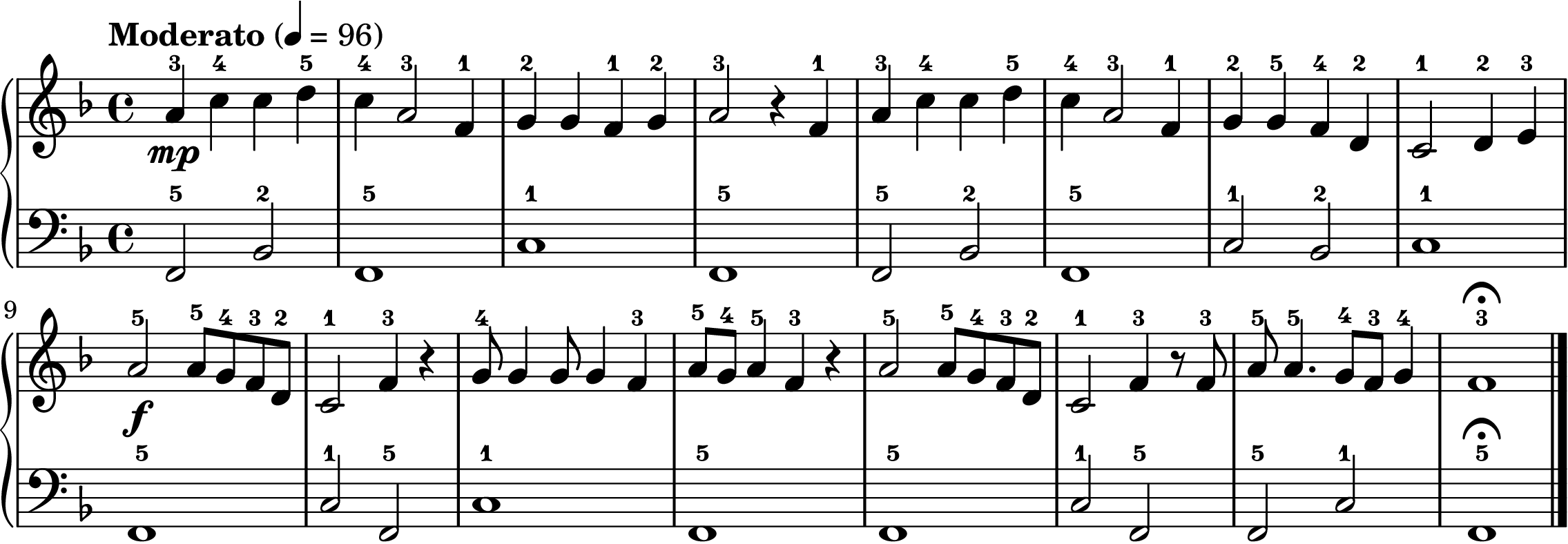
Section B starts with the verse, measures 9-16, at mp and in quarter notes, with the hand moved up to F4. It climbs A4, C5, C5, D5 and comes back to a half-note A4 in measure 10. Measures 13-14 repeat measures 9-10, and in measure 15 a finger change on the repeated G4 (2 to 5) brings the hand down. The four beats of measure 16, a half-note C4 then D4 and E4, lead into the forte chorus of measures 17-24, which ends on F4 under a fermata. The way back into the chorus, measures 15-17, is the bar to repeat at x0.75.
The full score
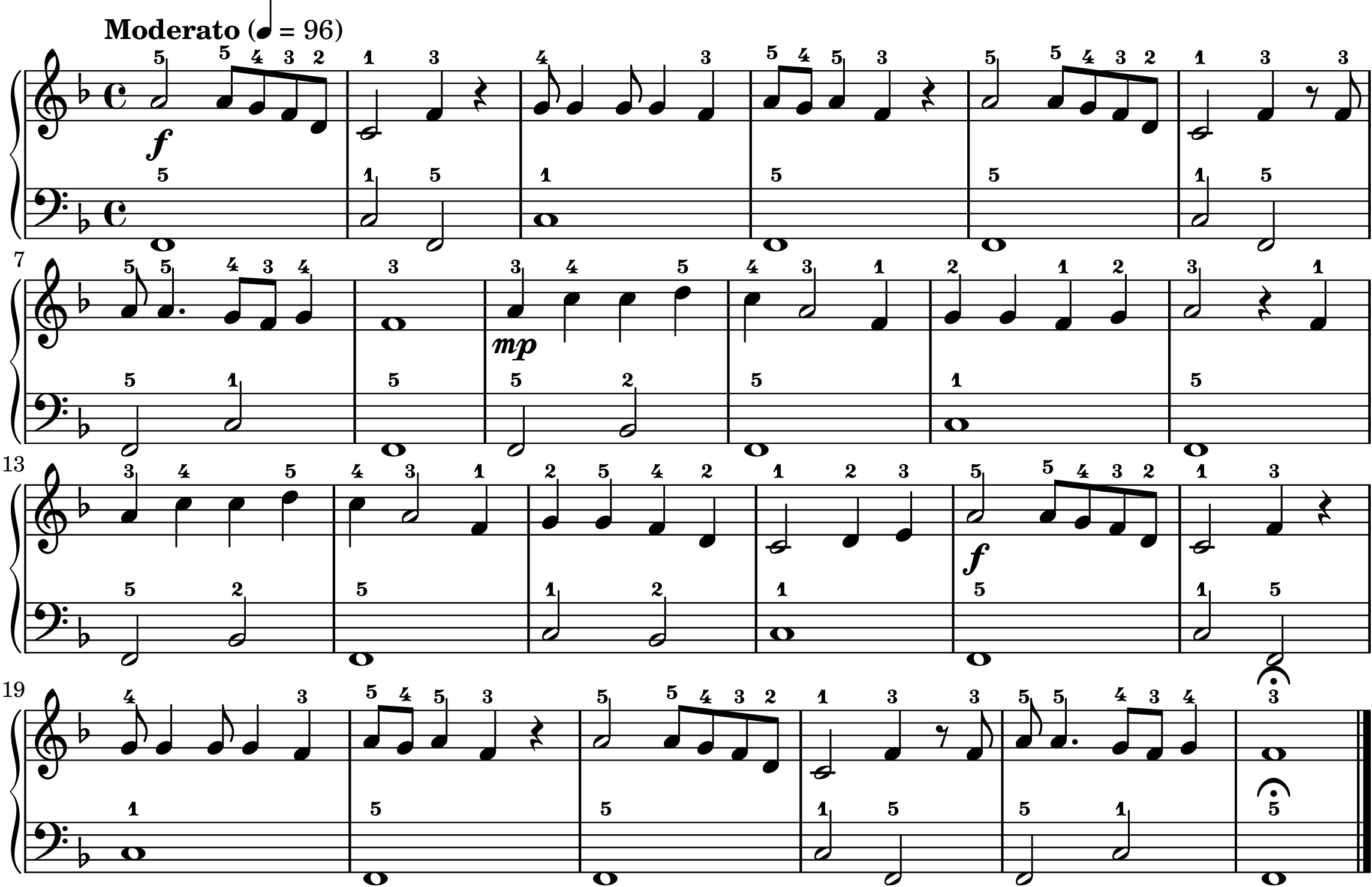
The 24 measures run at Moderato, 96 to the quarter. The left hand plays F2, C3 and Bb2, a whole note or two half notes per bar, so most of your attention goes to the right hand. Count the chorus eighths as one-and-two-and and keep them even, as the 1930 print has them. Note the eighth rest before the last F4 of measures 6 and 22.
Note by note: keys and fingering
- Right hand: Two positions. For the chorus, measures 1-8 and 17-24, the thumb (1) is on C4, index (2) on D4, middle (3) on F4, ring (4) on G4 and pinky (5) on A4, an open hand that skips E4. For the verse, measures 9-16, the hand moves up: thumb on F4, index on G4, middle on A4, ring on C5 and pinky on D5. In measure 15 the pinky replaces the index on the repeated G4, which brings the hand back down; F4 then takes 4 and D4 takes 2, and measure 16 walks C4, D4, E4 on 1-2-3 into the chorus.
- Left hand: Only three notes, all in one position: pinky (5) on F2, index (2) on Bb2 and thumb (1) on C3. Each bar holds a whole note or two half notes. Bb2 comes only in the verse, in measures 9, 13 and 15.
| Note | On the Staff | On the Keyboard | Finger |
|---|---|---|---|
| C4 | Ledger line below the treble staff (middle C) | Middle C | RH Thumb (1) |
| D4 | Space just below the treble staff | White key between the two black keys above middle C | RH Index (2) |
| E4 | Bottom line of treble staff | White key right of the two black keys above middle C | RH Middle (3) |
| F4 | First space of treble staff | White key left of the three black keys above middle C | RH Middle (3) |
| G4 | Second line of treble staff | White key between the first two of three black keys above middle C | RH Ring (4) |
| A4 | Second space of treble staff | White key between the last two of three black keys above middle C | RH Pinky (5) |
| C5 | Third space of treble staff | One octave above middle C | RH Ring (4) |
| D5 | Fourth line of treble staff | White key between the two black keys above C5 | RH Pinky (5) |
| F2 | Space just below the bass staff | White key left of the three black keys, an octave and a fifth below middle C | LH Pinky (5) |
| Bb2 | Second line of bass staff, flat in the key signature | Black key, last of the three black keys below C3 | LH Index (2) |
| C3 | Second space of bass staff | One octave below middle C | LH Thumb (1) |
Prefer a video? Watch the keys light up
Same color code as the player: green marks the right hand, blue the left hand, with the score and keyboard in one vertical video.
The story behind Go Tell It on the Mountain
Go Tell It on the Mountain is an anonymous African-American spiritual. The earliest print we found is in Religious Folk Songs of the Negro as Sung on the Plantations, the new edition arranged by the musical directors of the Hampton Institute (Hampton, Va., 1909), page 174. Our pitches come from it. That page prints the verse first; we start and end with the chorus. Its dotted figures and triplets are evened out to eighths, as in Utica Jubilee Singers Spirituals (Boston: Ditson, 1930), taken down by J. Rosamond Johnson. At measures 4 and 20 the tune turns back down, A-G-A-F, as in the 1909, 1925 and 1930 prints. The higher turn many people sing today came later. The words are not printed here.
Get the printable PDF
No email is needed for the PDF: it downloads directly and is free. Print it for the full score with fingering, plus a tip for each section. For more free carols, see our Christmas piano sheets page.
A child who sings Go Tell It on the Mountain at a school or church concert can learn to play it too; the piano bench height calculator works out the seat height they need, and our solid-wood kids piano bench is built for players their size.
FAQ
How hard is Go Tell It on the Mountain on piano?
It is a Level 2 piece. The left hand plays only F2, Bb2 and C3, in long notes. The right hand has eighth notes in the chorus and moves between two positions, with a finger change on the repeated G4 in measure 15 to come back down.
How long does it take to learn Go Tell It on the Mountain?
Usually one to two weeks. You learn the chorus once, since measures 17-24 repeat measures 1-8 and measures 5-6 start like measures 1-2. That leaves the verse, which moves in quarter notes.
What level is Go Tell It on the Mountain?
Go Tell It on the Mountain is Level 2 of our Christmas collection. It has 24 measures in F major and 4/4 at Moderato, 96 BPM. The right hand ranges from C4 to D5 and the left hand from F2 to C3, one note at a time.
What are the notes for Go Tell It on the Mountain?
The chorus starts A4, A4, G4, F4, D4, C4, F4, then G4 four times and F4, then A4, G4, A4, F4. That last turn goes back down, as in the 1909, 1925 and 1930 prints, rather than rising to a high D as many people sing it today.