
Coventry Carol moves between 4/4, 3/4 and 2/4 in this A minor version, so each bar keeps the note lengths of the 1825 print. The interactive player can slow it down, and you can drag the score back to any bar that trips you up. Scroll on for the sheet music, fingering for both hands and a free printable PDF.
Learn it with the interactive player
- Slow it down: x0.5 or x0.75 while you learn the notes, back to x1 once they flow.
- Pause anywhere: the current keys stay lit so you can find them on your own piano.
- Drag the score left or right, or use the 15s buttons, to replay a phrase.
The sheet music, section by section

The refrain fills section A, measures 1-12, and is played piano. It opens A4, A4, G#4 with fingers 2 and 1, goes on to A4 and C5, then B4, B4, A4, and rests on a dotted-half G#4 in measure 4. The second phrase climbs A4, B4, C5, D5, then the thumb moves to A4 for the leap up to E5 in measure 7. The meter starts in 4/4 and moves to 3/4, with 2/4 bars at measures 6 and 11, and the refrain finishes on a held C#5 in a 4/4 bar. Practice at x0.5 and count the beats of each bar out loud.

Section B (measures 13-26) is the verse, at mezzo-forte. For seven bars it follows the refrain closely, up to the same leap to E5 in measure 19. After that, D5, C5, B4, C5 and B4, B4, A4 come down to a G natural in measure 23, played piano with the thumb. It is the only G natural in the right hand. The last three bars repeat the end of the refrain and close on C#5 again. Loop measures 20-24 at x0.75.
The full score
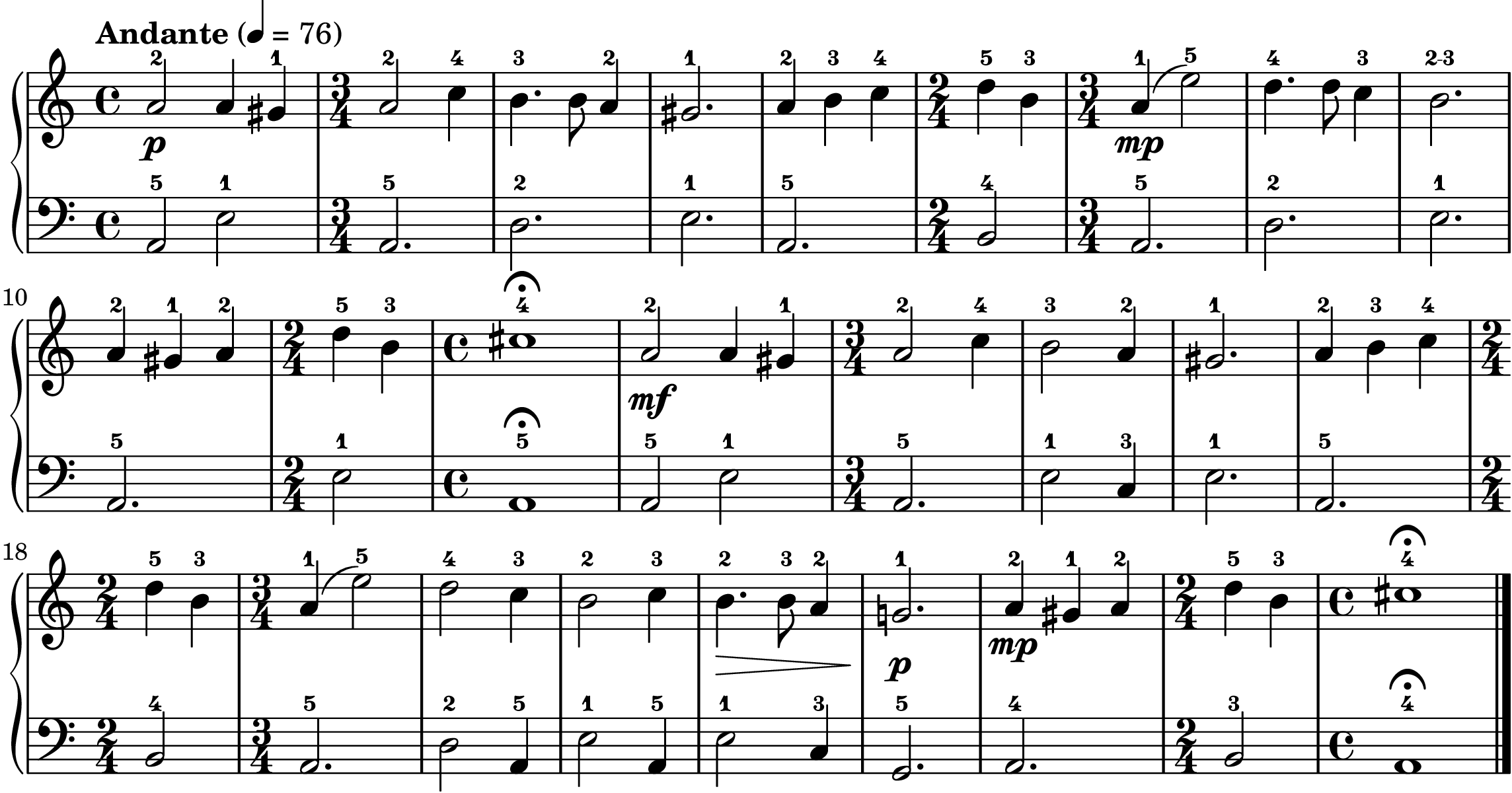
All 26 bars run at Andante, 76 to the quarter. The left hand plays one or two long notes per bar, mostly A2, D3 and E3. Since the bar lengths change, learn the meter first: tap the beats along with the player at x0.5 before adding the notes, and give both fermatas on C#5 their full time.
Note by note: keys and fingering
- Right hand: One main position with the thumb (1) on G#4: index (2) on A4, middle (3) on B4, ring (4) on C5 and pinky (5) on D5. For the leap to E5 in measures 7 and 19, the thumb moves up to A4 so the pinky can reach E5. The closing C#5 takes the ring finger (4), and the G natural in measure 23 takes the thumb.
- Left hand: Pinky (5) on A2 as the home note, with the thumb (1) on E3 and the index (2) on D3. B2 comes in the 2/4 bars, and the verse adds C3 with the middle finger (3) and a low G2 with the pinky in measure 23. Most bars hold one dotted half note, so the left hand has time to prepare each move.
| Note | On the Staff | On the Keyboard | Finger |
|---|---|---|---|
| G4 | Second line of treble staff, with a natural sign | White key between the first two of three black keys above middle C | RH Thumb (1) |
| G#4 | Second line of treble staff, with a sharp sign | Black key right of G4, the middle one of the three black keys above middle C | RH Thumb (1) |
| A4 | Second space of treble staff | White key between the last two of three black keys above middle C | RH Index (2) |
| B4 | Middle line of treble staff | White key right of the three black keys above middle C | RH Middle (3) |
| C5 | Third space of treble staff | One octave above middle C | RH Ring (4) |
| C#5 | Third space of treble staff, with a sharp sign | Black key right of C5, the first of the two black keys above C5 | RH Ring (4) |
| D5 | Fourth line of treble staff | White key between the two black keys above C5 | RH Pinky (5) |
| E5 | Fourth space of treble staff | White key right of the two black keys above C5 | RH Pinky (5) |
| G2 | Bottom line of bass staff | White key between the first two of three black keys, an octave and a fourth below middle C | LH Pinky (5) |
| A2 | First space of bass staff | White key between the last two of three black keys, an octave and a third below middle C | LH Pinky (5) |
| B2 | Second line of bass staff | White key right of the three black keys, an octave and a step below middle C | LH Ring (4) |
| C3 | Second space of bass staff | One octave below middle C | LH Middle (3) |
| D3 | Third line of bass staff | White key between the two black keys below middle C | LH Index (2) |
| E3 | Third space of bass staff | White key right of the two black keys below middle C | LH Thumb (1) |
Prefer a video? Watch the keys light up
Same color code as the player: green marks the right hand, blue the left hand, with the score and keyboard in one vertical video.
The story behind Coventry Carol
Nobody knows who wrote the tune, or the 16th-century text, which is not printed here. Thomas Mawdyke copied the three-part song on 13 May 1591 into Robert Croo's pageant manuscript of 1534, and that manuscript burned in 1879. Thomas Sharp (died 1841) printed it first, as Song II in A Dissertation on the Pageants or Dramatic Mysteries Anciently Performed at Coventry (Coventry, 1825). Sharp's print has no barlines. Our bars keep every printed note length, which is why the meter changes. We moved the tune up a whole tone, from G with one flat to A minor, and kept the major-third endings and the G natural in the verse.
Get the printable PDF
Print the Coventry Carol PDF for the full score, fingering for both hands and one practice tip per section. The download is free and direct, with no email asked. The same PDF is door 22 of the Free Piano Advent Calendar, whose doors open December 1-24.
Coventry Carol is slow enough for a young player to manage at a family gathering; the piano bench height calculator gives a seat height for their size, and our solid-wood kids piano bench is made for children.
FAQ
How hard is Coventry Carol on piano?
In our Advent calendar collection it is a Level 3 piece. The notes are slow and the right hand stays near one position. What takes practice is the meter, which changes between 4/4, 3/4 and 2/4, and the leap up to E5, which needs a thumb shift.
How long does it take to learn Coventry Carol?
Two to three weeks for most adult beginners. The verse starts almost exactly like the refrain, so section B goes quickly once section A is secure. Spend the first days tapping the changing bar lengths with the player before you play the notes.
What level is Coventry Carol?
Coventry Carol is Level 3 of our Advent calendar collection. Its 26 measures are in A minor at Andante, 76 BPM, and mix bars of 4/4, 3/4 and 2/4. Both hands play one note at a time, the right from G4 to E5 and the left from G2 to E3.
What are the notes for Coventry Carol?
The melody begins A4, A4, G#4, A4, C5, B4, B4, A4 and a long G#4, then A4, B4, C5, D5, B4 and the leap from A4 to E5. The refrain ends A4, G#4, A4, D5, B4 on a held C#5. The left hand opens on A2 and E3. The full note table is above.