
Joplin’s first strain of the Maple Leaf Rag, 16 bars, keeps its syncopation here, with tied notes that land between the beats. The score is in G major, a semitone below Joplin’s A-flat, and written in 4/4 with eighths for his sixteenths.
Learn it with the interactive player
- Slow it down: x0.5 or x0.75 while you learn the notes, back to x1 once they flow.
- Pause anywhere: the current keys stay lit so you can find them on your own piano.
- Drag the score left or right, or use the 15s buttons, to replay a phrase.
The sheet music, section by section
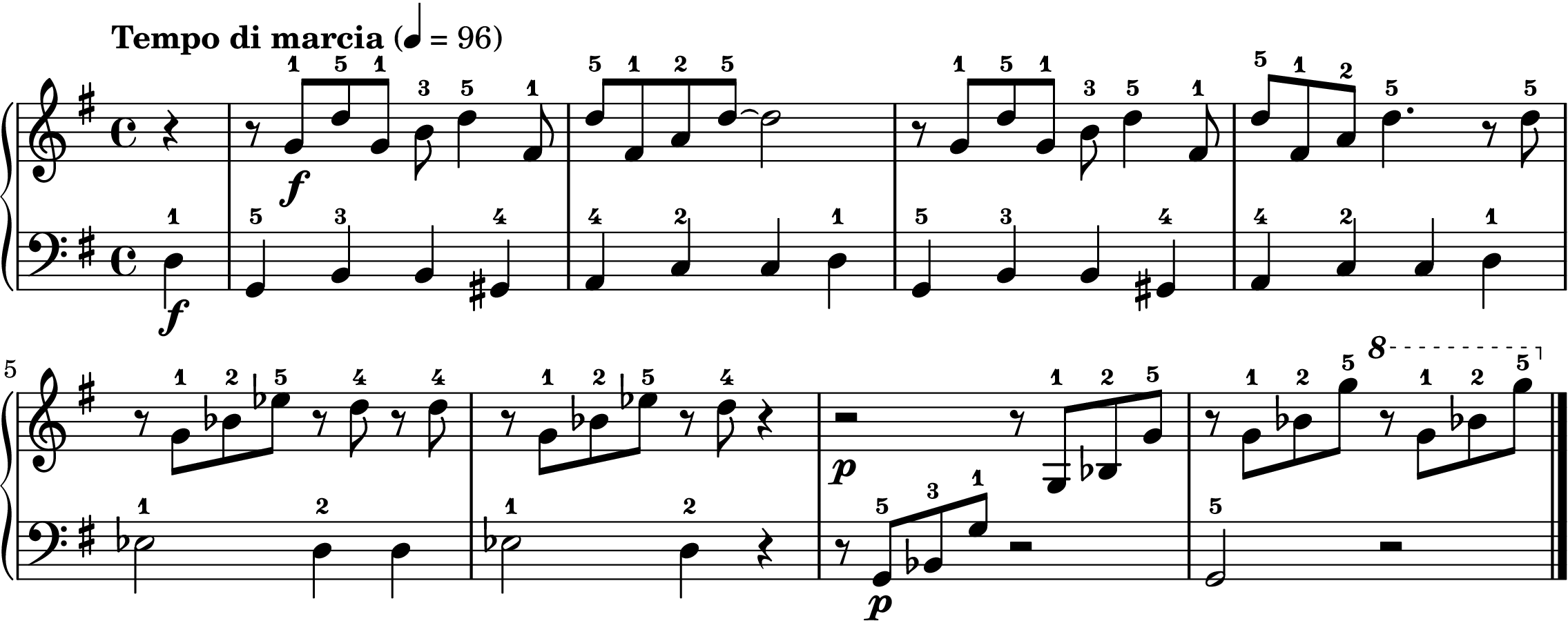
In section A, the pickup and measures 1-8, the right hand plays the opening figure forte: G4, D5, G4, B4, then a quarter D5 on the off-beat and F#4, with fingers 1-5-1-3-5-1. Measure 2 ends on a D5 tied into a half note. Measures 5-6 bring in the flats, Bb4 and Eb5, over a left-hand Eb3. Measure 7 drops to piano: the left hand starts a rising arpeggio on G2, Bb2 and G3, and the right hand carries it from G3 up to G6 across measures 7-8, the last group under an 8va sign.
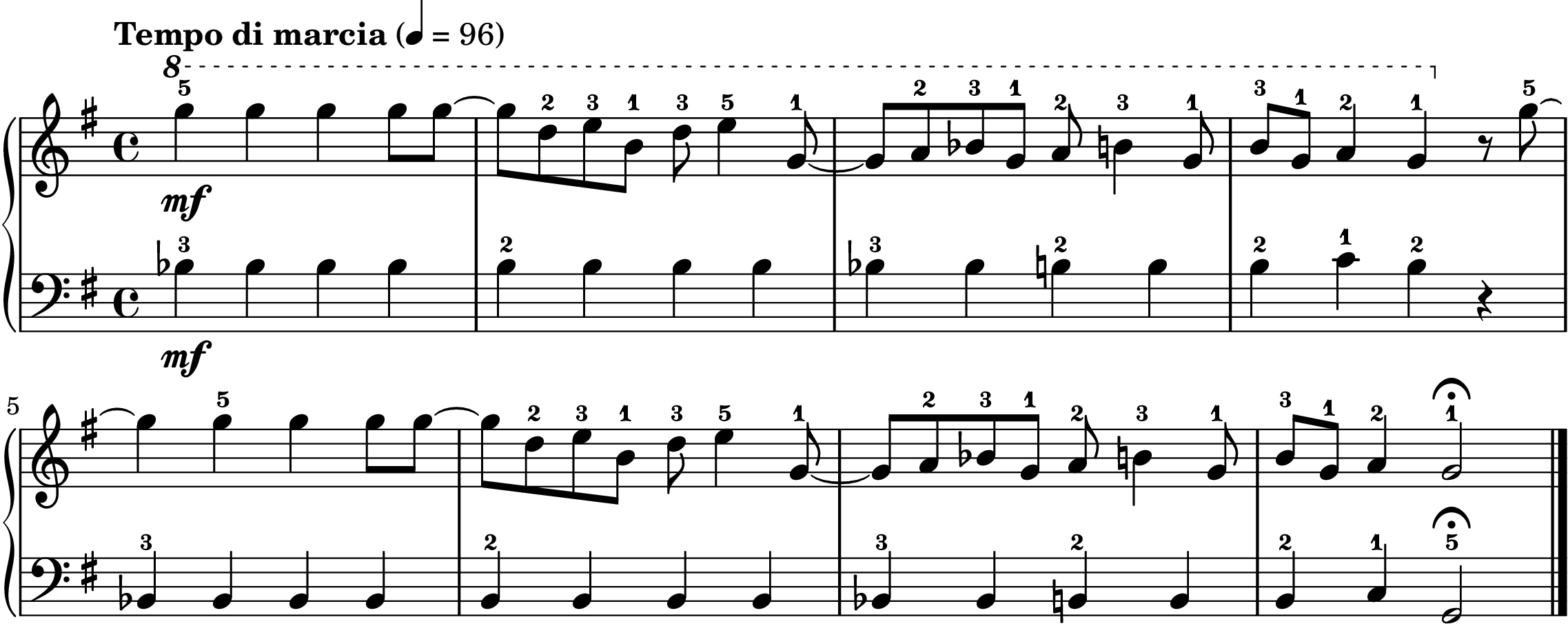
The 8va sign is already in place when section B begins at measure 9: what you read as G5 sounds as G6, five times, the last one tied over the bar line. Measures 10-12 answer with D6, E6, B5 and a line that comes down to G5, while the left hand plays Bb3 and B3 in steady quarters. The 8va line stops before the last beat of measure 12, and measures 13-16 repeat the answer an octave lower, Joplin's echo, over Bb2 and B2. On the page they look the same as measures 9-12; only the 8va line tells them apart.
The full score
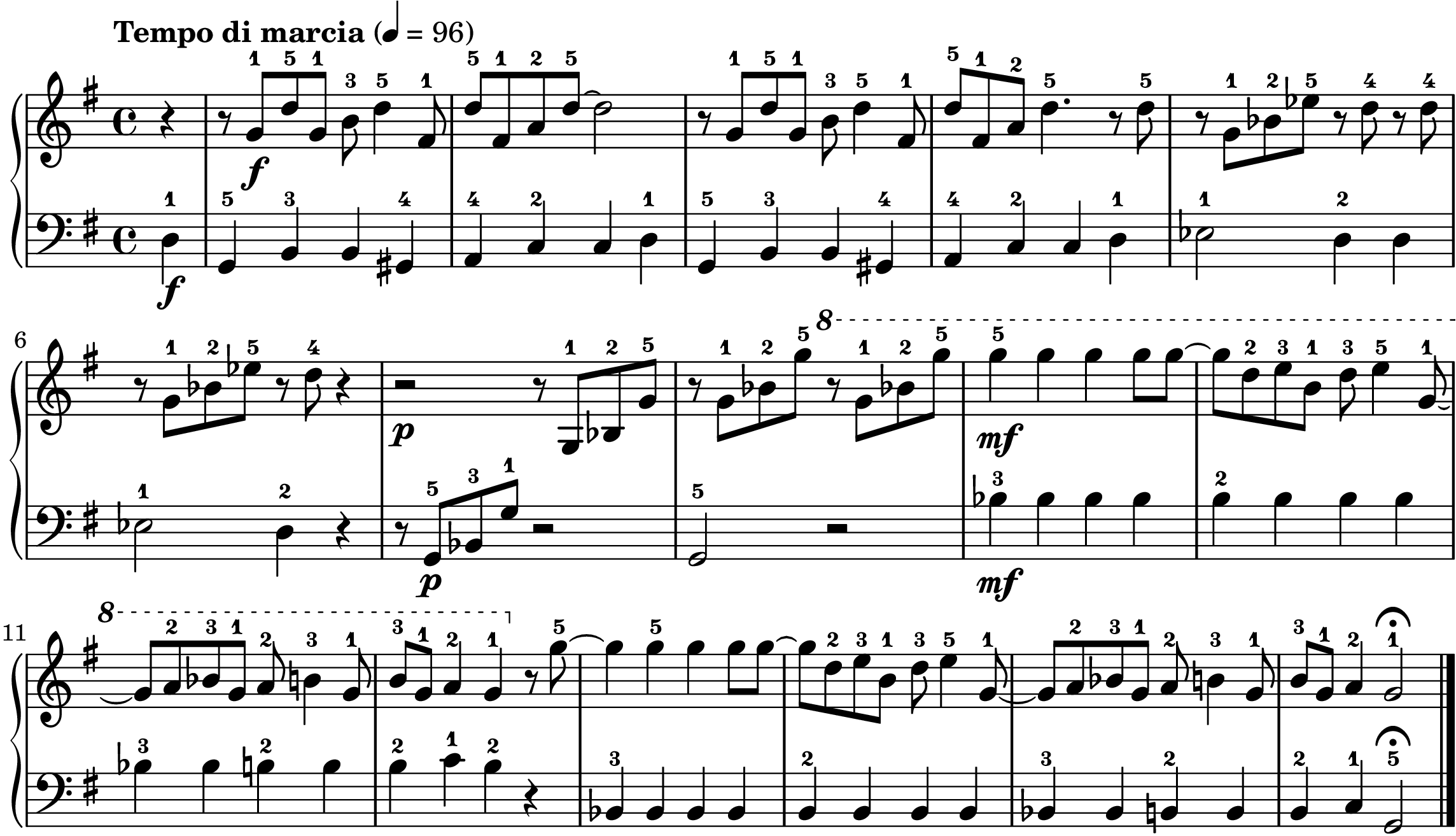
Joplin's own heading is Tempo di marcia, taken here at 96 to the quarter over the pickup and 16 bars. The left hand keeps the beat in quarter notes almost everywhere, and the right hand's tied eighths fall between those beats. Count in eighths (1-and-2-and) at 60 before going faster, and hold every tie to its full length.
Note by note: keys and fingering
- Right hand: The right hand moves through several positions, with the finger written at each change. Measures 1-4: thumb (1) on G4 or F#4, index (2) on A4, middle (3) on B4 and pinky (5) on D5. For measures 5-6 it is 1, 2, 5 on G4, Bb4, Eb5, with the ring finger (4) on D5. Measures 7-8 climb in groups of three with 1, 2, 5 each time: G3, Bb3, G4, then G4, Bb4, G5, then G5, Bb5, G6. In measures 9-16 the pinky (5) plays the repeated G, then 2, 3, 1, 3, 5 on D, E, B, D, E, the thumb on G, and 2, 3, 1, 2, 3, 1 on A, Bb, G, A, B, G.
- Left hand: Measures 1-4 are an oom-pah bass, one note at a time: pinky (5) on G2, middle (3) on B2, ring (4) on G#2 and A2, index (2) on C3 and thumb (1) on D3. Measures 5-6: thumb on Eb3, index on D3. In measure 7 the left hand starts the arpeggio, G2, Bb2, G3 with 5, 3, 1, and holds G2 in measure 8. From measure 9 it plays quarter notes on Bb3 (finger 3) and B3 (finger 2), with the thumb on C4 in measure 12, then the same an octave lower, ending on G2 with the pinky.
| Note | On the Staff | On the Keyboard | Finger |
|---|---|---|---|
| G3 | Below the second ledger line under the treble staff | White key between the first two of the three black keys below middle C | RH Thumb (1) |
| Bb3 | Just below the first ledger line under the treble staff, with a flat sign | Black key between A3 and B3, just below middle C | RH Index (2) |
| F#4 | First space of treble staff, sharp from the key signature | Black key right of F4, the first of the three black keys above middle C | RH Thumb (1) |
| G4 | Second line of treble staff | White key between the first two of the three black keys above middle C | RH Thumb (1) |
| A4 | Second space of treble staff | White key between the last two of the three black keys above middle C | RH Index (2) |
| Bb4 | Middle line of treble staff, with a flat sign | Black key between A4 and B4, the last of the three black keys above middle C | RH Index (2) |
| B4 | Middle line of treble staff | White key right of the three black keys above middle C | RH Middle (3) |
| D5 | Fourth line of treble staff | White key between the two black keys above C5 | RH Pinky (5) |
| Eb5 | Fourth space of treble staff, with a flat sign | Black key between D5 and E5 | RH Pinky (5) |
| E5 | Fourth space of treble staff | White key right of the two black keys above C5 | RH Middle (3) |
| G5 | Space above the treble staff (in measures 8-12, under the 8va sign, written on the second line) | White key between the first two of the three black keys above C5 | RH Pinky (5) |
| A5 | Written in the second space, under the 8va sign | White key between the last two of the three black keys above C5 | RH Index (2) |
| Bb5 | Written on the middle line with a flat, under the 8va sign | Black key between A5 and B5 | RH Index (2) |
| B5 | Written on the middle line, under the 8va sign (natural sign after a B-flat) | White key right of the three black keys above C5 | RH Middle (3) |
| D6 | Written on the fourth line, under the 8va sign | White key between the two black keys above C6 | RH Index (2) |
| E6 | Written in the fourth space, under the 8va sign | White key right of the two black keys above C6 | RH Middle (3) |
| G6 | Written in the space above the staff, under the 8va sign | White key between the first two of the three black keys above C6, two octaves above G4 | RH Pinky (5) |
| G2 | Bottom line of bass staff | White key between the first two of three black keys, an octave and a fourth below middle C | LH Pinky (5) |
| G#2 | Bottom line of bass staff, with a sharp sign | Black key between G2 and A2 | LH Ring (4) |
| A2 | First space of bass staff | White key between the last two of three black keys, an octave and a third below middle C | LH Ring (4) |
| Bb2 | Second line of bass staff, with a flat sign | Black key between A2 and B2 | LH Middle (3) |
| B2 | Second line of bass staff | White key right of the three black keys, an octave and a step below middle C | LH Index (2) |
| C3 | Second space of bass staff | One octave below middle C | LH Index (2) |
| D3 | Middle line of bass staff | White key between the two black keys below middle C | LH Thumb (1) |
| Eb3 | Third space of bass staff, with a flat sign | Black key between D3 and E3 | LH Thumb (1) |
| G3 | Fourth space of bass staff | White key between the first two of the three black keys below middle C | LH Thumb (1) |
| Bb3 | Space above the bass staff, with a flat sign | Black key between A3 and B3, just below middle C | LH Middle (3) |
| B3 | Space above the bass staff | White key just left of middle C | LH Index (2) |
| C4 | First ledger line above the bass staff | Middle C | LH Thumb (1) |
Prefer a video? Watch the keys light up
Same color code as the player: green marks the right hand, blue the left hand, with the score and keyboard in one vertical video.
The story behind the Maple Leaf Rag
The Maple Leaf Rag came out in Sedalia, Missouri, in 1899, published by John Stark & Son for Scott Joplin (about 1868-1917); the copyright was registered on 18 September 1899. The first strain of that first edition, marked Tempo di marcia, is our source. Our score is transposed down a semitone, from A-flat major to G major, so it has one sharp instead of four flats, and Joplin's sixteenths become eighths in 4/4. The right hand plays his top line only, without the octave doublings, and from the middle of bar 8 to bar 12 it sits an octave higher, as he wrote it. The strain is played once. Sydney Brown wrote lyrics for it in 1903; they are not used here.
Get the printable PDF
A printable PDF of this strain is free to download straight from this page, no email needed. It holds Joplin's strain with both hands fingered, a tip for each of the two sections and a practice plan. Another five pieces at the same level are bundled into a Level 5 pack, free by email.
Measures 7-8 send the right hand from G3 to G6 in two bars, a reach that is easier with the arm free to travel; an Adjustable Piano Bench with Back Support set to your height, placed far enough back from the keys, gives it that room.
FAQ
Is the Maple Leaf Rag in its original key here?
No. Joplin wrote it in A-flat major, with four flats; this score is a semitone lower, in G major, with one sharp. Every interval and the syncopated rhythm stay as he wrote them.
How hard is the Maple Leaf Rag on piano?
Even simplified, it is a high Level 5. The right hand climbs from G3 to G6 across measures 7-8 and then reads under an 8va sign, and the tied off-beat notes need exact counting over the steady left-hand quarters.
How long will the Maple Leaf Rag take to learn?
Plan on four to six weeks for this 16-bar strain, practicing most days. Measures 13-16 repeat 9-12 an octave lower, so start with 9-12, then the opening figure, then the arpeggio of measures 7-8, slowly and hands separately, before joining.
What notes does the Maple Leaf Rag start with?
In this G major version the right hand starts after an eighth rest: G4, D5, G4, B4, a quarter D5 and F#4, then D5, F#4, A4 and a long tied D5. The left hand opens with a D3 pickup, then G2, B2, B2, G#2.