
Each key lights up on the interactive player as Samuel A. Ward’s hymn tune for America the Beautiful plays, here in C major and 4/4 over a single-note bass line. The sheet music with fingering for both hands comes below, and so does a free printable PDF.
Learn it with the interactive player
- Slow it down: x0.5 or x0.75 while you learn the notes, back to x1 once they flow.
- Pause anywhere: the current keys stay lit so you can find them on your own piano.
- Drag the score left or right, or use the 15s buttons, to replay a phrase.
The sheet music, section by section

The first two phrases of section A (upbeat to measure 8) begin with the same long-short figure: a dotted-quarter G4, an eighth E4 (D4 the second time), then a quarter on that same low note, which stays under the thumb. Measure 3 climbs F4, G4, A4, B4 on fingers 2 to 5. Watch the end of measure 6, where the line leaps from D4 to D5. Measure 7 holds the only sharp of the melody, C#5 on finger 3, and the section ends on a long D5.

E5, the top note of the piece, opens section B on the pinky, now at mp. The dotted rhythm returns on a falling line, E5, D5, C5, then C5, B4. In measure 11 the hands move in opposite directions: the right hand comes down D5, B4, A4, G4 while the left climbs F3, G3, A3, B3 to middle C. Measure 13 goes back to mf; the fermata is on the last C5.
The full score
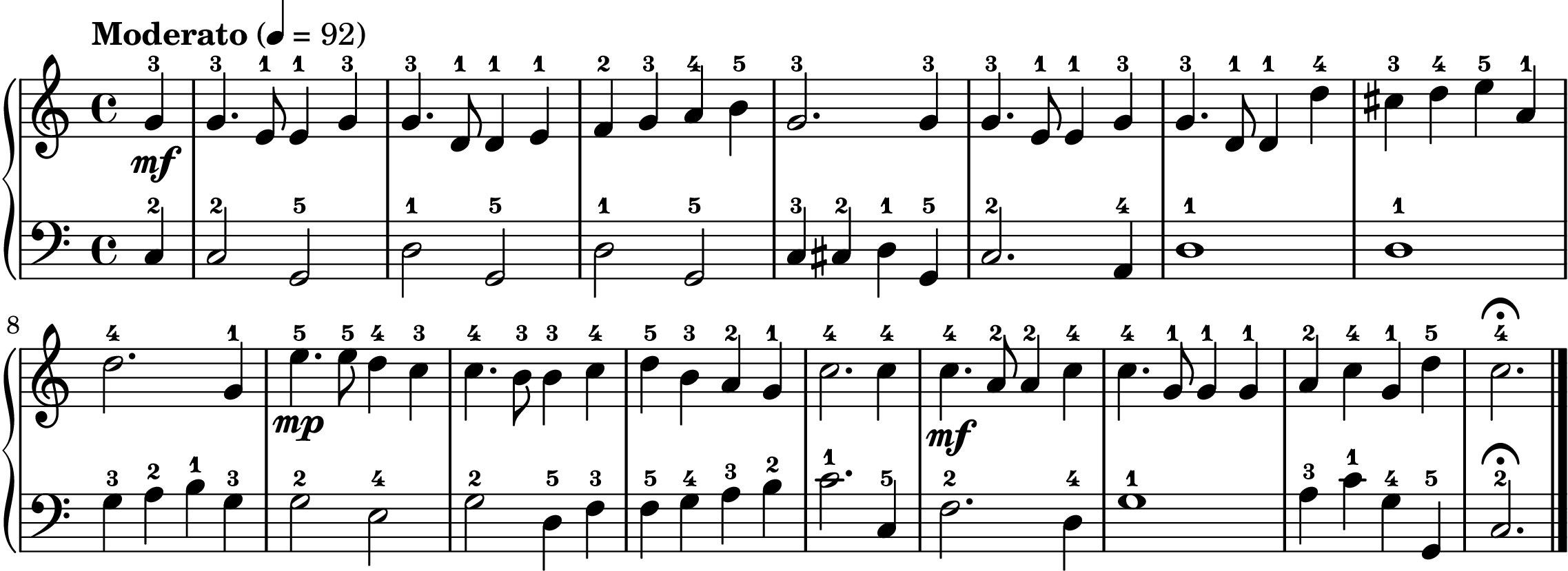
Half the bars open with the dotted quarter and eighth: count each dotted quarter as 1, 2 and put the eighth on the and of 2. The marking is Moderato, 92 to the quarter, for an upbeat plus 16 bars; keep it near 66 until both hands are sure.
Note by note: keys and fingering
- Right hand: In the opening phrases the thumb (1) covers E4 and D4 while the middle finger (3) stays on G4, and measure 3 walks F4, G4, A4, B4 on fingers 2, 3, 4, 5. At the end of measure 6 the hand jumps to D5 with the ring finger (4); C#5 then takes the middle finger (3), E5 the pinky (5), and the thumb comes down to A4. Section B starts with the pinky on E5 and the ring finger on C5 and D5. The thumb returns for G4 in measures 11, 14 and 15, and the pinky plays D5 in measure 15 before the ring finger ends on C5.
- Left hand: Mostly half and whole notes. The index (2) plays C3 and the pinky (5) G2 in the first bars, with the thumb (1) on D3. Measure 4 creeps up C3, C#3, D3 on fingers 3, 2, 1 and drops back to G2. D3 is held a whole bar in measures 6 and 7, and measure 8 climbs G3, A3, B3 on 3, 2, 1. Section B sits higher: G3 and E3, then F3, G3, A3, B3 on fingers 5, 4, 3, 2, up to middle C on the thumb in measure 12, followed by an octave drop to C3 on the pinky. The last C3 is played with the index.
| Note | On the Staff | On the Keyboard | Finger |
|---|---|---|---|
| D4 | Just below the bottom line of the treble staff | White key between the two black keys right of middle C | RH Thumb (1) |
| E4 | Bottom line of treble staff | White key right of the two black keys above middle C | RH Thumb (1) |
| F4 | First space of treble staff | White key left of the three black keys above middle C | RH Index (2) |
| G4 | Second line of treble staff | White key between the first two of three black keys above middle C | RH Middle (3) |
| A4 | Second space of treble staff | White key between the last two of three black keys above middle C | RH Index (2) |
| B4 | Middle line of treble staff | White key right of the three black keys above middle C | RH Middle (3) |
| C5 | Third space of treble staff | One octave above middle C | RH Ring (4) |
| C#5 | Third space of treble staff, with a sharp sign | Black key right of C5, the first of the two black keys above C5 | RH Middle (3) |
| D5 | Fourth line of treble staff | White key between the two black keys above C5 | RH Ring (4) |
| E5 | Fourth space of treble staff | White key right of the two black keys above C5 | RH Pinky (5) |
| G2 | Bottom line of bass staff | White key between the first two of three black keys, an octave and a fourth below middle C | LH Pinky (5) |
| A2 | First space of bass staff | White key between the last two of three black keys, an octave and a third below middle C | LH Ring (4) |
| C3 | Second space of bass staff | One octave below middle C | LH Index (2) |
| C#3 | Second space of bass staff, with a sharp sign | Black key right of C3, the first of the two black keys below middle C | LH Index (2) |
| D3 | Third line of bass staff | White key between the two black keys below middle C | LH Thumb (1) |
| E3 | Third space of bass staff | White key right of the two black keys below middle C | LH Ring (4) |
| F3 | Fourth line of bass staff | White key left of the three black keys below middle C | LH Middle (3) |
| G3 | Fourth space of bass staff | White key between the first two of three black keys below middle C | LH Middle (3) |
| A3 | Top line of bass staff | White key between the last two of three black keys below middle C | LH Middle (3) |
| B3 | Space above the top line of the bass staff | White key just left of middle C | LH Thumb (1) |
| C4 | Ledger line above the bass staff (middle C) | Middle C | LH Thumb (1) |
Prefer a video? Watch the keys light up
Same color code as the player: green marks the right hand, blue the left hand, with the score and keyboard in one vertical video.
The story behind America the Beautiful
MATERNA, as hymnals call this tune, was composed in 1882 by Samuel Augustus Ward (1847-1903). The first print we found is The Parish Choir, No. 378, published by C. L. Hutchins in Medford, Massachusetts, on 12 July 1888, where it appears as Hymn Tune 27; hymnals usually give 1892, the year of the Episcopal Hymnal. Katharine Lee Bates (died 1929) wrote the words, which were paired with Ward's tune in 1910; this page gives the music only. We set it a half step lower than the 1888 print, in C major instead of D-flat, so the C#5 in measure 7 is Ward's D natural. The hymn barring becomes 4/4 with an upbeat and the Amen is left out. Ward's bass is simplified for the left hand.
Get the printable PDF
The free printable PDF needs no email; it downloads straight away with the full score, fingering for both hands, a practice tip for each section and a short practice plan. For more seasonal sheets, the Thanksgiving pack button gives Level 1 as a free download and sends Levels 2 and 3 by email.
In measure 12 the left hand drops a full octave, from middle C to C3, a distance that is easier to judge from a centered seat. Set the Adjustable Piano Bench with Back Support to the height the piano bench height calculator gives you.
FAQ
Which parts of America the Beautiful are hardest?
The dotted quarter and eighth, and the leap from D4 to D5 at the end of measure 6. Little else needs reading, since the melody moves mostly by step and the second half reuses the rhythm of the first, which keeps it at Level 2.
What key is America the Beautiful in?
Ward's tune is in D-flat major in the 1888 print we follow. This easy version is a half step lower, in C major, so only two accidentals appear: C#5 in the right hand in measure 7 and C#3 in the left hand in measure 4.
How long will America the Beautiful take to learn?
About two weeks of daily 15-minute sessions, if you already play simple melodies. Section B uses the same rhythm as section A, so learn A first; then put the hands together at about 66 to the quarter and work up to 92.
What are the letter notes for America the Beautiful?
After an upbeat G4: G4, E4, E4, G4, then G4, D4, D4, E4, then F4, G4, A4, B4 and a long G4. Section B begins E5, E5, D5, C5. The left hand opens on C3 and G2.