
We Three Kings is in 3/4 here, with the minor-key verse and major-key chorus of the 1863 print and every note value doubled. Slow the interactive player to x0.5 and watch both hands on the keys before you open the sheet music or print the free PDF further down.
Learn it with the interactive player
- Slow it down: x0.5 or x0.75 while you learn the notes, back to x1 once they flow.
- Pause anywhere: the current keys stay lit so you can find them on your own piano.
- Drag the score left or right, or use the 15s buttons, to replay a phrase.
The sheet music, section by section

Measures 1-15 make up section A, the verse. It opens at mp with B4, A4, G4, E4 on fingers 5-4-3-1, then F#4, G4, F#4 and a half-note E4 in measure 4. Measures 5-8 play the same four bars again. At mf in measure 9 the line climbs on repeated notes, G4, A4 and B4, each a half note and a quarter, reaches D5 in measure 12 and steps back down to E4 in measure 15. Watch the second G4 in measure 9: it takes the thumb, which moves the hand up for the climb.

Section B is the chorus, measures 16-32, at f. A slurred F#4 to A4 opens it, then G4 on finger 4 alternates with D4 and E4 below. Measures 21-24 repeat measures 17-20 at mp. From measure 25, at mf, the tune rises through A4 and B4 to C5 in measure 27 and comes back to G4 in measure 29, with a finger change on the repeated G4 in measures 25 and 29. The last bar is a dotted-half G4 under a fermata. Measures 25-29 hold the only real hand move of the chorus, so they get the most loops.
The full score
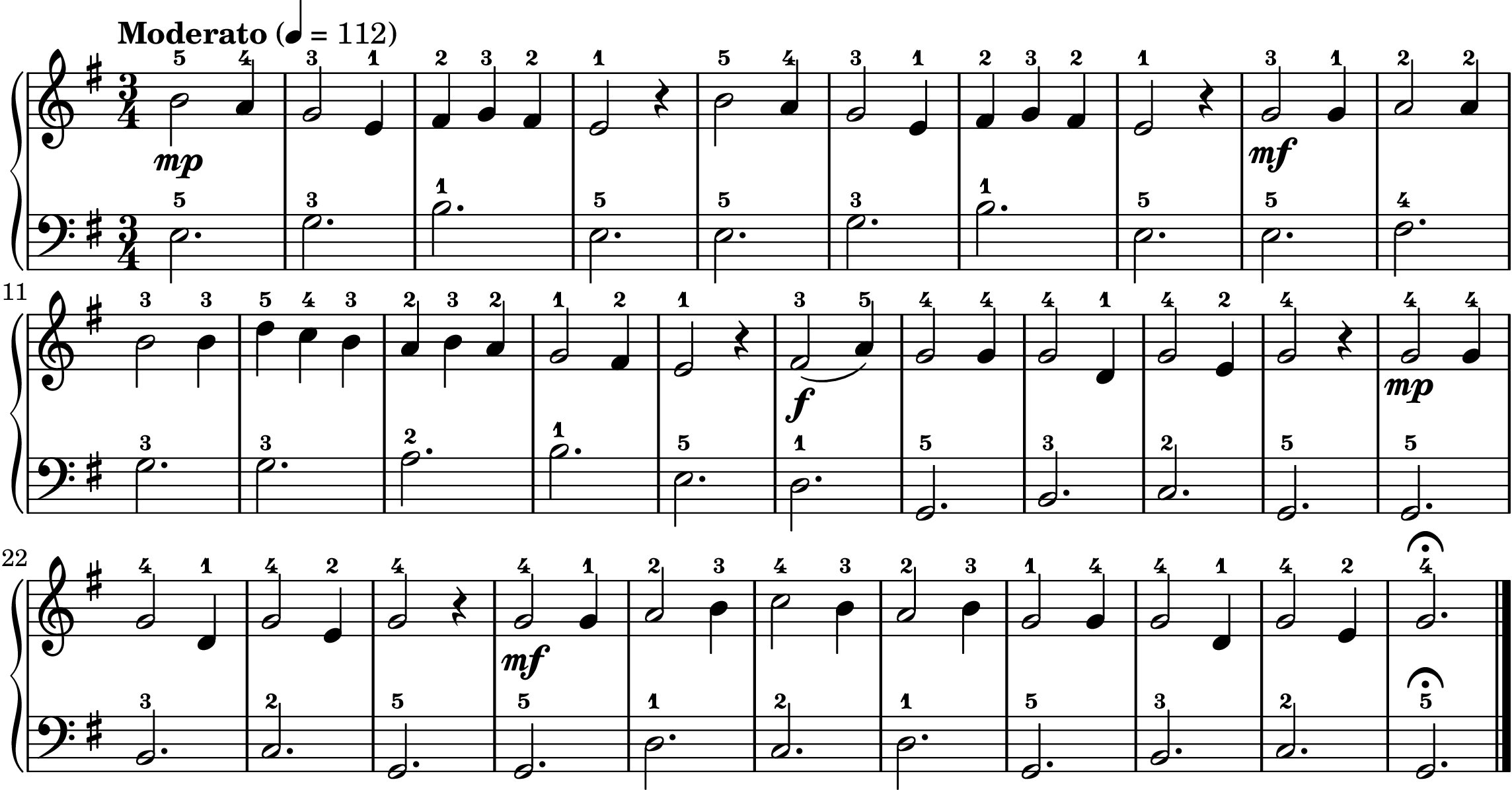
All 32 measures are in 3/4, Moderato at 112 to the quarter. The left hand plays one dotted half note in every bar and changes position only once, in measure 16. Count three beats per bar out loud and give each half note its full two beats.
Note by note: keys and fingering
- Right hand: In measures 1-8 the thumb (1) is on E4, index (2) on F#4, middle (3) on G4, ring (4) on A4 and pinky (5) on B4. In measure 9 the hand moves up on the repeated G4 (3, then 1): thumb on G4, index on A4, middle on B4, ring on C5 and pinky on D5. After the half-note G4 in measure 14 the hand drops back, so F#4 takes 2 and E4 the thumb. The chorus starts with the middle finger (3) on F#4 and the pinky on A4, which puts the thumb on D4 and the ring finger (4) on G4; most of the chorus goes back and forth between G4 on 4 and D4 or E4 below it. In measure 25 the second G4 takes the thumb for the climb to C5, and in measure 29 the second G4 goes back to finger 4.
- Left hand: One dotted half note per bar, in two positions. In the verse the pinky (5) is on E3, ring (4) on F#3, middle (3) on G3, index (2) on A3 and thumb (1) on B3. For the chorus the hand moves down: pinky on G2, middle on B2, index on C3 and thumb on D3. Measure 16 is the move: the thumb takes D3 there, so the pinky is ready for G2 in measure 17.
| Note | On the Staff | On the Keyboard | Finger |
|---|---|---|---|
| D4 | Space just below the treble staff | White key between the two black keys above middle C | RH Thumb (1) |
| E4 | Bottom line of treble staff | White key right of the two black keys above middle C | RH Thumb (1) |
| F#4 | First space of treble staff, sharp in the key signature | Black key, first of the three black keys above middle C | RH Index (2) |
| G4 | Second line of treble staff | White key between the first two of three black keys above middle C | RH Ring (4) |
| A4 | Second space of treble staff | White key between the last two of three black keys above middle C | RH Index (2) |
| B4 | Middle line of treble staff | White key right of the three black keys above middle C | RH Middle (3) |
| C5 | Third space of treble staff | One octave above middle C | RH Ring (4) |
| D5 | Fourth line of treble staff | White key between the two black keys above C5 | RH Pinky (5) |
| G2 | Bottom line of bass staff | White key between the first two of three black keys, an octave and a fourth below middle C | LH Pinky (5) |
| B2 | Second line of bass staff | White key right of the three black keys, an octave and a step below middle C | LH Middle (3) |
| C3 | Second space of bass staff | One octave below middle C | LH Index (2) |
| D3 | Third line of bass staff | White key between the two black keys below middle C | LH Thumb (1) |
| E3 | Third space of bass staff | White key right of the two black keys below middle C | LH Pinky (5) |
| F#3 | Fourth line of bass staff, sharp in the key signature | Black key, first of the three black keys below middle C | LH Ring (4) |
| G3 | Fourth space of bass staff | White key between the first two of three black keys below middle C | LH Middle (3) |
| A3 | Top line of bass staff | White key between the last two of three black keys below middle C | LH Index (2) |
| B3 | Space just above the bass staff | White key just left of middle C | LH Thumb (1) |
Prefer a video? Watch the keys light up
Same color code as the player: green marks the right hand, blue the left hand, with the score and keyboard in one vertical video.
The story behind We Three Kings
John Henry Hopkins Jr. (died 1891) wrote both the words and the music. The carol is on pages 12-13 of his Carols, Hymns, and Songs (New York: Church Book Depository), under the title Three Kings of Orient. The title page has no date; the copy we read is dated 1863. Our verse is Gaspard's part, which a note on page 12 also gives for verses 2-4, and our chorus is the top voice of the printed chorus. Hopkins wrote the carol in 3/8; we doubled every value to make 3/4 and left out his instrumental interlude. Hollis Dann's Christmas Carols and Hymns (1910) has the same pitches in all 32 bars. Hopkins' words are not printed here.
Get the printable PDF
Download the We Three Kings PDF for free, directly, without giving an email address. Inside are the full score, fingering for both hands and one practice tip per section. Our Christmas piano sheets page has more free carols.
We Three Kings puts a long note on the first beat of nearly every bar, which gives a child time to find the next key; our solid-wood kids piano bench is made for young players, and the piano pedal extender brings the pedals within reach of short legs.
FAQ
How hard is We Three Kings on piano?
It is an easy Level 2 piece. Both hands play one note at a time, mostly half notes and quarter notes in 3/4, and the left hand holds one note per bar. The main work is in the right hand, which changes position on repeated G4s in measures 9, 25 and 29.
How long does it take to learn We Three Kings?
Allow one to two weeks for most adult beginners. Measures 5-8 repeat measures 1-4 and measures 21-24 repeat 17-20, so a quarter of the bars are repeats. Many students learn the chorus first, since it stays close to G4, then add the verse.
What level is We Three Kings?
Level 2 in our Christmas collection, with 32 measures of 3/4 at Moderato, 112 BPM: the verse is in E minor, the chorus in G major. The right hand ranges from D4 to D5 and the left hand from G2 to B3.
What are the notes for We Three Kings?
The verse begins B4, A4, G4, E4, F#4, G4, F#4, E4, played twice. The chorus begins F#4, A4, G4, G4, G4, D4, G4, E4, G4. The left hand starts on E3 in the verse and on D3 then G2 in the chorus.