
This Nutcracker March keeps the top voice of Tchaikovsky’s own piano version, in G major and 4/4, over a staccato left hand that never leaves G2 to D3. Run the interactive player at x0.5 first to hear where the short rests fall. The score and a free printable PDF are further down.
Learn it with the interactive player
- Slow it down: x0.5 or x0.75 while you learn the notes, back to x1 once they flow.
- Pause anywhere: the current keys stay lit so you can find them on your own piano.
- Drag the score left or right, or use the 15s buttons, to replay a phrase.
The sheet music, section by section
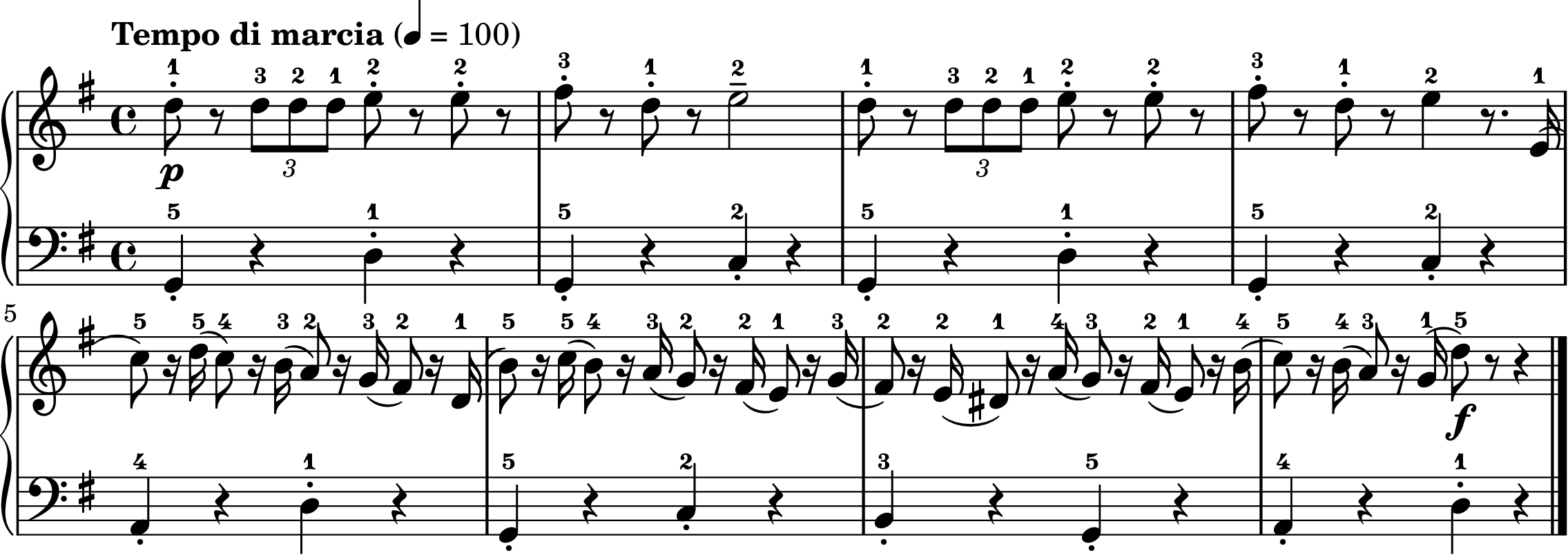
Section A runs from measure 1 to 8. Measures 1-4 are the fanfare, played p: a short D5 on the thumb, three quick D5s in a triplet with fingers 3-2-1, then E5 and F#5, with a held E5 in measure 2. The E4 at the end of measure 4 starts the string answer, where each eighth note is followed by a sixteenth rest and a sixteenth slurred to the next note. It steps down from C5 to D4 in measure 5, passes E4 and D#4 in measures 6-7, and lands on a forte D5 with the pinky in measure 8. Shift the hand inside the sixteenth rests, at x0.5 to begin.
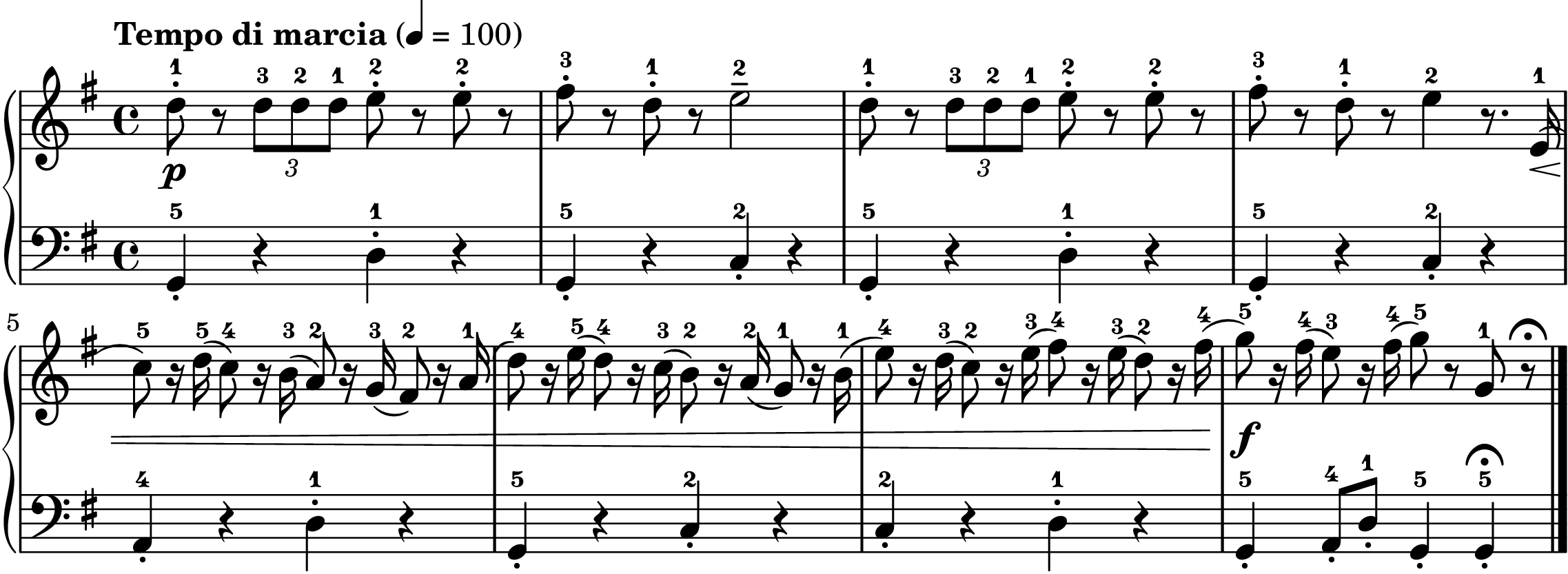
Measures 9-12 bring back the fanfare at p, note for note, and a crescendo starts on the E4 at the end of measure 12. From there section B takes a new path. Measure 13 begins like measure 5 but ends on A4 with the thumb, measure 14 starts higher on D5, and measure 15 climbs through E5 and F#5 to the G5 that opens measure 16 at f. That bar is Tchaikovsky's own ending: G5, F#5, E5, F#5, G5, then a short G4. Loop measures 13-16 at x0.75.
The full score
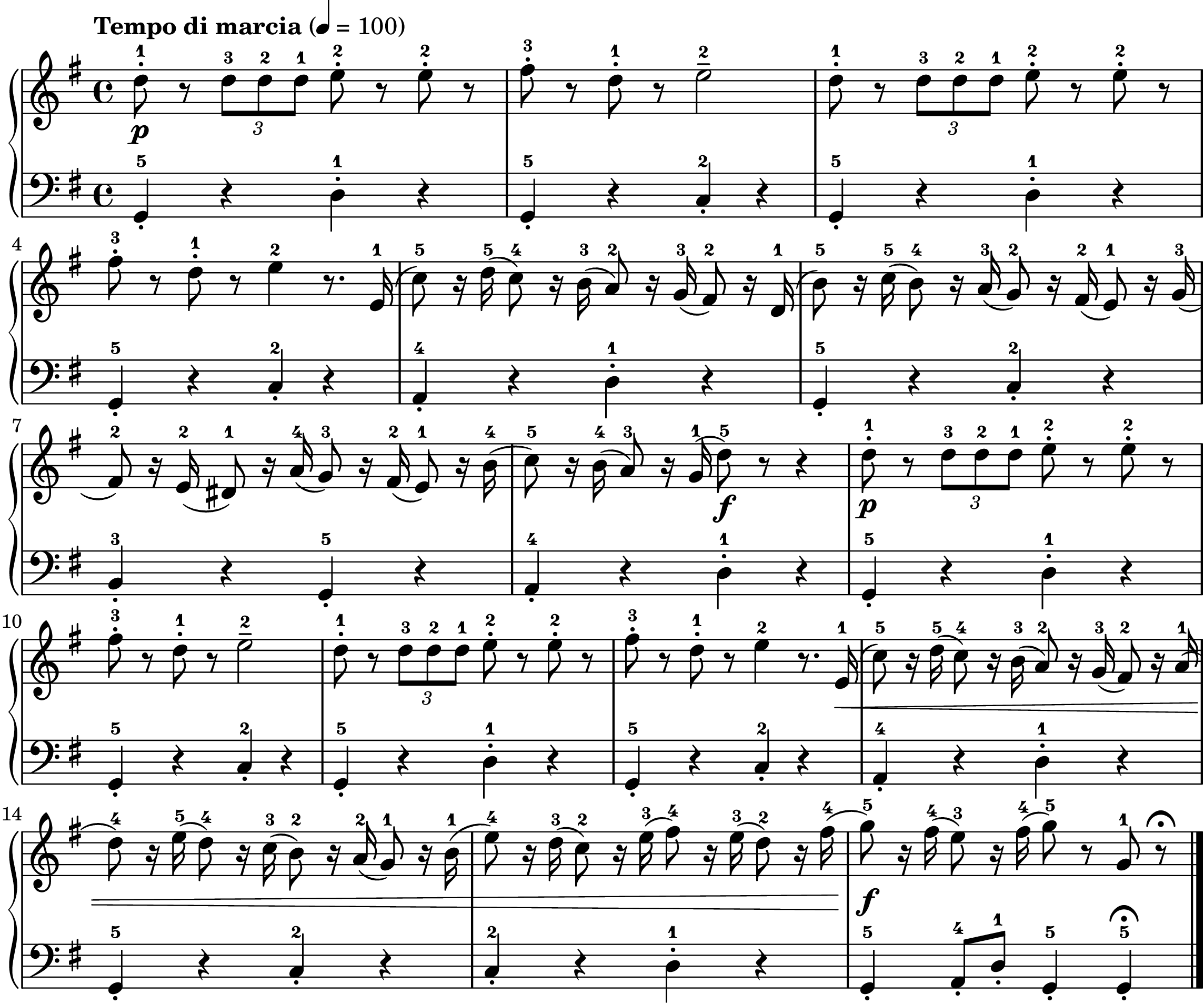
The 16 measures are in 4/4, Tempo di marcia, at 100 to the quarter where Tchaikovsky marks 144. The left hand stays in one position and plays short notes on beats 1 and 3 until the last bar. Count the right hand in sixteenths, 1-e-and-a, so every rest gets its exact length. The fast flourish of the source's measure 8 is left out, which is why measure 8 ends with rests after the D5.
Note by note: keys and fingering
- Right hand: Fanfare position for measures 1-4 and 9-12: thumb (1) on D5, index (2) on E5 and middle (3) on F#5, with the repeated triplet D5 taken 3-2-1. In the string answer the hand moves during each sixteenth rest: measure 5 starts with the pinky (5) on C5 and D5 and comes down to the thumb on D4, the thumb takes E4 and D#4 in measures 6-7, and in measure 8 it lands on G4 so the pinky can reach the forte D5. Measure 14 puts the thumb on G4 and B4, measure 15 uses no thumb at all, and the last bar ends with the pinky on G5 and the thumb on G4.
- Left hand: One position for the whole piece: pinky (5) on G2, ring (4) on A2, middle (3) on B2, index (2) on C3 and thumb (1) on D3. Up to measure 15 every note is a short quarter on beat 1 or 3, with a rest after it, and most bars pair G2 with D3 or C3. Measure 7 plays B2 then G2, and measure 15 plays C3 then D3. The last measure adds two eighths, A2 and D3, before two G2s with the pinky.
| Note | On the Staff | On the Keyboard | Finger |
|---|---|---|---|
| D4 | Space just below the treble staff | White key between the two black keys right of middle C | RH Thumb (1) |
| D#4 | Space just below the treble staff, with a sharp sign | Black key, second of the two black keys above middle C | RH Thumb (1) |
| E4 | Bottom line of treble staff | White key right of the two black keys above middle C | RH Thumb (1) |
| F#4 | First space of treble staff, sharp in the key signature | Black key, first of the three black keys above middle C | RH Index (2) |
| G4 | Second line of treble staff | White key between the first two of three black keys above middle C | RH Middle (3) |
| A4 | Second space of treble staff | White key between the last two of three black keys above middle C | RH Index (2) |
| B4 | Middle line of treble staff | White key right of the three black keys above middle C | RH Ring (4) |
| C5 | Third space of treble staff | One octave above middle C | RH Pinky (5) |
| D5 | Fourth line of treble staff | White key between the two black keys above C5 | RH Thumb (1) |
| E5 | Fourth space of treble staff | White key right of the two black keys above C5 | RH Index (2) |
| F#5 | Top line of treble staff, sharp in the key signature | Black key, first of the three black keys above C5 | RH Middle (3) |
| G5 | Space just above the treble staff | White key between the first two of three black keys above C5 | RH Pinky (5) |
| G2 | Bottom line of bass staff | White key between the first two of three black keys, an octave and a fourth below middle C | LH Pinky (5) |
| A2 | First space of bass staff | White key between the last two of three black keys, an octave and a third below middle C | LH Ring (4) |
| B2 | Second line of bass staff | White key right of the three black keys, an octave and a step below middle C | LH Middle (3) |
| C3 | Second space of bass staff | One octave below middle C | LH Index (2) |
| D3 | Third line of bass staff | White key between the two black keys below middle C | LH Thumb (1) |
Prefer a video? Watch the keys light up
Same color code as the player: green marks the right hand, blue the left hand, with the score and keyboard in one vertical video.
The story behind Nutcracker March
The March is No. 2 of the Suite from The Nutcracker, Op. 71a, by P. I. Tchaikovsky (d. 1893), published in Moscow by Jurgenson in 1892. It has no words. We read it from Tchaikovsky's own piano solo arrangement of the Suite, in the Rahter reprint of 1898, and checked it against the full score and a piano solo by A. Strelezki (d. 1906), printed by Augener under the name Esipoff. Measures 1-15 are the source's first 15 bars and measure 16 is its final bar, 88. We kept only the top voice, in the source key of G major, and left out the fast flourish and high D6 of bar 8. Tchaikovsky marks 144 to the quarter; our practice tempo is 100.
Get the printable PDF
Our Nutcracker March PDF costs nothing and asks for no email; the button downloads it at once. You get the full score with fingering and one practice tip per section. More free Christmas pieces for easy piano are on our Christmas page.
Short staccato notes like these come most easily with the forearm level with the keys, so for a child, the piano bench height calculator gives a seat height for their size, and our solid-wood kids piano bench is made for young players.
FAQ
How hard is the Nutcracker March on piano?
It is a Level 3 piece in our Christmas collection. The left hand stays on five notes, G2 to D3, and plays short notes, mostly on beats 1 and 3. The right hand is the harder part: a quick triplet on one repeated D5 with fingers 3-2-1, and a string figure where each sixteenth rest gives you a moment to move the hand.
How long does it take to learn the Nutcracker March?
Most adult beginners need three to four weeks. Measures 9-12 repeat measures 1-4, so the fanfare is learned once. Most of the time goes into measures 5-8 and 13-16, best practiced hands separately at x0.5 until every rest falls in the same place.
What level is the Nutcracker March?
It is Level 3 of our Christmas collection: 16 measures in G major and 4/4, Tempo di marcia at 100 BPM. Each hand plays one note at a time, the right from D4 to G5 and the left from G2 to D3.
What are the notes for the Nutcracker March?
The fanfare is D5, three quick D5s, E5, E5, then F#5, D5 and a long E5. It repeats, and the E4 at the end of measure 4 leads into C5, D5, C5, B4, A4, G4, F#4, D4. The left hand alternates G2 with D3 or C3.