
The Dance of the Sugar Plum Fairy theme stays in E minor and 2/4 here, almost all staccato, with the melody slipping down by half steps from D5 to B4. Set the interactive player below to x0.5 to hear those short notes slowly. Then come the sheet music, fingering and a free printable PDF.
Learn it with the interactive player
- Slow it down: x0.5 or x0.75 while you learn the notes, back to x1 once they flow.
- Pause anywhere: the current keys stay lit so you can find them on your own piano.
- Drag the score left or right, or use the 15s buttons, to replay a phrase.
The sheet music, section by section
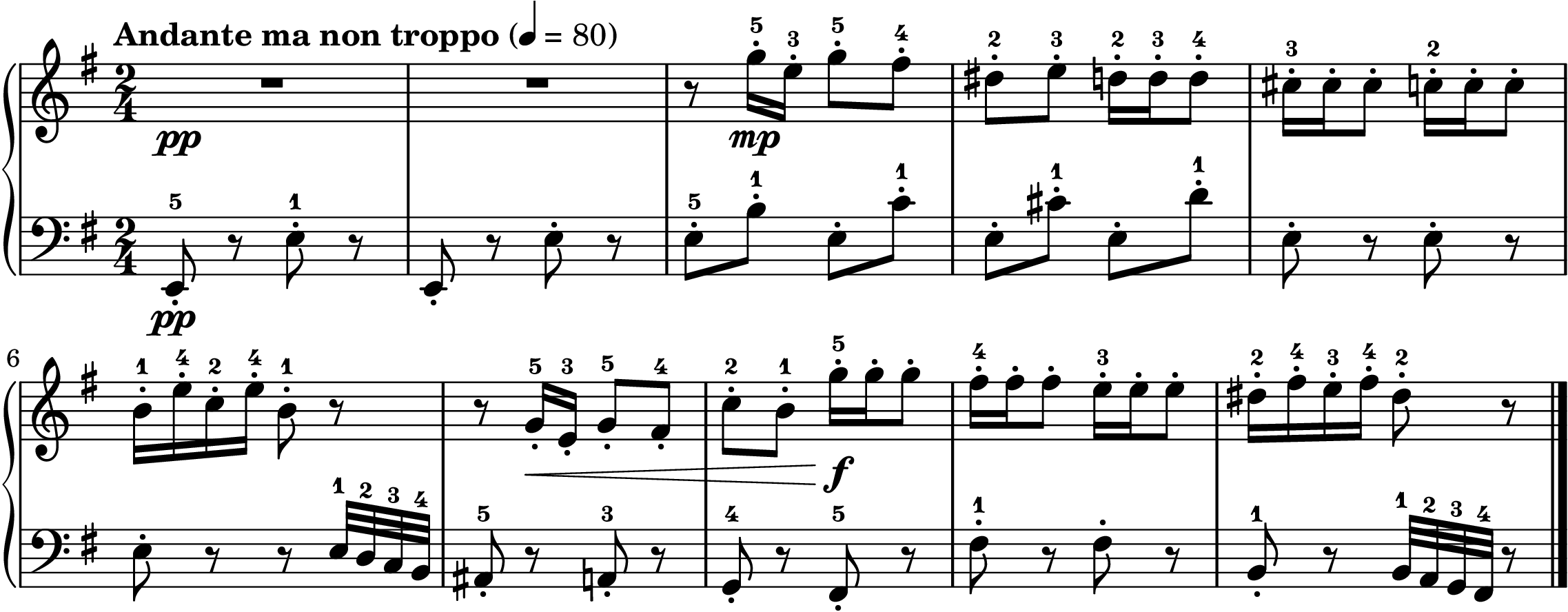
Section A covers measures 1-10. For two bars the left hand plays alone, E2 and E3 at pp. The theme enters in measure 3, G5, E5, G5, F#5 with fingers 5-3-5-4, then D#5, E5 and repeated notes stepping down D5, C#5, C5 to B4 on the thumb. Measure 7 plays the opening an octave lower with the same fingers while the left hand walks down A#2, A2, G2, F#2. Start at x0.5 and keep every note short.
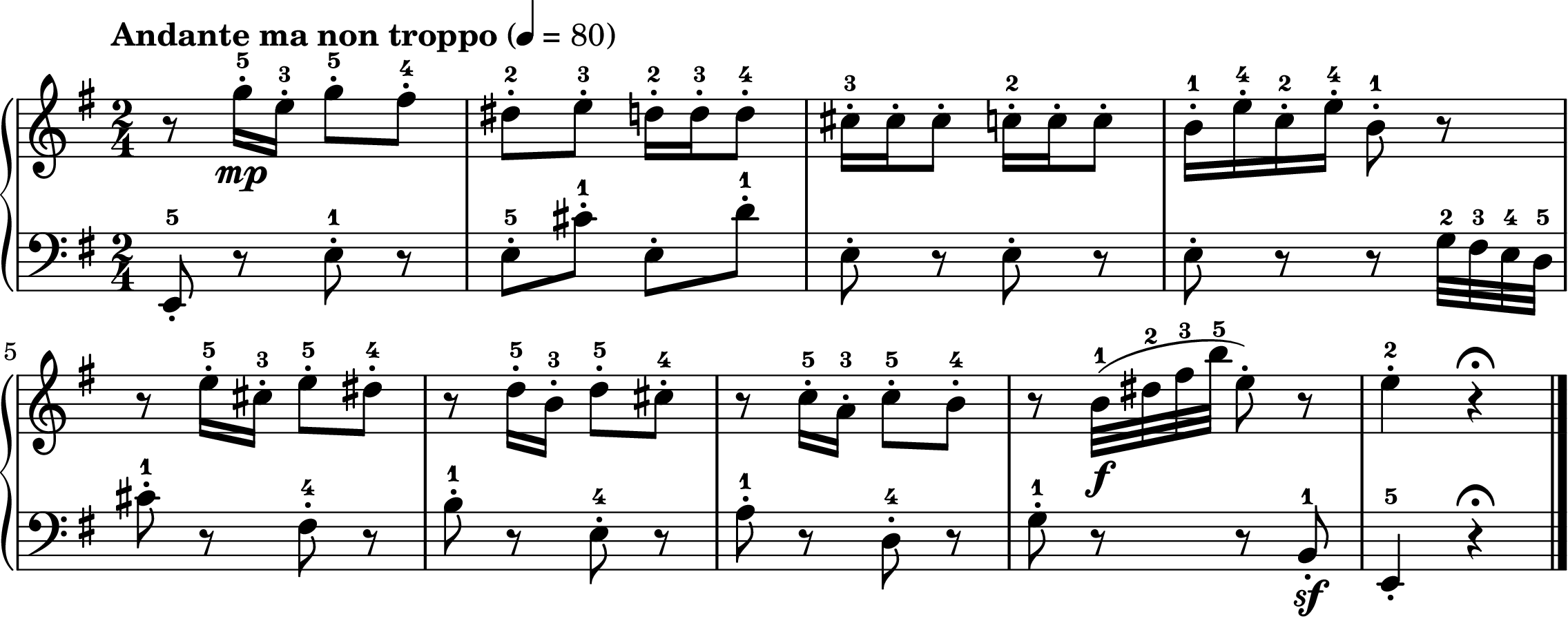
Section B, measures 11-19, brings the theme back at mp, then a falling sequence: the same short figure starts on E5 in measure 15, D5 in measure 16 and C5 in measure 17, always 5-3-5-4. The left hand answers with the thumb on C#4, B3 and A3 and finger 4 a fifth lower. The one fast run comes in measure 18 (drill it at x0.5, then x0.75): B4, D#5, F#5, B5 in 32nd notes on 1-2-3-5 at f, landing on E5.
The full score
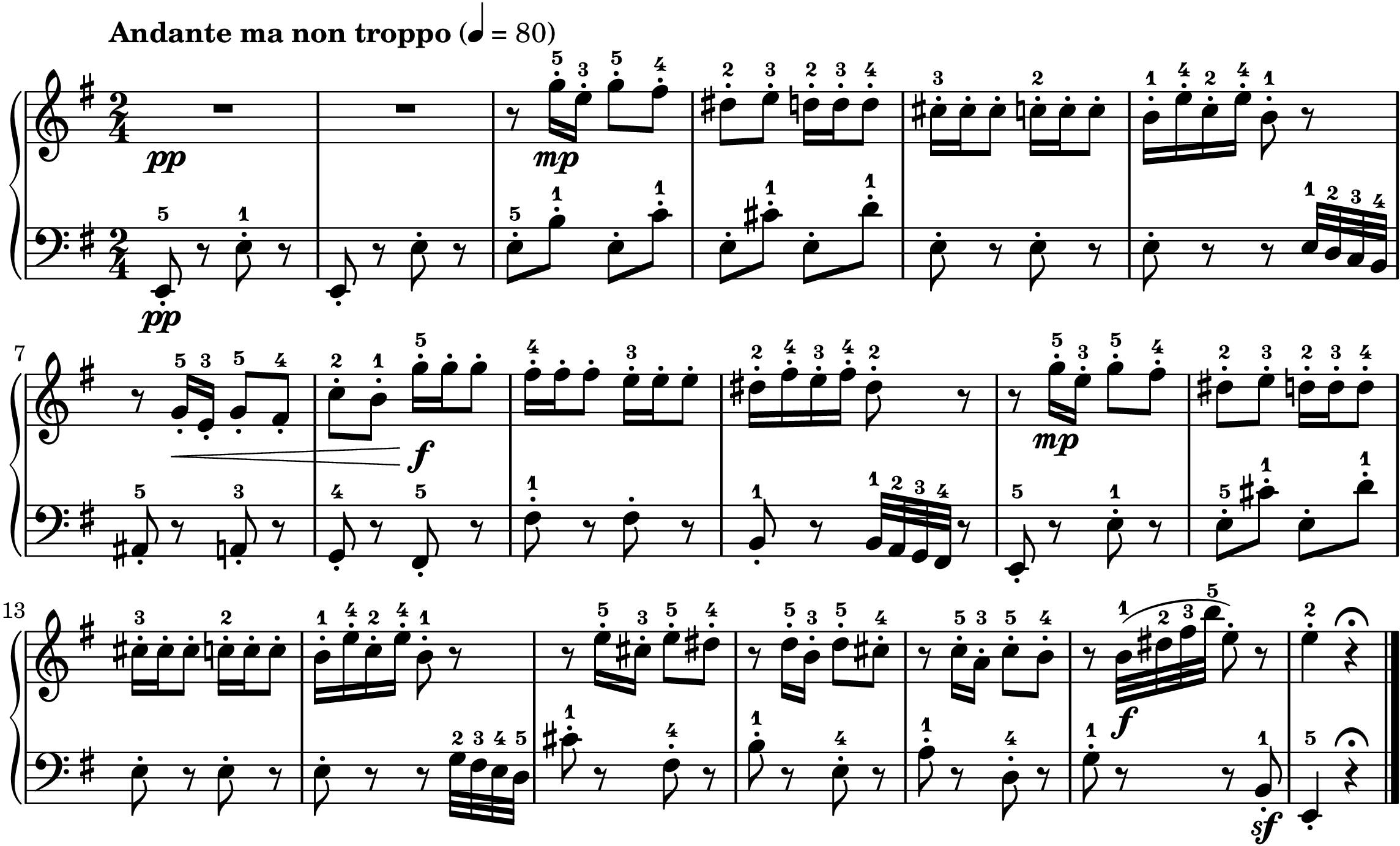
All 19 measures are in 2/4, Andante ma non troppo at 80 to the quarter. Count in eighths, two sixteenths to each eighth, and keep both hands staccato and light. The dynamics run pp in the intro, mp for the theme, f from measure 8 to 10 and again in measure 18. Listen for the short left-hand runs at the end of measures 6, 10 and 14; each one leads into the next bar. Once the sixteenths are even at x0.5, move to x0.75.
Note by note: keys and fingering
- Right hand: Upper position for measures 3-6: pinky (5) on G5, ring (4) on F#5, middle (3) on E5, index (2) on D#5 and D5, thumb (1) on B4, with C#5 on 3 and C5 on 2. Measure 7 moves the same 5-3-5-4 shape down an octave (G4, E4, F#4), and measure 8 stretches from the thumb on B4 back up to the pinky on G5. In measures 15-17 the 5-3-5-4 figure moves down a step each bar, and measure 18 spans B4 to B5 with 1-2-3-5.
- Left hand: No fixed position: short staccato bass notes on the beats, and the rests give the hand time to move. Measures 1-2 play E2 with the pinky (5) and E3 with the thumb (1). From measure 3 the pinky (5) stays on E3 and the thumb (1) walks up the off-beat notes B3, C4, C#4 and D4, so the hand opens instead of hopping. The run in measure 6 goes E3, D3, C3, B2 on 1-2-3-4 and lands on A#2 with the pinky; the hand then moves down for A2, G2, F#2 on 3-4-5. The measure 14 run, G3, F#3, E3, D3 on 2-3-4-5, lets the thumb reach C#4 without a jump. Measures 15-17 pair the thumb on C#4, B3 and A3 with finger 4 a fifth lower, the thumb takes G3 and B2 in measure 18, and the piece ends on E2 with the pinky (5).
| Note | On the Staff | On the Keyboard | Finger |
|---|---|---|---|
| E4 | Bottom line of treble staff | White key right of the two black keys above middle C | RH Middle (3) |
| F#4 | First space of treble staff, sharp in the key signature | Black key, first of the three black keys above middle C | RH Ring (4) |
| G4 | Second line of treble staff | White key between the first two of three black keys above middle C | RH Pinky (5) |
| A4 | Second space of treble staff | White key between the last two of three black keys above middle C | RH Middle (3) |
| B4 | Middle line of treble staff | White key right of the three black keys above middle C | RH Thumb (1) |
| C5 | Third space of treble staff | One octave above middle C | RH Index (2) |
| C#5 | Third space of treble staff with a sharp sign | Black key, first of the two black keys above C5 | RH Middle (3) |
| D5 | Fourth line of treble staff | White key between the two black keys above C5 | RH Index (2) |
| D#5 | Fourth line of treble staff with a sharp sign | Black key, second of the two black keys above C5 | RH Index (2) |
| E5 | Fourth space of treble staff | White key right of the two black keys above C5 | RH Middle (3) |
| F#5 | Top line of treble staff, sharp in the key signature | Black key, first of the three black keys above C5 | RH Ring (4) |
| G5 | Space just above the treble staff | White key between the first two of three black keys above C5 | RH Pinky (5) |
| B5 | Space above the first ledger line over the treble staff | White key right of the three black keys above C5 | RH Pinky (5) |
| E2 | First ledger line below the bass staff | White key right of the two black keys, an octave and a sixth below middle C | LH Pinky (5) |
| F#2 | Space just below the bass staff, sharp in the key signature | Black key, first of the three black keys below C3 | LH Pinky (5) |
| G2 | Bottom line of bass staff | White key between the first two of three black keys, an octave and a fourth below middle C | LH Ring (4) |
| A2 | First space of bass staff | White key between the last two of three black keys, an octave and a third below middle C | LH Middle (3) |
| A#2 | First space of bass staff with a sharp sign | Black key, last of the three black keys below C3 | LH Pinky (5) |
| B2 | Second line of bass staff | White key right of the three black keys, an octave and a step below middle C | LH Thumb (1) |
| C3 | Second space of bass staff | One octave below middle C | LH Middle (3) |
| D3 | Third line of bass staff | White key between the two black keys below middle C | LH Ring (4) |
| E3 | Third space of bass staff | White key right of the two black keys below middle C | LH Pinky (5) |
| F#3 | Fourth line of bass staff, sharp in the key signature | Black key, first of the three black keys below middle C | LH Thumb (1) |
| G3 | Fourth space of bass staff | White key between the first two of three black keys below middle C | LH Thumb (1) |
| A3 | Top line of bass staff | White key between the last two of three black keys below middle C | LH Thumb (1) |
| B3 | Space just above the bass staff | White key just left of middle C | LH Thumb (1) |
| C4 | Ledger line above the bass staff (middle C) | Middle C | LH Thumb (1) |
| C#4 | Ledger line above the bass staff with a sharp sign | Black key just right of middle C | LH Thumb (1) |
| D4 | Just above the ledger line over the bass staff | White key between the two black keys right of middle C | LH Thumb (1) |
Prefer a video? Watch the keys light up
Same color code as the player: green marks the right hand, blue the left hand, with the score and keyboard in one vertical video.
The story behind Dance of the Sugar Plum Fairy
This is the theme of the Dance of the Sugar Plum Fairy from The Nutcracker, Op. 71, by P. I. Tchaikovsky (d. 1893), published in Moscow by Jurgenson in 1892 (Suite Op. 71a, No. 2b). The piece has no words. We read it from Tchaikovsky's own piano solo arrangement of the Suite, in the 1898 Rahter reprint, and checked it against the celesta part in a Breitkopf & Härtel edition from about 1910. The source prints the theme in sixths; we keep only the top voice, one octave below the written celesta part, in the source key of E minor and 2/4. The left hand takes the pizzicato bass roots and single off-beat notes from the source chords. We added the short closing E in measure 19.
Get the printable PDF
The free PDF of Dance of the Sugar Plum Fairy comes as a direct download, no email needed, and contains the full score, fingering for both hands and a practice tip for each section. It sits behind door 19 of the Free Piano Advent Calendar too; the doors open December 1-24.
Light staccato is easier from the right seat height. For a child preparing the Dance of the Sugar Plum Fairy for the family, the piano bench height calculator finds a seat height for their size, and a solid-wood kids piano bench means a place of their own at the piano.
Piano teacher? Track your students' practice. Join the early list
FAQ
How hard is Dance of the Sugar Plum Fairy on piano?
It is one of the Level 3 pieces in our Advent calendar collection. Nearly every note is staccato and the theme moves in sixteenth notes and half steps (C#5, D#5 and F#5 all appear). The left hand keeps its pinky on E3 while the thumb takes the off-beat notes above it, and measure 18 has a quick four-note run.
How long does it take to learn Dance of the Sugar Plum Fairy?
Allow three to four weeks for most adult beginners. You learn the theme once, since measures 3-6 return in measures 11-14. After that the new work is the octave shift in measures 7-8, the falling sequence in measures 15-17 and the run in measure 18.
What level is Dance of the Sugar Plum Fairy?
Level 3 of our Advent calendar collection. E minor, 2/4, Andante ma non troppo at 80 BPM, 19 measures. The right hand ranges from E4 to B5 and the left hand from E2 to D4, one note at a time.
What are the notes for Dance of the Sugar Plum Fairy?
The left hand opens alone with E2 and E3. The right hand enters in measure 3 with G5, E5, G5, F#5, then D#5, E5, D5, D5, D5, then C#5 three times, C5 three times, and B4, E5, C5, E5, B4. For the fingers, see the table above.