
It Came Upon the Midnight Clear is arranged here in C major and 6/8, over a left hand that plays two long notes per bar (one in the last). The interactive player below can slow it to half speed while you learn, and further down you will find the sheet music, fingering for both hands and a free printable PDF.
Learn it with the interactive player
- Slow it down: x0.5 or x0.75 while you learn the notes, back to x1 once they flow.
- Pause anywhere: the current keys stay lit so you can find them on your own piano.
- Drag the score left or right, or use the 15s buttons, to replay a phrase.
The sheet music, section by section

The pickup and measures 1-8 make up section A. The thumb takes the G4 pickup and the pinky jumps straight up to E5; from there the line steps down D5, D5, C5, A4 to G4. In measure 3 the hand climbs A4, B4, C5 with 2-3-4, and the thumb passes under on the repeated C5 to reach D5 and E5. The left hand starts on C3 and F3, one dotted quarter each. At x0.5, count all six eighths in every bar.

Section B also starts with a pickup and runs to measure 16. At mf the melody drops an octave, E5 to E4, then E4, E4, F#4, G#4 rise with fingers 1-1-2-3 into A4 in measure 10. Underneath, the left hand walks down from E3 to B2 and A2 and reaches G2 in measure 12. Loop measure 11 at x0.75 (D5, C5, B4, A4, then the middle finger crosses over for B4). Measures 13-15 repeat measures 5-7 at mp, and measure 16 closes on a long C5 under a fermata.
The full score
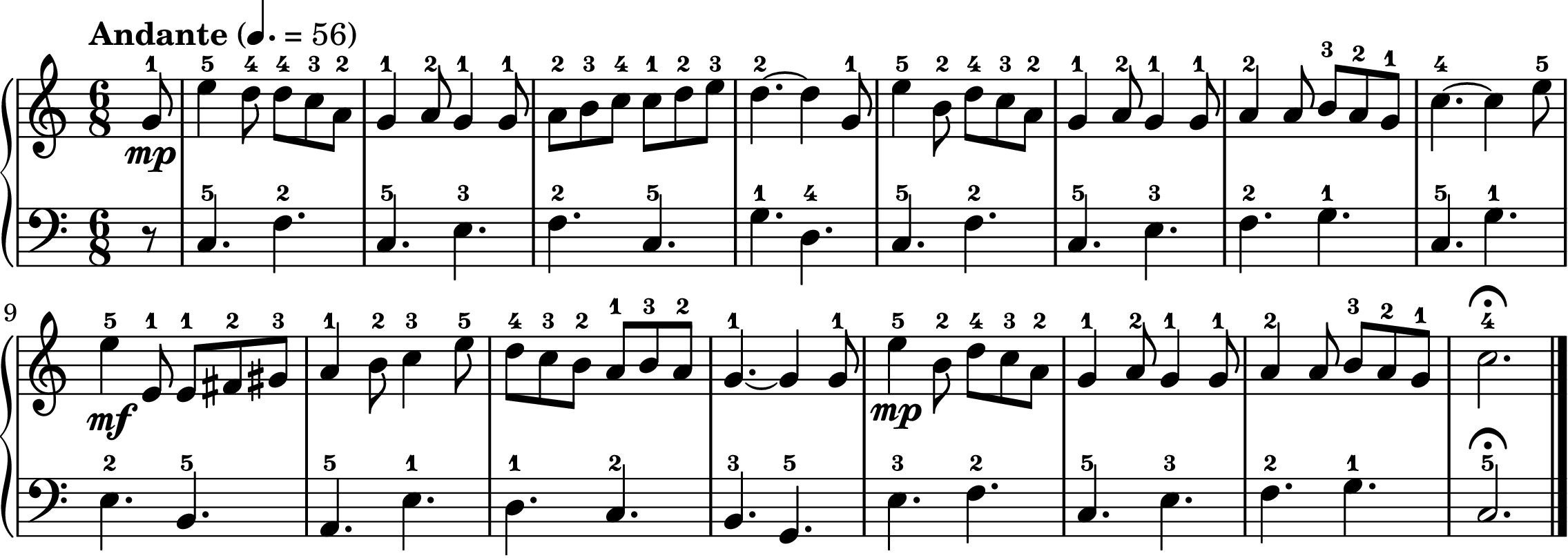
Andante at 56 to the dotted quarter means the 6/8 of the full score (a pickup and 16 measures) is felt in two slow beats per bar. The left hand plays exactly on those two beats. Watch the ties in measures 4, 8 and 12, where the long note lasts five eighths before the next pickup. Begin hands together at x0.5, and go up to x0.75 once the count stays steady.
Note by note: keys and fingering
- Right hand: Thumb (1) on G4, index (2) on A4, middle (3) on C5, ring (4) on D5 and pinky (5) on E5 for the opening, a stretched hand from G4 to E5. In measure 3 the middle takes B4 and the ring C5, then the thumb passes under on the repeated C5 so fingers 2 and 3 play D5 and E5. Measure 9 drops an octave to the thumb on E4, with F#4 on 2 and G#4 on 3, and measure 10 restarts on the thumb on A4.
- Left hand: C position: pinky (5) on C3, ring (4) on D3, middle (3) on E3, index (2) on F3 and thumb (1) on G3, one note per dotted-quarter beat. In measures 9-12 the hand walks down: E3 (2) to B2 (5), A2 (5) to E3 (1), D3 (1) to C3 (2), then B2 (3) to G2 (5).
| Note | On the Staff | On the Keyboard | Finger |
|---|---|---|---|
| E4 | Bottom line of treble staff | White key right of the two black keys above middle C | RH Thumb (1) |
| F#4 | First space of treble staff with a sharp sign | Black key, first of the three black keys above middle C | RH Index (2) |
| G4 | Second line of treble staff | White key between the first two of three black keys above middle C | RH Thumb (1) |
| G#4 | Second line of treble staff with a sharp sign | Black key, middle of the three black keys above middle C | RH Middle (3) |
| A4 | Second space of treble staff | White key between the last two of three black keys above middle C | RH Index (2) |
| B4 | Middle line of treble staff | White key right of the three black keys above middle C | RH Middle (3) |
| C5 | Third space of treble staff | One octave above middle C | RH Middle (3) |
| D5 | Fourth line of treble staff | White key between the two black keys above C5 | RH Ring (4) |
| E5 | Fourth space of treble staff | White key right of the two black keys above C5 | RH Pinky (5) |
| G2 | Bottom line of bass staff | White key between the first two of three black keys, an octave and a fourth below middle C | LH Pinky (5) |
| A2 | First space of bass staff | White key between the last two of three black keys, an octave and a third below middle C | LH Pinky (5) |
| B2 | Second line of bass staff | White key right of the three black keys, an octave and a step below middle C | LH Pinky (5) |
| C3 | Second space of bass staff | One octave below middle C | LH Pinky (5) |
| D3 | Third line of bass staff | White key between the two black keys below middle C | LH Ring (4) |
| E3 | Third space of bass staff | White key right of the two black keys below middle C | LH Middle (3) |
| F3 | Fourth line of bass staff | White key left of the three black keys below middle C | LH Index (2) |
| G3 | Fourth space of bass staff | White key between the first two of three black keys below middle C | LH Thumb (1) |
Prefer a video? Watch the keys light up
Same color code as the player: green marks the right hand, blue the left hand, with the score and keyboard in one vertical video.
The story behind It Came Upon the Midnight Clear
The tune, CAROL, is Study No. 23 in Richard Storrs Willis's Church Chorals and Choir Studies (New York, 1850); Willis died in 1900. Its 6/8 hymn form is credited either to Willis or to U. C. Burnap, who also died in 1900. The words, by Edmund H. Sears (d. 1876), are not printed here. Our melody comes from The Church Hymnal edited by C. L. Hutchins (Boston, 1894), No. 59, which prints it in B-flat. We moved it up a whole tone to C major and changed nothing else. The eighth note right after the opening E5 (D5 here) is the one Hutchins prints; some later prints have a lower note there.
Get the printable PDF
Door 16 of the Free Piano Advent Calendar (doors open December 1-24) is It Came Upon the Midnight Clear. Its printable PDF is a free direct download with no email asked, and it holds the full score, fingering for both hands and a practice tip per section.
A parent and a child who are both learning It Came Upon the Midnight Clear for Christmas Eve can each look up a seat height for their size in the piano bench height calculator; our solid-wood kids piano bench is made for the younger one.
FAQ
How hard is It Came Upon the Midnight Clear on piano?
It is a Level 2 piece in our Advent calendar collection, and the left hand plays at most two notes per bar. The right hand has three moves to learn: the jump from the G4 pickup to E5, the thumb passing under in measure 3, and the octave drop from E5 to E4 in measure 9.
How long does it take to learn It Came Upon the Midnight Clear?
Count on two to three weeks for most beginners. Measures 13-15 repeat measures 5-7 before the final C5, so once measures 1-8 are learned, the extra time goes into measures 9-12, where the sharps F#4 and G#4 appear and the left hand moves lower.
What level is It Came Upon the Midnight Clear?
C major and 6/8, Andante at 56 BPM to the dotted quarter, with a one-eighth pickup and 16 measures, at Level 2 of our Advent calendar collection. The right hand covers E4 to E5 and the left hand G2 to G3, one note at a time.
What are the notes for It Came Upon the Midnight Clear?
After a G4 pickup the melody plays E5, D5, D5, C5, A4, then G4, A4, G4, then A4, B4, C5, C5, D5, E5 and a long D5. The left hand begins with C3 and F3, then C3 and E3. The rest, with fingering, is in the table above.