
Joy to the World opens with a complete C major scale falling one octave, and the interactive player below is the fastest way to learn it: hear it at half speed, watch the notes and keys light up, and drag the score to loop any bar. Sheet music, fingering for both hands, and a free printable PDF come next.
Learn it with the interactive player
- Slow it down: x0.5 or x0.75 while you learn the notes, back to x1 once they flow.
- Pause anywhere: the current keys stay lit so you can find them on your own piano.
- Drag the score left or right, or use the 15s buttons, to replay a phrase.
The sheet music, section by section

Section A opens with a complete C major scale falling from C5 to middle C, fingered 5-4-3-2-1 down to F4 and then the middle finger crossing over for E4-D4-C4. The answer rises G4-A4-B4 into a long C5 on King; set the player to x0.5 and drill the crossover at the F4 to E4 join.

Section B is the echo: repeated E4s then repeated D4s pulse under the thumb while the bass keeps marching, and the final phrase leaps from E4 to a long C5 with the pinky before G4-F4-E4, F4, E4-D4-C4 brings the falling scale back to close. Take it at x0.75 and let the left hand be the metronome.
The full score
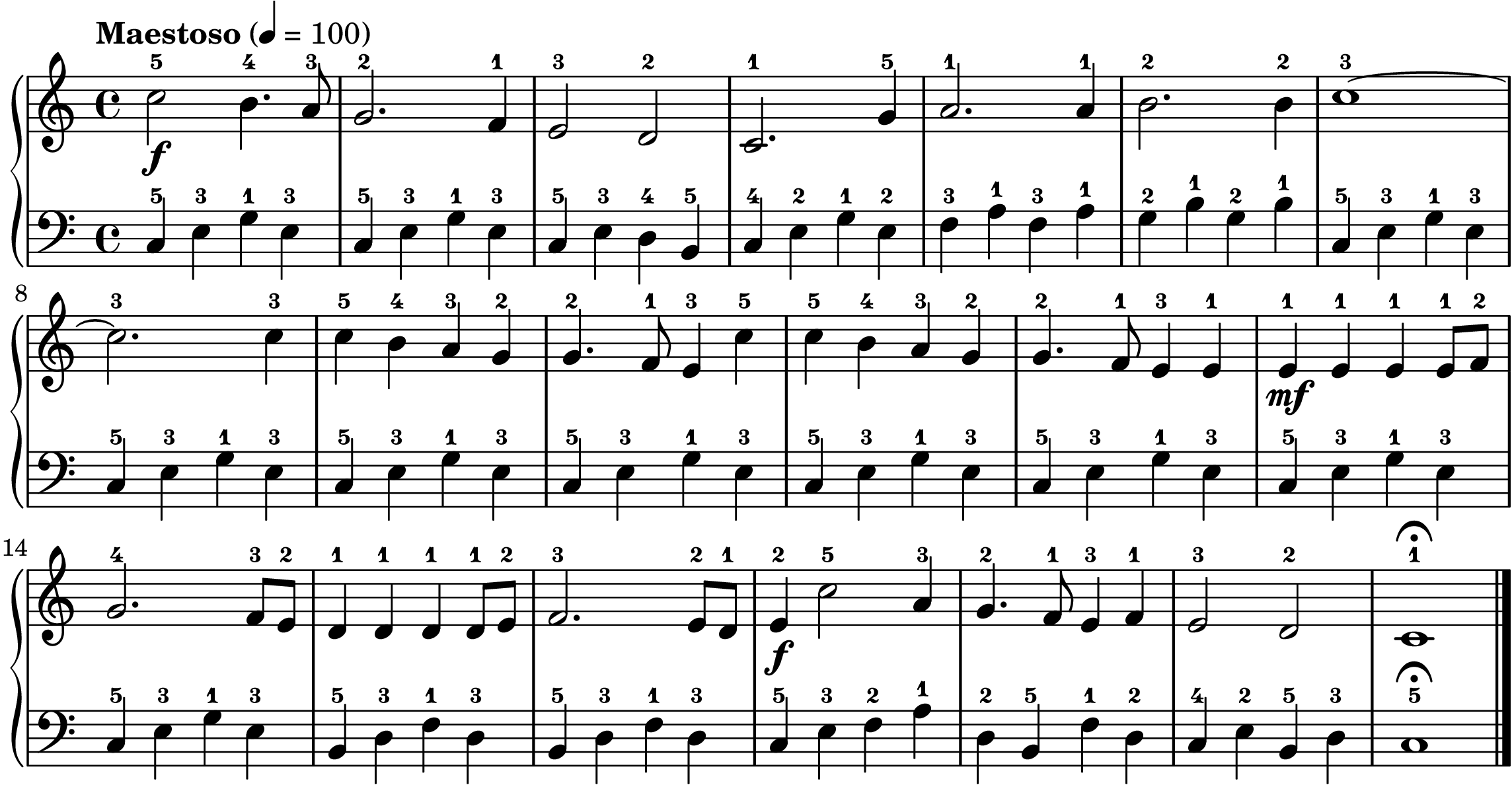
Hands together from bar 1, the left hand plays a quarter note on every beat, so the long melody notes must be counted rather than felt. Build from 66 toward the 100 BPM Maestoso, forte and stately, and release the final C3 together after four full counts.
Note by note: keys and fingering
- Right hand: The whole octave under a scale fingering: the opening descent uses pinky (5) on C5, ring (4) on B4, middle (3) on A4, index (2) on G4 and thumb (1) on F4, then the middle finger crosses over the thumb for E4-D4-C4. The rising answer lifts the hand so the thumb starts on A4, and a substitution on the repeated E4 (3 to 1) resets it for the echo phrases.
- Left hand: C position, pinky (5) on C3: a steady quarter-note pulse C3-E3-G3-E3 with 5-3-1-3 like a broken-chord march, shifting down to B2-D3-F3 under the dominant bars and walking C3-E3-F3-A3 with 5-3-2-1 at the final cadence.
| Note | On the Staff | On the Keyboard | Finger |
|---|---|---|---|
| C5 | Third space of treble staff | One octave above middle C | RH Pinky (5) |
| B4 | Middle line of treble staff | White key right of the three black keys above middle C | RH Ring (4) |
| A4 | Second space of treble staff | White key between the last two of three black keys above middle C | RH Middle (3) |
| G4 | Second line of treble staff | White key between the first two of three black keys above middle C | RH Index (2) |
| F4 | First space of treble staff | White key left of the three black keys above middle C | RH Thumb (1) |
| E4 | Bottom line of treble staff | White key right of the two black keys above middle C | RH Middle (3) |
| D4 | Just below the bottom line of the treble staff | White key between the two black keys right of middle C | RH Index (2) |
| C4 | Ledger line below the treble staff (middle C) | Middle C | RH Thumb (1) |
| B2 | Second line of bass staff | White key right of the three black keys, an octave and a step below middle C | LH Pinky (5) |
| C3 | Second space of bass staff | One octave below middle C | LH Pinky (5) |
| D3 | Third line of bass staff | White key between the two black keys below middle C | LH Ring (4) |
| E3 | Third space of bass staff | White key right of the two black keys below middle C | LH Middle (3) |
| F3 | Fourth line of bass staff | White key left of the three black keys below middle C | LH Middle (3) |
| G3 | Fourth space of bass staff | White key between the first two of three black keys below middle C | LH Thumb (1) |
| A3 | Top line of bass staff | White key between the last two of three black keys below middle C | LH Thumb (1) |
| B3 | Space just above the bass staff | White key just left of middle C | LH Thumb (1) |
Prefer a video? Watch the keys light up
Same color code as the player: green marks the right hand, blue the left hand, with the score and keyboard in one vertical video.
The story behind Joy to the World
The words of Joy to the World are by Isaac Watts, who published them in 1719 as a paraphrase of Psalm 98, not originally as a Christmas hymn at all. The tune we sing, called Antioch, was arranged in 1839 by the Boston music educator Lowell Mason, who credited it from Handel because its opening echoes phrases from Messiah. Whoever deserves the credit, the design is unforgettable: the melody opens by falling straight down a complete major scale, one octave from top to bottom. It has become the most published Christmas hymn in North America, and this 20-bar arrangement keeps the full tune over a marching single-note bass.
Get the printable PDF
The printable PDF of Joy to the World - full score, hand positions, and a step-by-step practice guide - ships inside our free Christmas pack together with fourteen other carols.
A stately Maestoso pulse comes from the whole body, not just the fingers, and an Adjustable Piano Bench with Back Support keeps your posture tall through all twenty bars.
Piano teacher? Track your students' practice. Join the early list
FAQ
How hard is Joy to the World on piano?
It is a Level 2 piece in our Christmas collection, and the first one built on a full scale. The right hand covers one octave with a finger crossover, the left hand plays a quarter note on every beat, and the echo section repeats single notes under the thumb, so the challenge is steadiness rather than reach.
How long does it take to learn Joy to the World?
Two to three weeks for most beginners. The opening descent is a C major scale you can drill in a day, the running lines in measures 9-12 reuse the same crossover, and the marching bass is fourteen bars of one C-E-G-E pattern; the last four bars add the only new shapes.
What level is Joy to the World?
Level 2 of our Christmas collection. C major, 4/4, Maestoso at 100 BPM, 20 measures. The right hand spans middle C to C5 with scale fingering and the left hand plays single quarter notes from B2 to B3.
What are the notes for Joy to the World?
The melody falls C5, B4, A4, G4, F4, E4, D4, C4, then rises G4, A4, A4, B4, B4 into a long C5. The running lines go C5, B4, A4, G4, G4, F4, E4, and the echo repeats E4 then D4 before the final E4, C5, A4, G4, F4, E4, F4, E4, D4, C4. The left hand marches C3, E3, G3, E3; see the full table above.