
In the Bleak Midwinter is the quietest carol in our Christmas collection, and the interactive player below is the gentlest way to learn it: hear it at half speed, watch the notes and keys light up, and drag the score to repeat any phrase. Sheet music, fingering for both hands, and a free printable PDF come next.
Learn it with the interactive player
- Slow it down: x0.5 or x0.75 while you learn the notes, back to x1 once they flow.
- Pause anywhere: the current keys stay lit so you can find them on your own piano.
- Drag the score left or right, or use the 15s buttons, to replay a phrase.
The sheet music, section by section

Section A is two nearly identical phrases: E4-F4-G4-E4, D4-C4, then D4-E4-D4 reaching down to A3 and resting on a whole-note D4 where the score marks a silent change from finger 4 to 2; the second phrase repeats the opening and settles home on middle C. The left hand tolls C3 and G2 in slow halves; take it at x0.5.
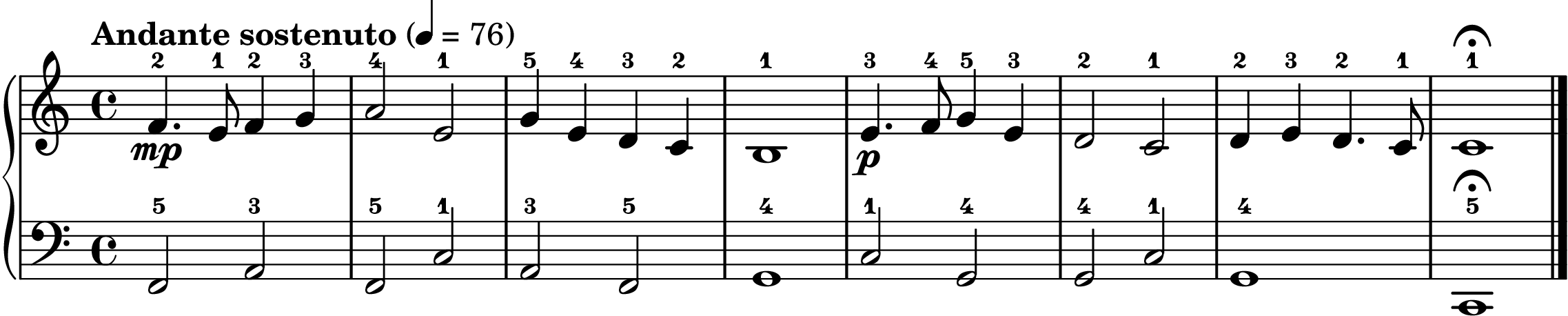
Section B rises for the only time: F4-E4-F4-G4 lifts to A4 at mp, then G4-E4-D4-C4 falls step by step to a hushed whole-note B3. The last phrase repeats the opening line, In the bleak midwinter, long ago, and dissolves onto a bottom C2 in the left hand under a fermata; play it at x0.75 as if trying not to wake someone.
The full score
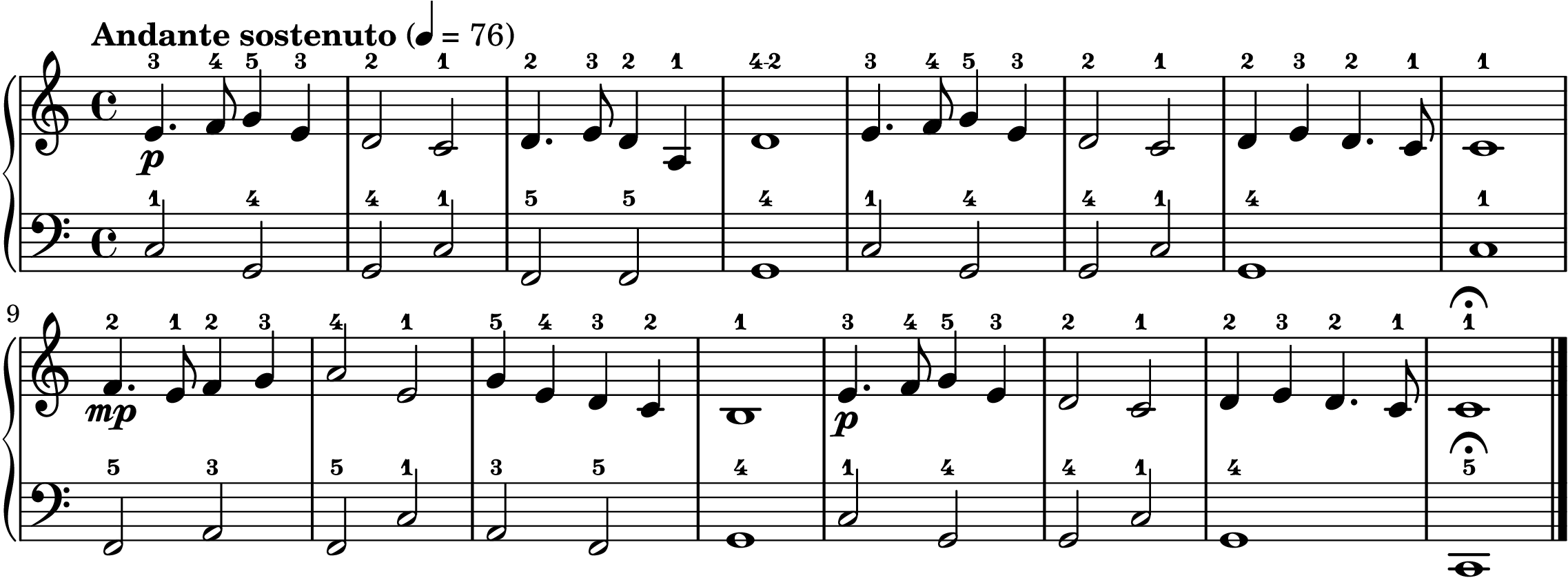
In the full score stillness is the technique: start at 60 BPM, keep the left hand at half the volume of the melody, and breathe with a tiny lift of both wrists at the end of each four-bar phrase. Target the 76 BPM Andante sostenuto with an unbroken legato line.
Note by note: keys and fingering
- Right hand: Thumb (1) on middle C with index (2), middle (3), ring (4) and pinky (5) over D4, E4, F4 and G4: the whole carol sits in one gentle five-finger region, dipping below the staff to A3 and B3 with the thumb and touching A4 only once, with the ring finger, at snow on snow.
- Left hand: A still, hymn-like bass in halves and wholes: pinky (5) on F2, ring (4) on G2, middle (3) on A2, thumb (1) on C3, everything within that fifth until the final bar sinks the pinky to a deep C2.
| Note | On the Staff | On the Keyboard | Finger |
|---|---|---|---|
| A3 | Space below the first ledger line under the treble staff | White key between the last two of three black keys below middle C | RH Thumb (1) |
| B3 | Just below the treble staff, under the middle C ledger line | White key just left of middle C | RH Thumb (1) |
| C4 | Ledger line below the treble staff (middle C) | Middle C | RH Thumb (1) |
| D4 | Just below the bottom line of the treble staff | White key between the two black keys right of middle C | RH Index (2) |
| E4 | Bottom line of treble staff | White key right of the two black keys above middle C | RH Middle (3) |
| F4 | First space of treble staff | White key left of the three black keys above middle C | RH Ring (4) |
| G4 | Second line of treble staff | White key between the first two of three black keys above middle C | RH Pinky (5) |
| A4 | Second space of treble staff | White key between the last two of three black keys above middle C | RH Ring (4) |
| C2 | Second ledger line below the bass staff | Two octaves below middle C | LH Pinky (5) |
| F2 | Space just below the bottom line of the bass staff | White key left of the three black keys, two octaves below F4 | LH Pinky (5) |
| G2 | Bottom line of bass staff | White key between the first two of three black keys, an octave and a fourth below middle C | LH Ring (4) |
| A2 | First space of bass staff | White key between the last two of three black keys, an octave and a third below middle C | LH Middle (3) |
| C3 | Second space of bass staff | One octave below middle C | LH Thumb (1) |
Prefer a video? Watch the keys light up
Same color code as the player: green marks the right hand, blue the left hand, with the score and keyboard in one vertical video.
The story behind In the Bleak Midwinter
Christina Rossetti wrote the poem In the Bleak Midwinter in 1872 as a meditation on winter and the nativity, with its famous line snow had fallen, snow on snow. In 1906 Gustav Holst, later famous for The Planets, set it to music for The English Hymnal and named the tune Cranham after the Gloucestershire village where he had spent childhood holidays. The melody is deliberately plain: short phrases, repeated notes, almost no ornament, like footprints in fresh snow. In 2008 a BBC poll of choral experts voted it the greatest Christmas carol ever written. Its difficulty lies not in the notes but in the calm, and in the quiet art of changing fingers on a note that is still sounding.
Get the printable PDF
The printable PDF of In the Bleak Midwinter - full score, hand positions, and a step-by-step practice guide - ships inside our free Christmas pack together with fourteen other carols.
Playing this slowly and softly exposes any tension in the back, and an Adjustable Piano Bench with Back Support is the simplest way to sit tall without effort.
Piano teacher? Track your students' practice. Join the early list
FAQ
How hard is In the Bleak Midwinter on piano?
It is a Level 3 piece in our Christmas collection, though the notes themselves are simple: the right hand stays in one five-finger region around middle C with two dips to A3 and B3, and the left hand plays slow halves and wholes on five notes. The difficulty is the calm, the balance between hands, and the silent finger change on the held D4 in measure 4.
How long does it take to learn In the Bleak Midwinter?
Two to three weeks for most learners. Phrases 1, 2 and 4 are nearly the same, so the notes come within days; the finger substitution in measure 4, the shift up to A4 in measures 9-11 and the unbroken legato at 76 BPM are what take the time.
What level is In the Bleak Midwinter?
Level 3 of our Christmas collection. C major, 4/4, Andante sostenuto at 76 BPM, 16 measures. The right hand covers A3 to A4 and the left hand plays single notes from C2 to C3, never two keys at once.
What are the notes for In the Bleak Midwinter?
The melody starts E4, F4, G4, E4, then D4, C4, then D4, E4, D4, A3 and a whole-note D4; the second phrase repeats E4, F4, G4, E4, D4, C4 and ends D4, E4, D4, C4, C4. The middle phrase rises F4, E4, F4, G4, A4, E4, then falls G4, E4, D4, C4 to B3. The left hand opens C3, G2; see the full table above.