
Carol of the Bells is one four-note motif repeated for 22 bars, and the interactive player below is the best way to learn it: hear the bell at half speed, watch the notes and keys light up, and drag the score to loop any bar. Sheet music, fingering for both hands, and a free printable PDF come next.
Learn it with the interactive player
- Slow it down: x0.5 or x0.75 while you learn the notes, back to x1 once they flow.
- Pause anywhere: the current keys stay lit so you can find them on your own piano.
- Drag the score left or right, or use the 15s buttons, to replay a phrase.
The sheet music, section by section
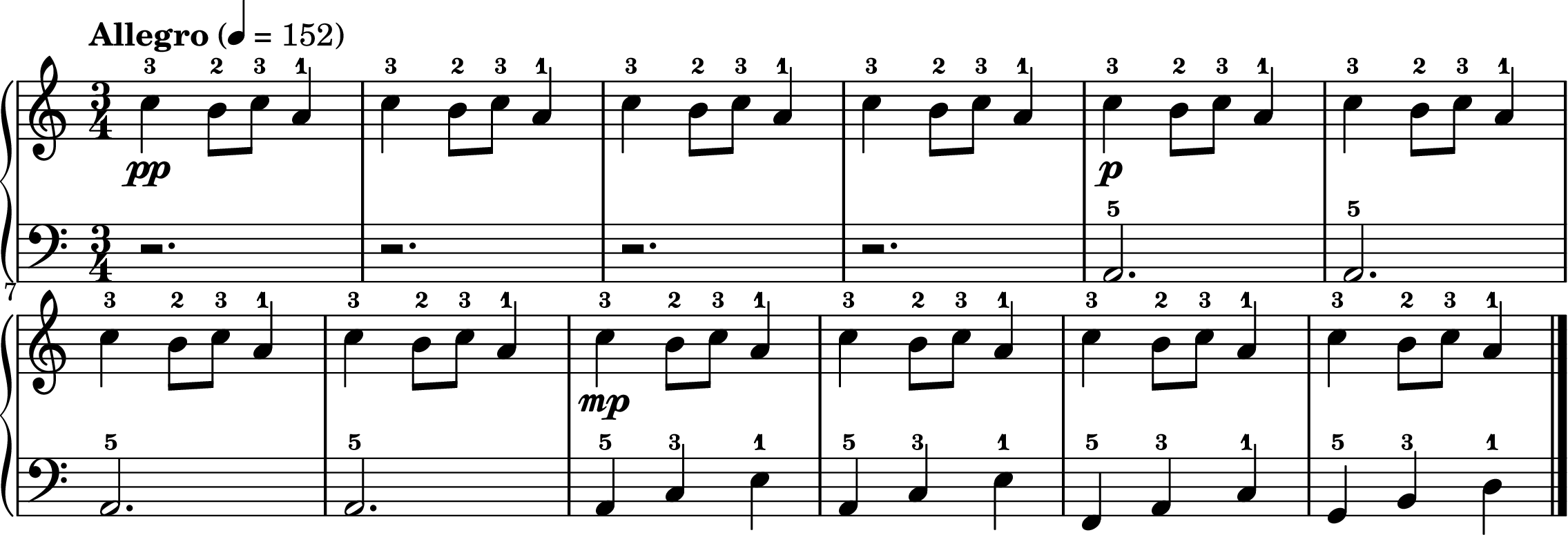
Section A is the bell building: the motif C5-B4-C5-A4, quarter, two eighths, quarter, plays alone at pp for four bars, a low A2 drone joins at measure 5, and at measure 9 the left hand starts to climb broken chords, A minor, A minor, F, G, as the volume grows to mp. Lock the rhythm at x0.5 and say ding, di-ga, dong.
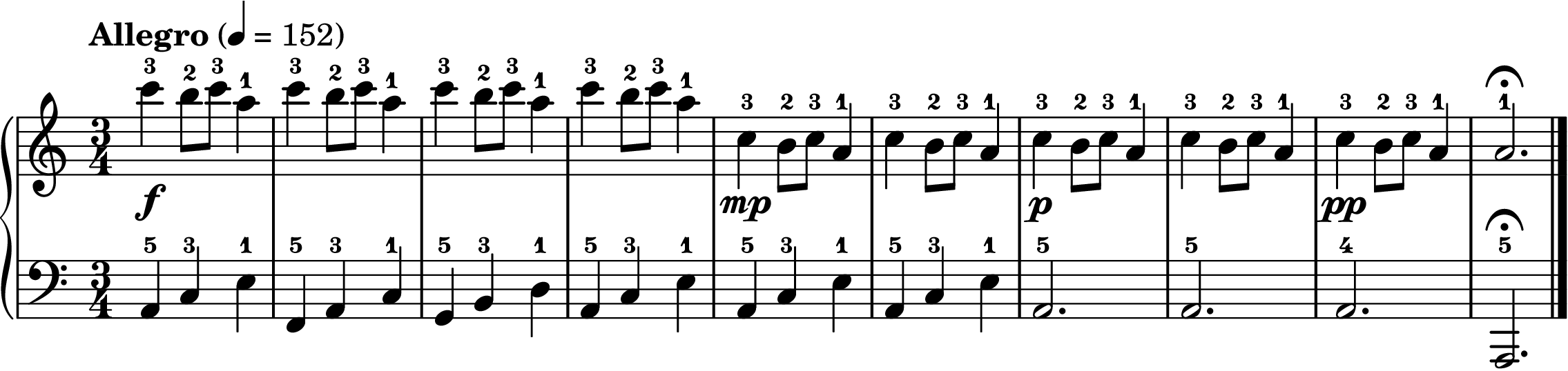
Section B is the peal and the fade: the motif leaps an octave to C6-B5-C6-A5 at f over the moving bass for four bars, then steps back down, the bass thins to the drone, and the dynamics fall through mp and p to pp until a bare A4 rings over a cavernous A1. Practice the octave jump between measures 12 and 13 at x0.75.
The full score
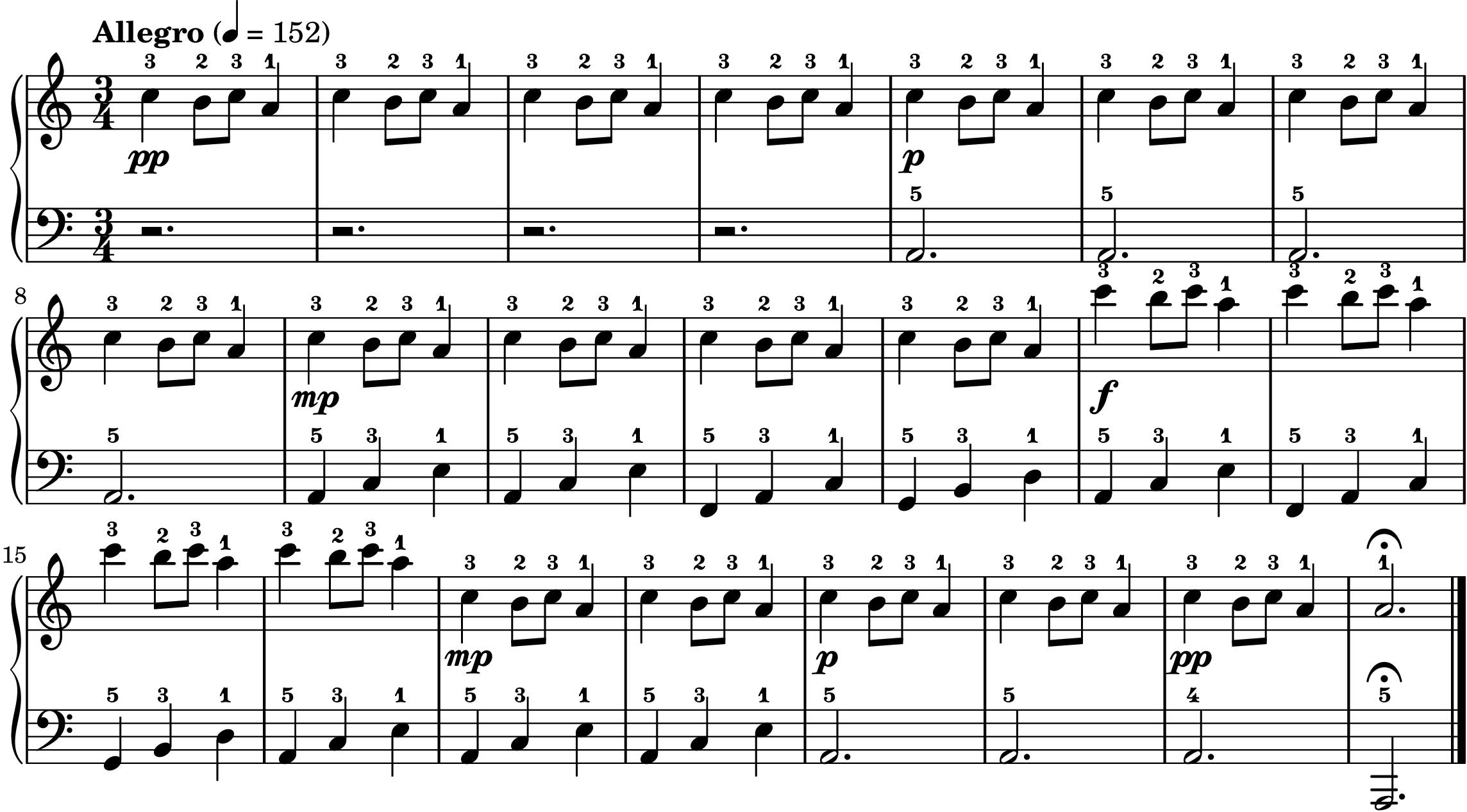
Build the full score layer by layer, exactly as the piece is written: right hand alone, then add the drone, then the moving bass. Start hands together at 100 BPM and add 10 BPM per clean day toward the 152 BPM Allegro; the test is whether a listener hears one growing and fading bell.
Note by note: keys and fingering
- Right hand: One three-note cell under fingers 3-2-3-1: middle (3) on C5, index (2) on B4, middle again on C5, thumb (1) on A4, in every bar. At the climax the identical shape jumps one octave higher, C6-B5-C6-A5, with the same fingering. The right hand learns one gesture and rides it for 22 bars.
- Left hand: Three layers: silence, then a low A drone with the pinky (5) on A2, then rising broken chords played 5-3-1, A2-C3-E3, F2-A2-C3 and G2-B2-D3. The final bar drops the pinky to a ringing low A1, the deepest note in the whole collection.
| Note | On the Staff | On the Keyboard | Finger |
|---|---|---|---|
| C5 | Third space of treble staff | One octave above middle C | RH Middle (3) |
| B4 | Middle line of treble staff | White key right of the three black keys above middle C | RH Index (2) |
| A4 | Second space of treble staff | White key between the last two of three black keys above middle C | RH Thumb (1) |
| C6 | Second ledger line above the treble staff | Two octaves above middle C | RH Middle (3) |
| B5 | Space above the first ledger line over the treble staff | White key right of the three black keys above C5 | RH Index (2) |
| A5 | First ledger line above the treble staff | White key between the last two of three black keys above C5 | RH Thumb (1) |
| A2 | First space of bass staff | White key between the last two of three black keys, an octave and a third below middle C | LH Pinky (5) |
| C3 | Second space of bass staff | One octave below middle C | LH Middle (3) |
| E3 | Third space of bass staff | White key right of the two black keys below middle C | LH Thumb (1) |
| F2 | Space just below the bottom line of the bass staff | White key left of the three black keys, two octaves below F4 | LH Pinky (5) |
| G2 | Bottom line of bass staff | White key between the first two of three black keys, an octave and a fourth below middle C | LH Pinky (5) |
| B2 | Second line of bass staff | White key right of the three black keys, an octave and a step below middle C | LH Middle (3) |
| D3 | Third line of bass staff | White key between the two black keys below middle C | LH Thumb (1) |
| A1 | Third ledger line below the bass staff | Two octaves and a third below middle C, far left of the keyboard | LH Pinky (5) |
Prefer a video? Watch the keys light up
Same color code as the player: green marks the right hand, blue the left hand, with the score and keyboard in one vertical video.
The story behind Carol of the Bells
Long before it rang in holiday film trailers, this was Shchedryk, a Ukrainian new-year song about a swallow flying into a household to promise a bountiful spring. The Ukrainian composer Mykola Leontovych spent years polishing his choral setting of the tiny four-note folk chant; it premiered in Kyiv in 1916. In 1919 the touring Ukrainian Republic Capella carried it across Europe and to America, where it stunned a Carnegie Hall audience in October 1922 - Leontovych had been killed the year before. This arrangement follows Leontovych's original Shchedryk only: one hypnotic four-note motif, repeated and layered from a whisper to a full peal and back to silence, over a drone and a moving single-note bass.
Get the printable PDF
The printable PDF of Carol of the Bells - full score, hand positions, and a step-by-step practice guide - ships inside our free Christmas pack together with fourteen other carols.
A piece that lives on one repeated gesture is the ideal thing to play for a room full of guests, and if a pianist is on your gift list, our gifts for pianists guide pairs well with the Adjustable Piano Bench with Back Support.
Piano teacher? Track your students' practice. Join the early list
FAQ
How hard is Carol of the Bells on piano?
It is a Level 3 piece in our Christmas collection, but its difficulty is stamina, not reach. The right hand plays a single four-note cell with fingers 3-2-3-1 in every bar, jumping one octave for the climax, and the left hand adds a drone, then broken chords in single notes, while the dynamics travel from pp to f and back.
How long does it take to learn Carol of the Bells?
Two to three weeks for most learners once the motif is even. The cell itself takes an evening, the left-hand layers are three broken chords with one hand shape, and the rest of the time goes into holding a steady 152 BPM and shaping the long crescendo and fade.
What level is Carol of the Bells?
Level 3 of our Christmas collection. A minor, 3/4, Allegro at 152 BPM, 22 measures. The right hand uses only C5, B4 and A4, plus the same cell an octave up, and the left hand ranges from A1 to E3, never playing two keys at once.
What are the notes for Carol of the Bells?
Every bar of the melody is C5, B4, C5, A4 in a quarter, two eighths, quarter rhythm; at the climax it becomes C6, B5, C6, A5, and the piece ends on a lone A4. The left hand enters with a drone on A2, then climbs A2, C3, E3, F2, A2, C3, G2, B2, D3, and finishes on a low A1. See the full table above.