
O Christmas Tree is the evergreen of our Christmas collection, and the interactive player below is the easiest way to learn it: hear the waltz at half speed, watch the notes and keys light up as they play, and drag the score to repeat any strain. The sheet music, fingering for both hands, and a free printable PDF come next.
Learn it with the interactive player
- Slow it down: x0.5 or x0.75 while you learn the notes, back to x1 once they flow.
- Pause anywhere: the current keys stay lit so you can find them on your own piano.
- Drag the score left or right, or use the 15s buttons, to replay a phrase.
The sheet music, section by section

Section A is the O Christmas tree strain: after the upbeat G4, three repeated C5s with the ring finger and a D5, then the hand glides up one step so finger 3 takes the repeated E5s, before D5-E5-F5 drops to B4 under the thumb and cadences D5-C5. Loop the D5 to E5 join at x0.5.

Section B is the high verse strain: G5 with the ring finger, a leap down to E5 with the index, the pinky's A5 on green, then repeated F5s with finger 3 sinking step by step toward E5. Put the hand in the high position first, thumb on D5, and run it at x0.75.
The full score
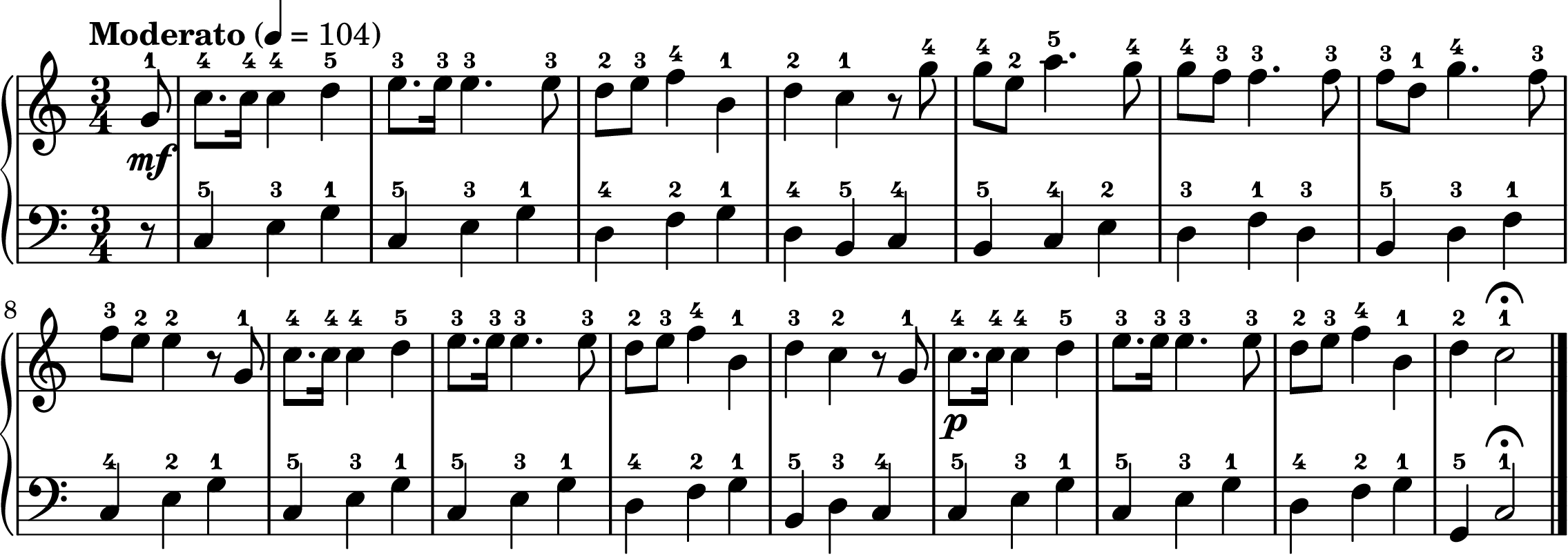
In the full score the left hand plays three single quarter notes per bar, C3-E3-G3 under the theme like an oom-pah-pah without chords, and the form is A, B, A, A echo. Build to 104 BPM, and take the last four bars piano with a gentle fermata.
Note by note: keys and fingering
- Right hand: Three positions that climb the keyboard: thumb (1) on G4 for the opening with ring (4) on C5 and pinky (5) on D5, thumb on C5 for how lovely are thy branches with middle (3) on E5 and ring (4) on F5, and thumb on D5 for the high verse strain where the pinky reaches A5.
- Left hand: C position waltz bass: pinky (5) on C3, middle (3) on E3, thumb (1) on G3, three single quarter notes per bar outlining each chord, with the ring (4) on D3, index (2) on F3 and the pinky dipping to B2 or G2 at the cadences.
| Note | On the Staff | On the Keyboard | Finger |
|---|---|---|---|
| G4 | Second line of treble staff | White key between the first two of three black keys above middle C | RH Thumb (1) |
| B4 | Middle line of treble staff | White key right of the three black keys above middle C | RH Thumb (1) |
| C5 | Third space of treble staff | One octave above middle C | RH Ring (4) |
| D5 | Fourth line of treble staff | White key between the two black keys above C5 | RH Pinky (5) |
| E5 | Fourth space of treble staff | White key right of the two black keys above C5 | RH Middle (3) |
| F5 | Top line of treble staff | White key left of the three black keys above C5 | RH Ring (4) |
| G5 | Space just above the treble staff | White key between the first two of three black keys above C5 | RH Ring (4) |
| A5 | First ledger line above the treble staff | White key between the last two of three black keys above C5 | RH Pinky (5) |
| G2 | Bottom line of bass staff | White key between the first two of three black keys, an octave and a fourth below middle C | LH Pinky (5) |
| B2 | Second line of bass staff | White key right of the three black keys, an octave and a step below middle C | LH Pinky (5) |
| C3 | Second space of bass staff | One octave below middle C | LH Pinky (5) |
| D3 | Third line of bass staff | White key between the two black keys below middle C | LH Ring (4) |
| E3 | Third space of bass staff | White key right of the two black keys below middle C | LH Middle (3) |
| F3 | Fourth line of bass staff | White key left of the three black keys below middle C | LH Index (2) |
| G3 | Fourth space of bass staff | White key between the first two of three black keys below middle C | LH Thumb (1) |
Prefer a video? Watch the keys light up
Same color code as the player: green marks the right hand, blue the left hand, with the score and keyboard in one vertical video.
The story behind O Christmas Tree
The melody of O Tannenbaum is a German folk tune that singers already knew in the sixteenth century, long before it had any connection with Christmas. In 1824 the Leipzig teacher and organist Ernst Anschutz wrote the verses we still sing, praising the fir tree whose green needles survive the winter. The tune proved so sturdy that it was borrowed for the American state song Maryland, My Maryland and the British labor anthem The Red Flag. Its praise of the evergreen made it the natural soundtrack for the Christmas tree tradition that spread from Germany across the world during the nineteenth century, and this arrangement keeps it as a simple C major waltz.
Get the printable PDF
The printable PDF of O Christmas Tree - full score, hand positions, and a step-by-step practice guide - ships inside our free Christmas pack together with fourteen other carols.
A waltz bass that keeps the left hand moving all evening is far easier from a steady, well-set seat, which is exactly what an Adjustable Piano Bench with Back Support gives you.
Piano teacher? Track your students' practice. Join the early list
FAQ
How hard is O Christmas Tree on piano?
It is a Level 2 piece in our Christmas collection. The melody spans G4 to A5 through three neighboring positions, the left hand plays a single-note waltz bass on every beat, and the two things to practice are the glide from D5 to E5 in measure 2 and the leap to G5 for the verse strain.
How long does it take to learn O Christmas Tree?
Two to three weeks for most beginners. The four-bar theme returns three times, so learning it once covers twelve of the sixteen bars; the high verse strain and the moving left hand take the extra time hands together.
What level is O Christmas Tree?
Level 2 of our Christmas collection. C major, 3/4 with an eighth-note upbeat, Moderato at 104 BPM, 16 measures. The right hand covers G4 to A5 and the left hand plays quarter notes from G2 to G3, one at a time.
What are the notes for O Christmas Tree?
After the upbeat G4, the theme runs C5, C5, C5, D5, then E5, E5, E5, E5, then D5, E5, F5, B4 and D5, C5. The verse strain goes G5, E5, A5, G5, then G5, F5, F5, F5, then F5, D5, G5, F5, then F5, E5, E5. The left hand plays C3, E3, G3 under the theme; see the full table above.