
Silent Night is the most recorded Christmas song in history, and the interactive player below is the calmest way to learn it: hear the 6/8 sway at half speed, watch the notes and keys light up, and drag the score to repeat any bar. Sheet music, fingering for both hands, and a free printable PDF come next.
Learn it with the interactive player
- Slow it down: x0.5 or x0.75 while you learn the notes, back to x1 once they flow.
- Pause anywhere: the current keys stay lit so you can find them on your own piano.
- Drag the score left or right, or use the 15s buttons, to replay a phrase.
The sheet music, section by section

Section A is the rocking theme in 6/8: the dotted-eighth, sixteenth, eighth figure on G4-A4-G4 settles on a long E4, twice, then D5-D5-B4 and C5-C5-G4 lift the line before A4-A4-C5-B4-A4 rounds it off. The left hand plays just C3 then G3 in each bar; take it at x0.5 and count 1-2-3, 4-5-6.

Section B is the climax: the hand leaps to the high position, D5-D5-F5-D5-B4, rests on C5 and E5, then floats down C5-G4-E4 and G4-F4-D4 to land on middle C. The eighth rest in measure 10 is your travel time back down; loop measure 11 at x0.5, fingers 5-2-1 then 5-4-2.
The full score
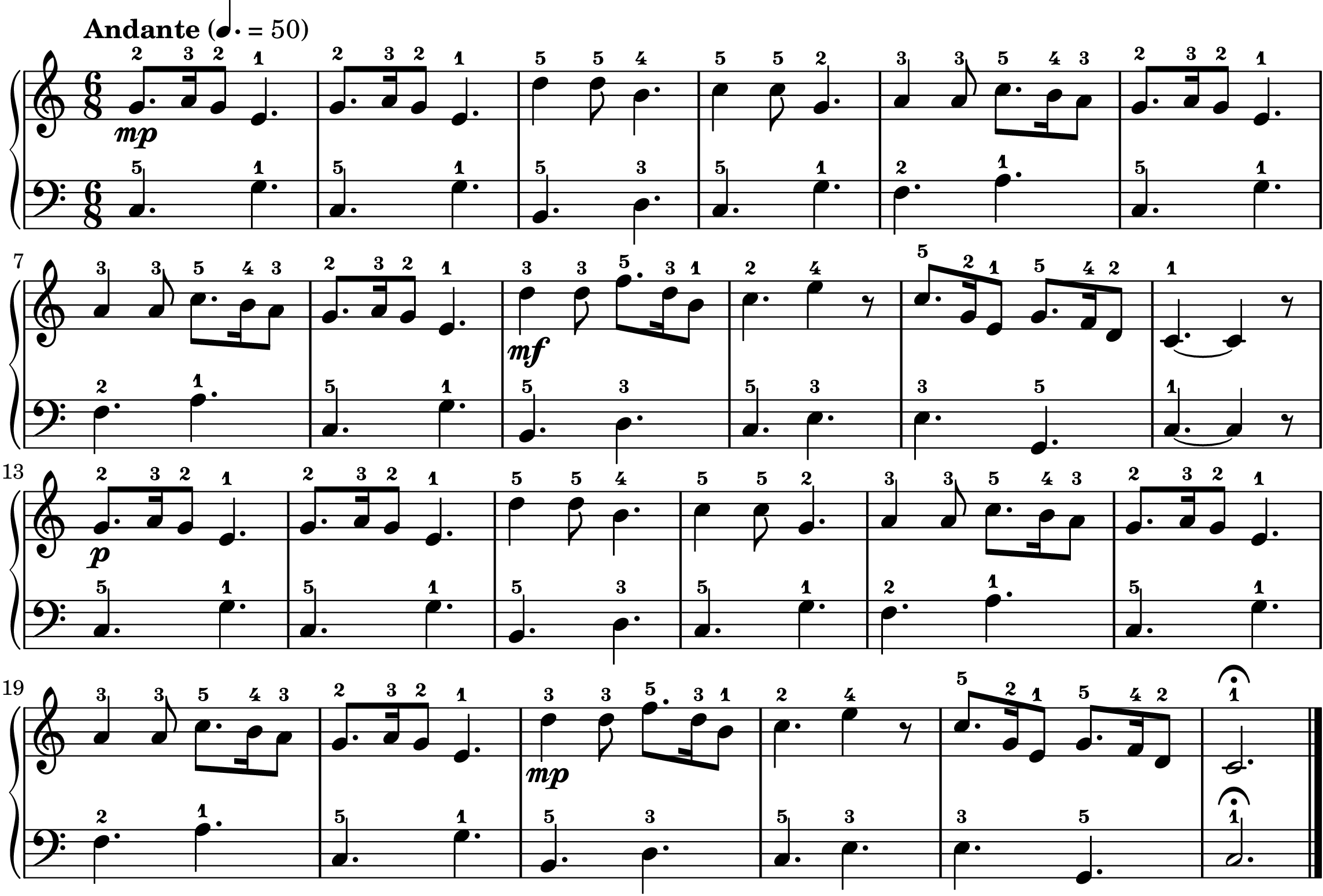
The full score is the 12-bar verse played twice, the second time marked piano like an echo from the next room. Keep the left hand notes exactly on beats 1 and 4 and let the dotted rhythm stay lazy rather than snappy, around 50 to the dotted quarter.
Note by note: keys and fingering
- Right hand: Two hand positions: a low one with the thumb (1) on E4, index (2) on G4, middle (3) on A4, ring (4) on B4 and the pinky (5) stretching to C5 and D5 for the rocking theme, then a high one with the thumb on B4, middle (3) on D5 and pinky (5) on F5 for the Sleep in heavenly peace climb.
- Left hand: Pinky (5) anchors on C3 with the thumb (1) on G3, two notes per bar. The pinky slides down to B2 or G2 and the thumb up to A3 where the harmony changes, and the middle (3) takes D3 and E3.
| Note | On the Staff | On the Keyboard | Finger |
|---|---|---|---|
| C4 | Ledger line below the treble staff (middle C) | Middle C | RH Thumb (1) |
| D4 | Just below the bottom line of the treble staff | White key between the two black keys right of middle C | RH Index (2) |
| E4 | Bottom line of treble staff | White key right of the two black keys above middle C | RH Thumb (1) |
| F4 | First space of treble staff | White key left of the three black keys above middle C | RH Ring (4) |
| G4 | Second line of treble staff | White key between the first two of three black keys above middle C | RH Index (2) |
| A4 | Second space of treble staff | White key between the last two of three black keys above middle C | RH Middle (3) |
| B4 | Middle line of treble staff | White key right of the three black keys above middle C | RH Ring (4) |
| C5 | Third space of treble staff | One octave above middle C | RH Pinky (5) |
| D5 | Fourth line of treble staff | White key between the two black keys above C5 | RH Pinky (5) |
| E5 | Fourth space of treble staff | White key right of the two black keys above C5 | RH Ring (4) |
| F5 | Top line of treble staff | White key left of the three black keys above C5 | RH Pinky (5) |
| G2 | Bottom line of bass staff | White key between the first two of three black keys, an octave and a fourth below middle C | LH Pinky (5) |
| B2 | Second line of bass staff | White key right of the three black keys, an octave and a step below middle C | LH Pinky (5) |
| C3 | Second space of bass staff | One octave below middle C | LH Pinky (5) |
| D3 | Third line of bass staff | White key between the two black keys below middle C | LH Middle (3) |
| E3 | Third space of bass staff | White key right of the two black keys below middle C | LH Middle (3) |
| F3 | Fourth line of bass staff | White key left of the three black keys below middle C | LH Index (2) |
| G3 | Fourth space of bass staff | White key between the first two of three black keys below middle C | LH Thumb (1) |
| A3 | Top line of bass staff | White key between the last two of three black keys below middle C | LH Thumb (1) |
Prefer a video? Watch the keys light up
Same color code as the player: green marks the right hand, blue the left hand, with the score and keyboard in one vertical video.
The story behind Silent Night
On Christmas Eve 1818, in the small Austrian village of Oberndorf, the schoolteacher Franz Xaver Gruber set a poem by the young priest Joseph Mohr to music in a single afternoon. It was sung that same night with just two voices and a guitar. Tyrolean folk singers carried the carol across Europe and America, and during the Christmas truce of 1914 soldiers on both sides of the trenches sang it together. In 2011 UNESCO declared Silent Night an intangible cultural heritage, and it remains the most recorded Christmas song in history. This arrangement keeps the rocking 6/8 lullaby in C major over a two-note-per-bar single-note bass.
Get the printable PDF
The printable PDF of Silent Night - full score, hand positions, and a step-by-step practice guide - ships inside our free Christmas pack together with fourteen other carols.
A carol this calm is a lovely first piece to play for family on Christmas Eve, and if someone at the piano is on your list, our gifts for pianists guide and the Adjustable Piano Bench with Back Support are good places to start.
Piano teacher? Track your students' practice. Join the early list
FAQ
How hard is Silent Night on piano?
It is a Level 2 piece in our Christmas collection, mainly because of the 6/8 meter and the dotted rhythm on Si-i-lent. The right hand uses two positions, the left hand plays only two soft notes per bar, and the highest reach is F5 in the Sleep in heavenly peace climb.
How long does it take to learn Silent Night?
Two to three weeks for most beginners. The rocking theme in measures 1-8 usually comes within the first week, the leap to the high position and the descent in measure 11 take another, and the second verse is a free repeat played softer.
What level is Silent Night?
Level 2 of our Christmas collection. C major, 6/8, Andante at 50 to the dotted quarter, 24 measures made of one 12-bar verse played twice. The right hand ranges from middle C to F5 and the left hand from G2 to A3, always one note at a time.
What are the notes for Silent Night?
The melody begins G4, A4, G4 and a long E4, played twice, then D5, D5, B4 and C5, C5, G4. The climb runs D5, D5, F5, D5, B4 to C5 and E5, and the ending falls C5, G4, E4, G4, F4, D4 to middle C. The left hand plays C3 and G3 in most bars; see the full table above.