
Away in a Manger is the lullaby of our Christmas collection, and the interactive player below is the easiest way to learn it: hear it at half speed, watch the notes and keys light up as they play, and drag the score to repeat any phrase. The sheet music, fingering for both hands, and a free printable PDF come next.
Learn it with the interactive player
- Slow it down: x0.5 or x0.75 while you learn the notes, back to x1 once they flow.
- Pause anywhere: the current keys stay lit so you can find them on your own piano.
- Drag the score left or right, or use the 15s buttons, to replay a phrase.
The sheet music, section by section

Section A opens with the thumb alone on G3, rises to middle C and rocks up through no crib for a bed to the peak A4, then floats back F4-F4-G4, E4-E4-C4 and settles on a low B3. Two substitutions steer the hand, C4 (4 to 1) in measure 1 and G4 (5 to 4) in measure 3; practice them at x0.5.

Section B is the second verse, note for note the same until the last two bars: instead of ending on B3, asleep on the hay walks D4, A3, B3 and rests on a fermata middle C with finger 3 over a final low C3. Play both endings back to back at x0.75.
The full score
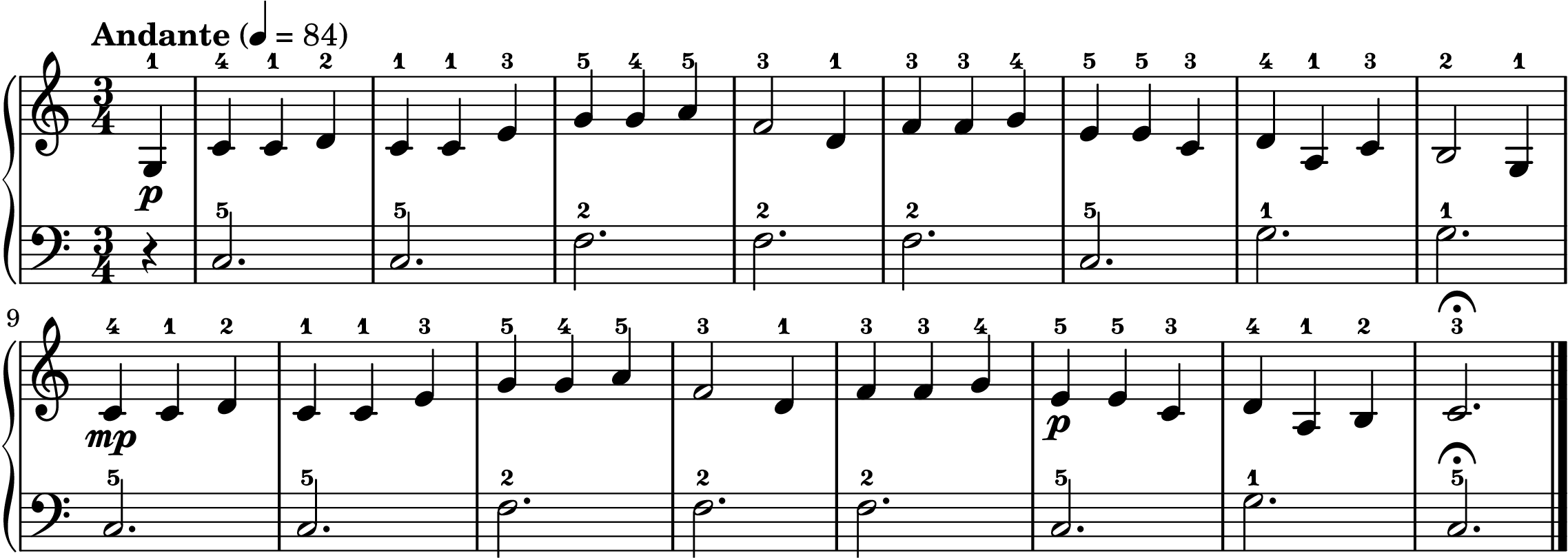
In the full score think of the cradle: one soft dotted half note per bar in the left hand on C3, F3 or G3, with the melody floating above. Verse two is marked softer, so play it as if the baby has just fallen asleep, around the 84 BPM Andante.
Note by note: keys and fingering
- Right hand: A gently drifting hand: the thumb (1) starts alone on G3, a finger substitution on middle C (ring 4 to thumb 1) slides the hand into C position, a second substitution on G4 (pinky 5 to ring 4) opens it for the high A4, and the last line sinks to A3 position with the thumb on A3.
- Left hand: The simplest bass in the pack: pinky (5) on C3, index (2) on F3, thumb (1) on G3, one dotted half note per measure rocking under the melody.
| Note | On the Staff | On the Keyboard | Finger |
|---|---|---|---|
| G3 | Second ledger line below the treble staff | White key left of middle C, between the first two of three black keys | RH Thumb (1) |
| A3 | Space below the first ledger line under the treble staff | White key between the last two of three black keys below middle C | RH Thumb (1) |
| B3 | Just below the treble staff, under the middle C ledger line | White key just left of middle C | RH Index (2) |
| C4 | Ledger line below the treble staff (middle C) | Middle C | RH Ring (4) |
| D4 | Just below the bottom line of the treble staff | White key between the two black keys right of middle C | RH Index (2) |
| E4 | Bottom line of treble staff | White key right of the two black keys above middle C | RH Middle (3) |
| F4 | First space of treble staff | White key left of the three black keys above middle C | RH Middle (3) |
| G4 | Second line of treble staff | White key between the first two of three black keys above middle C | RH Pinky (5) |
| A4 | Second space of treble staff | White key between the last two of three black keys above middle C | RH Pinky (5) |
| C3 | Second space of bass staff | One octave below middle C | LH Pinky (5) |
| F3 | Fourth line of bass staff | White key left of the three black keys below middle C | LH Index (2) |
| G3 | Fourth space of bass staff | White key between the first two of three black keys below middle C | LH Thumb (1) |
Prefer a video? Watch the keys light up
Same color code as the player: green marks the right hand, blue the left hand, with the score and keyboard in one vertical video.
The story behind Away in a Manger
The words of Away in a Manger first appeared in an American children's collection in 1885 and were long said to be by Martin Luther himself, a legend that sold plenty of songbooks but has no basis in fact. Ten years later the Philadelphia hymn writer William J. Kirkpatrick composed this gentle waltz of a tune, called Cradle Song, for a Christmas pageant collection, and it became the melody most of the world hums over the manger. It is a true lullaby, quiet and rocking, written to make a room fall still. Both halves are nearly identical, so once the first eight bars are under your fingers the whole carol is almost yours.
Get the printable PDF
The printable PDF of Away in a Manger - full score, hand positions, and a step-by-step practice guide - ships inside our free Christmas pack together with fourteen other carols.
A lullaby played this softly asks for a still, balanced posture, and an Adjustable Piano Bench with Back Support keeps a young player comfortable through the slow bars.
Piano teacher? Track your students' practice. Join the early list
FAQ
How hard is Away in a Manger on piano?
A gentle Level 1 piece in our Christmas collection. The melody moves mostly by step in a 3/4 sway, the left hand plays just three notes, C3, F3 and G3, one per bar, and the only new skill is two quiet finger substitutions on repeated notes.
How long does it take to learn Away in a Manger?
About a week for most beginners. The first eight bars are the whole tune, verse two repeats them with a different last measure, and the left hand is one note per bar. The substitutions in measures 1 and 3 take the most repetition, so practice them slowly and alone.
What level is Away in a Manger?
Level 1 of our Christmas collection. C major, 3/4 time with an upbeat, Andante at 84 BPM. The right hand ranges from G3 to A4 and the left hand uses only C3, F3 and G3 in dotted half notes.
What are the notes for Away in a Manger?
The thumb starts on G3, then the melody runs C4, C4, D4, C4, C4, E4, G4, G4, A4 and rests on F4, then F4, F4, G4, E4, E4, C4, D4, A3, C4 down to a long B3. Verse two repeats it and ends D4, A3, B3, C4. The left hand rocks on C3, F3 and G3; see the full table above.